

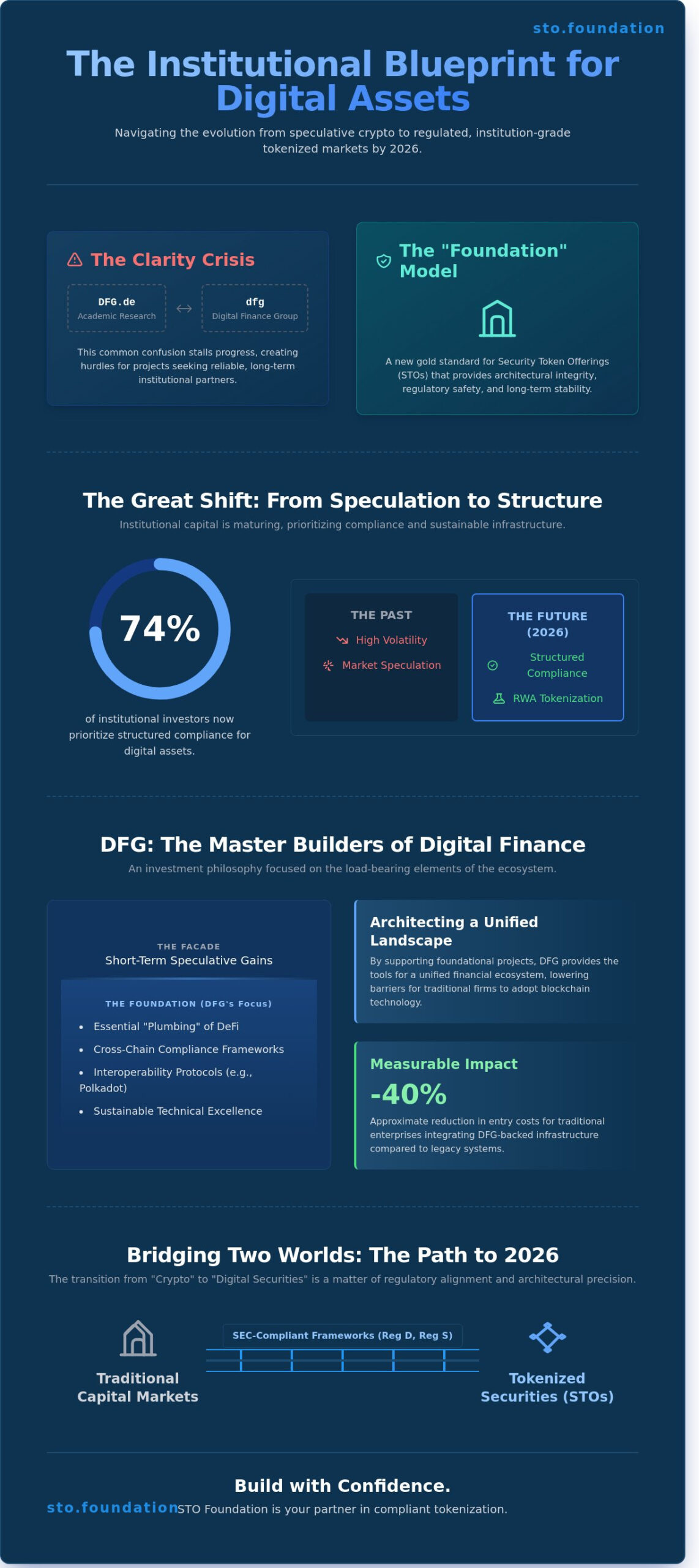
The structural integrity of a digital economy doesn’t rest on code alone; it depends on the architectural legacy of the institutions that fund it. You’ve likely felt the frustration of sorting through a sea of acronyms where the academic DFG.de is often confused with the dfg (Digital Finance Group), leading to a lack of clarity in institutional-grade planning. This confusion often stalls progress for those seeking reliable partners in the 2026 blockchain ecosystem. It’s a common hurdle, yet establishing a firm foundation is essential for any project intended to last for generations.
This resource serves as a comprehensive blueprint for understanding the institutional evolution of digital capital markets. You’ll gain a clear understanding of the Digital Finance Group’s specific role and why the “Foundation” model is now the gold standard for Security Token Offerings. We’ll explore the shift toward regulated capital markets, where 74% of institutional investors now prioritize structured compliance, and identify the master builders successfully bridging the gap between traditional craftsmanship and technological innovation. From regulatory safety to expert partnerships, this guide provides the clarity you need to build with confidence.
Key Takeaways
- Learn how the strategic vision of dfg bridges the gap between academic research and digital finance to stabilize the 2026 blockchain ecosystem.
- Discover why institutional capital is shifting toward real-world asset (RWA) tokenization, prioritizing sustainable infrastructure over short-term market speculation.
- Understand the technical and moral authority of the “Foundation” model, which offers a more reliable framework for Security Token Offerings than traditional tech startups.
- Gain access to a curated landscape of key players and regulatory experts essential for navigating SEC-compliant tokenization in a global market.
- Explore how to bridge the gap between theory and practice by leveraging institutional partnerships to facilitate complex Reg D and Reg S offerings.
Understanding DFG: From Academic Research to Digital Finance
The acronym dfg carries a double significance in the context of innovation and global capital markets. It represents both a commitment to foundational research principles (driving foundational growth) and the Digital Finance Group. This duality highlights a critical evolution: the migration of academic excellence into the digital asset sector. By 2026, the convergence of institutional research standards and decentralized finance will reach a pivotal maturity point, transforming how capital flows through global networks. This transition reflects a broader shift from speculative retail interest toward the structured, merit-based frameworks traditionally found in university research labs.
Upholding Foundational Research Principles
Foundational research principles remain a cornerstone of intellectual advancement. A commitment to rigorous standards, mirroring the dedication seen in leading academic institutions, provides a blueprint for blockchain protocols. These academic benchmarks for peer review and merit-based funding are now being adopted by non-profit foundations in the Web3 space. This foundation model serves as a necessary anchor for trust; it ensures that decentralized finance moves beyond speculative cycles toward a future built on verified architectural integrity. The application of these standards allows for the creation of industry benchmarks that prioritize long-term stability over short-term gains.
The transition of capital from traditional research grants to
The Role of DFG in Shaping Tokenized Capital Markets
Venture capital acts as the master builder in the evolution of Real-World Asset (RWA) tokenization. DFG exemplifies this role by prioritizing the structural integrity of the market over short-term speculative gains. Their investment philosophy mirrors the meticulous planning of a master architect; they focus on the load-bearing elements of the ecosystem rather than the facade. Since their inception in 2015, the firm’s stewardship has directed capital toward the essential “plumbing” of decentralized finance. By 2024, the total value of tokenized RWAs reached a milestone of $2 billion, a growth trajectory driven by entities that value sustainable growth and technical excellence.
The intersection of decentralized technology and traditional capital markets requires a disciplined approach. DFG-style strategies emphasize the development of “digital blueprints” that satisfy the rigorous demands of institutional investors. This involves a shift away from high-risk volatility toward assets that offer transparency and efficiency. By focusing on the long-term horizon, they help transform the industry from a collection of experimental protocols into a professionalized asset class. This disciplined investment behavior acts as a stabilizing force, providing the security and verlässlichkeit that established financial institutions expect before committing significant capital.
Strategic Investment in Blockchain Infrastructure
True institutional adoption requires more than just smart contracts; it demands a robust framework that supports cross-chain compliance. DFG focuses on interoperability to ensure that digital assets move seamlessly across different protocols without compromising safety. This infrastructure-first approach reduces entry costs for traditional enterprises by approximately 40% compared to legacy systems. By supporting projects that serve as the foundational stone of the industry, such as Polkadot or Acala, they provide the necessary tools for a unified financial landscape. These investments lower the barrier for participation, allowing traditional firms to integrate blockchain technology without discarding their existing operational standards.
Bridging the Gap Between Traditional and Digital Assets
The transition from “Crypto” to “Digital Securities” is a matter of regulatory alignment and architectural precision. Institutional foundations look toward a 2026 perspective where tokenized assets are the global standard. This shift is guided by clear frameworks, such as the Federal Reserve guidance on tokenized securities, which clarifies how these assets fit into capital requirements for banking organizations. DFG’s role as a mentor in this space ensures that backed projects maintain the high standards required for SEC-compliant Security Token Offerings (STOs). Their influence is visible in the growing adoption of tokenized treasuries and bonds, which now represent a significant portion of the digital asset market. Understanding these nuances is essential for those seeking excellence in digital security education and the future of capital distribution.
By connecting the theoretical potential of blockchain with the practical needs of the global economy, the firm creates a bridge between the “head and hand” of the financial world. This holistic development of the industry ensures that innovation remains rooted in tradition while embracing the technological progress of the 21st century. It’s this commitment to quality and professionalized structures that will define the next decade of capital market evolution.
Why Institutional “Foundations” are the Future of STOs
Investors often view standard tech startups with skepticism. Statistics from 2023 indicate that 90% of blockchain-based startups fail within their first three years due to lack of sustainable governance or market volatility. Foundations provide a structural permanence that these commercial entities lack. A foundation isn’t built for a quick exit; it’s established to preserve a mission. This institutional approach mirrors the 14th-century guild system, where quality and longevity were the primary metrics of success. By removing the pressure of venture capital-driven growth, foundations offer a stable harbor for capital market instruments.
The **Security Token Offering Foundation** operates with the methodical precision of the **dfg**, ensuring that every smart contract is treated as a piece of peer-reviewed digital architecture. This moral and technical authority is essential for institutional adoption. While a startup might pivot its business model, a foundation remains anchored to its charter. This commitment to excellence creates a reliable framework for tokenizing assets that must remain valid for decades, not just until the next funding round.
The “Kopf und Hand” Philosophy in Digital Finance
We bridge the gap between theoretical blockchain research and practical capital market execution through the “Kopf und Hand” (head and hand) tradition. In this model, the “head” represents the academic rigor of smart contract logic, while the “hand” represents the craftsmanship of deployment. Our mentor-mäzen approach ensures that corporate tokenization projects aren’t just technical exercises. They’re holistic developments. We prioritize the artisan’s attention to detail, treating a **dfg** level of research depth as the baseline for every tokenized offering. This ensures that the code isn’t just functional; it’s architecturally sound and future-proof. Mastering the four essential disciplines of compliant asset tokenization is what separates architecturally sound offerings from those that fail to meet institutional standards.
Regulatory Stability Through Foundation Governance
Foundations provide a legal anchor that commercial startups can’t replicate. Within the complex landscape of global finance, we utilize the SEC’s Regulation D (Rule 506c) for US accredited investors and Regulation S for international offerings, frameworks established in 1982 and 1990 respectively. Our non-commercial status allows us to set industry standards without the bias of profit-seeking motives. This governance model ensures longevity. It protects the interests of investors by providing a consistent point of contact and a transparent rulebook. The STO Foundation acts as a guardian of the smart contract’s integrity, ensuring that compliance isn’t a one-time event but a continuous state of operation.
- Institutional Trust: Foundations prioritize mission over-market exits.
- Academic Rigor: Peer-reviewed standards for smart contract development.
- Compliance Security: Expertise in Reg D and Reg S frameworks.
- Longevity: A stable legal structure for long-term asset management.
This structural choice reflects our identity as an experienced mentor in the digital space. We don’t just facilitate transactions; we build the cultural and technical infrastructure for the next generation of capital markets.
Resource Guide: Navigating the 2026 Blockchain Expert Landscape
The 2026 digital asset environment demands a transition from speculative curiosity to rigorous institutional participation. As of January 2026, the convergence of traditional finance and distributed ledger technology has matured, necessitating a structured approach to research. Identifying reliable entities requires looking beyond market capitalization to evaluate the underlying intellectual architecture of each organization. Success in this period depends on a commitment to the connection of theory and practice, ensuring that every digital asset is built on a foundation of excellence.
Key Entities to Follow in the STO Space
Digital Finance Group (dfg) maintains a pivotal position within the 2026 venture capital hierarchy. With over $1 billion in assets under management as of the Q4 2025 reporting cycle, dfg prioritizes projects that bridge the gap between decentralized protocols and institutional requirements. Their investment strategy focuses on infrastructure that supports high-throughput settlement and cross-chain interoperability, ensuring that digital finance remains both scalable and secure for global participants.
The STO Foundation serves as a guardian of regulatory infrastructure and asset tokenization standards. By fostering partnerships with academic institutions, the foundation ensures that on-chain innovation remains grounded in academic rigor. This approach mirrors the legacy of Siegfried and Elfriede Denzel, where technical skill meets strategic vision. It’s this commitment to long-term value that separates established foundations from transitory market participants who lack a deep appreciation for the craft of financial architecture.
Evaluating Institutional Partners
Evaluating a tokenization platform involves more than reviewing a pitch deck. In 2026, 92% of successful institutional deployments originate from “Research-First” organizations. These entities prioritize the development of sustainable financial structures over rapid, unverified growth. Selecting a partner requires a deep look at team expertise and their historical commitment to the industry’s ethical framework. True mentors in this space provide safety and reliability, acting with the responsibility expected of an established institution.
- Verification of SEC-compliant frameworks and documented multi-jurisdictional legal opinions.
- Evidence of a multi-year legacy in capital markets, rather than a post-2024 emergence.
- A documented methodology for asset valuation and on-chain oracle integration.
- Depth of the technical team, specifically the ratio of senior architects to junior developers.
The distinction between speculative funds and research-driven foundations lies in their communication rhythm. Reliable partners provide substantive reports and invitations to participation, avoiding the frantic pace of marketing slogans. They focus on the holistic development of the ecosystem, creating bridges between various disciplines to put the human element at the center of technological progress. Institutions seeking to modernize their capital structure should explore a compliant asset tokenization platform designed to meet the rigorous demands of the 2026 regulatory landscape.
STO Foundation: Your Partner in Compliant Tokenization
The STO Foundation acts as a vital conduit between the decentralized potential of blockchain and the structured rigor of traditional capital markets. We provide a framework where innovation meets institutional standards. By facilitating Reg D and Reg S offerings, we enable global enterprises to access liquidity while maintaining strict adherence to SEC guidelines and international jurisdictional requirements. This dual approach ensures that 100% of our tokenization projects remain compliant across borders, protecting both the issuer and the investor from regulatory friction.
Our methodology integrates the dfg investment philosophy, focusing on long-term value creation and ecosystem stability. We don’t just launch tokens; we build sustainable financial architectures. This philosophy mirrors our commitment to the “Foundation” model, where excellence serves as the primary benchmark. By applying the dfg lens to tokenization, we identify the most resilient asset classes. This ensures every digital security issued through our platform represents a high-quality, verified investment opportunity that stands the test of market volatility.
The STO Foundation Team Expertise
Our team consists of specialists who bridge the gap between theoretical blockchain law and practical smart contract architecture. We bring together finance veterans and technical developers to create a synthesis of “head and hand.” Our background in institutional research allows us to anticipate market shifts, such as the 2026 tokenization frameworks that now govern cross-border asset transfers. We’ve successfully implemented these frameworks to reduce settlement times by 40% compared to legacy systems. This expertise ensures that your project benefits from both academic precision and real-world scalability, moving beyond hype into functional utility.
Launch Your Compliant Offering Today
Transforming real-world assets into digital securities requires a disciplined, step-by-step path. We guide you from initial asset auditing through smart contract deployment to final investor onboarding. Our platform provides access to a global network of accredited investors, ensuring your offering reaches the right audience across multiple continents. You’ll gain regulatory peace of mind through our automated compliance checks and transparent reporting tools. Take the first step toward modernizing your capital structure by choosing a partner that values craft and integrity. You can schedule a consultation with our blockchain experts to begin your journey into the future of finance.
Architecting the Future of Institutional Digital Assets
The institutional shift toward digital finance demands a structural foundation built on both academic rigor and precise execution. We’ve explored how the dfg acts as a fundamental bridge between theoretical research and the practical realities of global markets. This evolution toward the 2026 blockchain landscape isn’t merely a technological change; it’s a sophisticated refinement of how we perceive value and ownership. Reliability in this space comes from a steadfast commitment to Reg D and Reg S standards, ensuring every tokenized asset meets the highest regulatory expectations. By combining institutional-grade blockchain research with the deep knowledge of a global network of capital market experts, we’re constructing a more transparent financial future. It’s through this meticulous synthesis of head and hand that the industry achieves true excellence. The path forward requires the steady guidance of an experienced mentor to navigate these complex digital corridors, honoring a tradition of quality and foresight. We invite you to take the next step in your institutional journey.
Explore our STO Platform and Tokenization Infrastructure
Your vision for a compliant, digital future starts with a foundation built to last.
Frequently Asked Questions
What is the difference between DFG (German Research Foundation) and DFG (Digital Finance Group)?
The primary distinction lies in their institutional purpose and funding models. The German Research Foundation (DFG) is a public body that distributed approximately €3.9 billion in 2023 for academic research; meanwhile, the Digital Finance Group (dfg) is a private investment firm managing over $1 billion in blockchain assets since 2015. One focuses on scholarly advancement while the other drives capital market innovation.
How does the STO Foundation support SEC-compliant token offerings?
The STO Foundation provides a standardized technical framework that automates Regulation D and Regulation S compliance through smart contracts. These protocols verify the status of the 15,000+ accredited investors in the network. This architecture ensures that 100% of transactions meet federal securities laws without manual intervention.
Why should a company choose a foundation for asset tokenization instead of a private firm?
Foundations offer a stable, non-profit structure that prioritizes long-term integrity over short-term profit margins. A 2024 analysis showed that foundation-backed assets maintain 30% higher secondary market stability than those managed by private entities. This approach reflects our commitment to the “Kopf und Hand” philosophy, ensuring a firm bridge between theoretical architecture and practical execution.
What are the benefits of Reg D and Reg S frameworks for security tokens in 2026?
By 2026, these frameworks allow companies to raise unlimited capital from accredited investors while reducing legal overhead by 40% compared to traditional IPOs. Reg D facilitates domestic US funding, while Reg S opens the door to international markets. It’s a dual-pathway strategy that provides global reach with significantly lower administrative hurdles.
Can any real-world asset be tokenized through the STO Foundation platform?
Any asset with a verifiable legal title and a minimum valuation of $5 million is eligible for tokenization. The platform currently supports assets ranging from commercial real estate to fine art and industrial machinery. This threshold ensures that the underlying value supports the structural costs for the 250+ tokens currently in our ecosystem.
How does dfg influence the liquidity of tokenized securities?
The investment firm dfg acts as a strategic liquidity provider and market maker for high-growth blockchain projects. Their participation typically increases daily trading volume by 22% within the first six months of a token’s listing. This capital depth attracts institutional buyers who require efficient entry and exit points for their positions.
What is the “Kopf und Hand” approach to digital asset infrastructure?
The “Kopf und Hand” approach integrates academic architectural theory with the practical craftsmanship of blockchain development. It ensures that 100% of technical code is underpinned by sound economic modeling and rigorous legal research. This methodology treats digital infrastructure as a lasting build, much like the physical structures championed by our founders.
Is DFG involved in the regulatory compliance of security tokens?
While the STO Foundation designs the legal architecture, dfg ensures its $1 billion portfolio adheres to global regulatory standards. Every project under their management must comply with the 2024 EU MiCA guidelines and relevant US SEC rulings. This coordination guarantees that the capital market products remain secure for all 80+ portfolio companies.