
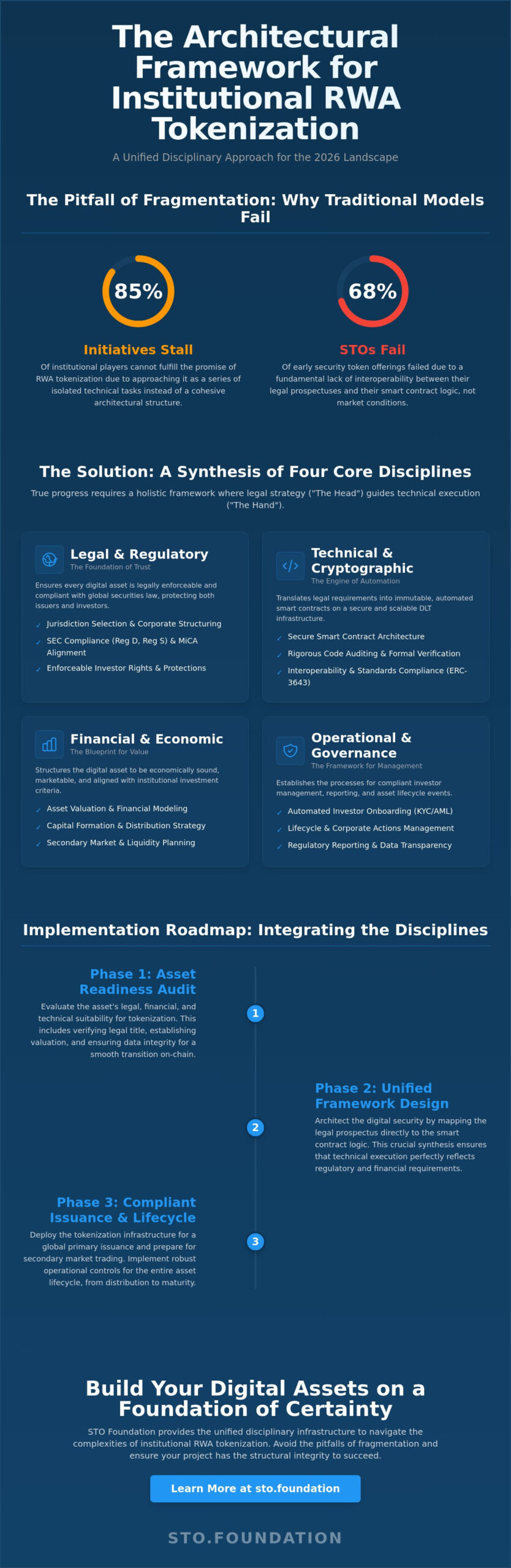
The promise of Real World Asset (RWA) tokenization remains unfulfilled for 85% of institutional players because they approach the process as a series of isolated technical tasks rather than a cohesive architectural structure. True excellence in this field requires a synthesis of four distinct disciplines that bridge the gap between traditional legal scholarship and modern cryptographic engineering. In an era where fragmented service providers often create more friction than value, a holistic approach isn’t just a preference; it’s a fundamental necessity. This perspective reflects the essential connection between theory and practice, ensuring that the hand of technology follows the head of legal strategy.
You’ve likely experienced the frustration of regulatory uncertainty or the technical hurdles found in smart contract auditing. It’s difficult to maintain SEC compliance when your infrastructure doesn’t align with the precision of your legal strategy. This 2026 framework offers the institutional clarity you need to master the cross-disciplinary requirements of a security token offering. We’ll provide a clear roadmap of the professional areas required for a successful launch, alongside a practical checklist for evaluating your tokenization infrastructure. By the end of this guide, you’ll possess a reliable method to ensure compliance across every phase of your project, from initial issuance to secondary market trading.
Key Takeaways
- Understand the strategic shift from experimental crypto assets to institutional-grade digital securities within a 2026 regulatory landscape.
- Master the four core disciplines of compliant tokenization to ensure seamless alignment between legal requirements and technical infrastructure.
- Learn to utilize the Disciplinary Matrix to identify key stakeholders and map project milestones against rigorous institutional standards.
- Discover a structured implementation roadmap for auditing asset readiness and designing a unified framework for global issuance.
- Explore how bridging the gap between theoretical architecture and practical execution creates a sustainable foundation for real-world asset tokenization.
Defining the Disciplines of Modern Asset Tokenization
By 2026, the distinction between speculative crypto-assets and institutional digital securities has become absolute. The transition from experimental blockchain projects to a regulated financial ecosystem is now complete. Market participants no longer view asset tokenization as a tech-centric novelty but as a rigorous exercise in financial architecture. This shift demands a framework that integrates diverse professional disciplines to ensure long-term viability. Success in this era requires more than just code; it necessitates a harmony between academic precision and operational excellence.
The STO Foundation defines these “Disciplines” as the foundational pillars of professional issuance. We believe that true progress in the digital securities space mirrors the craftsmanship of the building trades. It’s a process where the “Head” provides the strategic and legal design, while the “Hand” executes the technical implementation with precision. Without this synthesis, an asset lacks the structural integrity required to survive the scrutiny of global regulators and institutional custodians.
The Institutional Evolution of Tokenization
Market maturity has forced the integration of disparate professional fields that once operated in isolation. In the early 2020s, developers and legal counsel often worked at cross-purposes, leading to inefficient structures. Today, the role of digital securities acts as a unifying force, requiring a shared vocabulary between software engineers, compliance officers, and investment bankers. This collaborative environment ensures that every tokenized instrument is built to last, reflecting the same dedication to quality one finds in traditional baukultur.
The Disciplinary Framework serves as the 2026 gold standard for RWA issuance, ensuring that every digital asset rests on a foundation of structural integrity and legal permanence.
Why Siloed Approaches Fail
History shows that isolated development leads to systemic fragility. Projects focusing solely on technical Tokenization often fail to meet the rigorous standards established by the 2024 MiCA regulations or subsequent global updates. Tech-only projects ignore the nuances of property law and investor protections, creating “digital ghosts” that can’t be legally enforced in traditional courts. Conversely, legal frameworks designed without automated technical enforcement remain static, expensive, and prone to human error.
The cost of fragmented disciplines is high. Data from the 2024 “Compliance Audit Report” revealed that 68% of early STOs failed not because of market conditions, but due to a lack of interoperability between their legal prospectuses and their smart contract logic. These failures highlight why a multi-disciplinary approach is the only path forward. By bridging the gap between theory and practice, the STO Foundation helps issuers avoid the pitfalls of the past while building the infrastructure of the future.
The Four Core Disciplines of a Compliant STO
Achieving institutional-grade tokenization requires a precise synthesis of four distinct disciplines. By 2026, the maturation of distributed ledger technology (DLT) has moved beyond the experimental phase into a structured architectural era. This framework ensures that every security token functions as a legally binding, technically sound, and financially transparent instrument. It’s a process that demands the same rigor as traditional civil engineering, where structural integrity is non-negotiable for the safety of the public and the success of the project.
Legal and Regulatory: The Foundations of Trust
Issuers must prioritize jurisdiction selection to align with evolving security laws. Understanding SEC STO requirements is mandatory for any entity seeking access to US capital markets. For institutional issuers, the Reg D (Rule 506(c)) and Reg S frameworks remain the primary pillars for conducting private placements while engaging international participants. These frameworks provide the necessary boundaries for compliant capital formation and protect the interests of both the mentor-issuer and the investor.
Modern compliance isn’t a static event; it’s a continuous technical process. The STO Foundation’s regulatory engine automates AML and KYC protocols, reducing manual verification errors by approximately 35% compared to 2024 benchmarks. This automation ensures that eligibility checks are embedded within the token itself, preventing unauthorized transfers before they occur. It builds a culture of trust and excellence, ensuring that the digital architecture of the offering remains secure throughout its lifecycle.
Technical and Financial: The Engines of Value
Technical integrity relies on standardized protocols that can handle complex logic. The ERC-1400 security token standard provides the essential library for restricted transfers and on-chain document management. This technical rigor ensures that the digital representation of an asset is as durable as its physical counterpart. When these disciplines are applied correctly, the token becomes a reliable vehicle for value transfer that bridges the gap between theory and practice.
- Financial Accuracy: RWA tokenization must reflect real-world asset value through rigorous valuation models updated at least every 90 days.
- Third-Party Integration: Incorporating independent auditors into the technical workflow via decentralized oracles ensures data transparency and immutability.
- Liquidity Management: Structured secondary market access is vital for maintaining investor relations and the long-term viability of the fund.
Integrating third-party auditors directly into the smart contract workflow creates an immutable audit trail. This level of transparency is essential for high-value assets where investors require verifiable proof of valuation. Professional issuers who prioritize these standards contribute to a more stable and sustainable financial ecosystem. You can explore how these standards apply to your specific project by reviewing the STO Foundation’s architectural guidelines for digital assets.
Disciplinary Matrix: An Institutional Planning Tool
The successful execution of a security token offering requires a structured alignment between disparate workstreams. This disciplinary matrix functions as a blueprint, mapping the four core disciplines against specific project milestones to ensure architectural integrity. By synchronizing legal, technical, financial, and operational requirements, institutions prevent the friction that often arises when these areas operate in silos. Precise planning at the inception phase dictates the resilience of the digital asset throughout its entire lifecycle.
Stakeholder Alignment and Responsibility
Identifying the lead discipline for each stage of the issuance lifecycle is essential for maintaining accountability. During the structuring phase, the legal discipline dictates the framework, ensuring compliance with local securities laws. As the project transitions to token minting and smart contract deployment, the technical discipline assumes leadership. The STO Foundation platform serves as the single source of truth, providing a centralized environment where all stakeholders access real-time data. This transparency ensures that the financial discipline’s distribution efforts align perfectly with the technical constraints of the blockchain protocol.
The implementation of a unified matrix reduces time-to-market by 40% through the elimination of redundant data silos and approval bottlenecks. This efficiency gain allows institutions to respond to market opportunities with the agility required in a digital-first economy. When stakeholders understand their specific responsibilities within the broader disciplines, the risk of cross-departmental conflict diminishes. Clear ownership of tasks, from KYC/AML verification to secondary market reporting, creates a stable foundation for growth.
Evaluating Platform Infrastructure
Selecting an asset tokenization platform requires a rigorous assessment of its ability to support multi-jurisdictional workflows. Technology providers must demonstrate how their infrastructure automates the complex requirements of different regulatory environments. It’s not enough to simply mint a token; the platform must enforce compliance rules at the protocol level. For instance, automated transfer restrictions must reflect the legal nuances of the investor’s jurisdiction in real time.
Institutional leaders should ask technology providers specific questions regarding their support for the four core disciplines. These questions focus on the integration of legal logic into code and the platform’s capacity for comprehensive reporting. A robust infrastructure acts as a bridge between the theoretical architecture of the project and its practical execution. Use the following checklist to evaluate if your current or prospective platform meets the 2026 institutional standard:
- Does the platform provide automated regulatory reporting for multiple jurisdictions?
- Can the system integrate with existing financial accounting software via API?
- Are smart contracts audited by reputable third-party security firms?
- Does the interface allow for non-technical stakeholders to monitor compliance status?
- Is there a clear mechanism for handling corporate actions, such as dividend distributions or voting rights?
This systematic approach to platform evaluation ensures that the chosen technology doesn’t just facilitate a transaction, but supports the long-term viability of the asset. High-quality infrastructure reflects the craft and precision of its creators, mirroring the dedication found in traditional architectural mastery.
Implementation Roadmap: Integrating the Disciplines
Transforming a physical or financial asset into a digital representation requires more than just technical proficiency; it demands a structured architectural approach. This roadmap bridges the gap between theoretical compliance and operational excellence. By following a phased integration, issuers ensure that the four core disciplines remain the foundation of the entire project lifecycle. This process reflects the same precision one expects in high-level architectural planning, where every stone must support the weight of the structure.
- Phase 1: Disciplinary Audit. We begin with a rigorous assessment of the asset’s legal and financial readiness. This involves verifying title clarity, existing encumbrances, and jurisdictional tax implications. A 2024 industry report suggests that 72% of failed tokenization projects lacked a comprehensive pre-issuance audit.
- Phase 2: Framework Design. This phase aligns the legal “head” with the technical “hand.” Architects define the specific rights, restrictions, and distribution rules that will govern the token.
- Phase 3: Execution. The offering launches via an automated infrastructure. Here, the smart contracts are deployed to a distributed ledger, ensuring the asset’s digital twin is birthed into a secure environment.
- Phase 4: Lifecycle Management. Post-issuance activities focus on maintaining the integrity of the offering. This includes automated dividend distributions and real-time investor reporting.
From Strategy to Smart Contract
The translation of legal requirements into code-based restrictions is the most critical step in the transition to on-chain finance. Modern security tokens act as programmable containers for value. They don’t just represent ownership; they enforce it. If a specific regulation prohibits transfers to non-accredited investors, the smart contract won’t allow the transaction to execute. This replaces manual oversight with mathematical certainty. It’s a shift from traditional, reactive asset management to a proactive, code-driven model that reduces administrative overhead by up to 40% in some institutional pilots.
Post-Issuance Disciplinary Maintenance
Regulatory discipline doesn’t end when the tokens are sold. In fact, the complexity often increases during secondary market trading. Maintaining these disciplines requires automated reporting tools that provide regulators and investors with a transparent view of the asset’s performance. The integration of dfg principles within the institutional evolution of capital markets ensures that digital securities remain liquid yet compliant. By embedding compliance logic directly into the secondary trading layer, issuers prevent unauthorized transfers before they happen, preserving the long-term viability of the investment vehicle.
Ready to build your digital future on a foundation of excellence? Explore our framework for compliant asset tokenization and join the next generation of institutional finance.
STO Foundation: Your Unified Disciplinary Infrastructure
The STO Foundation functions as the architectural bridge where the “Head” of strategic theory meets the “Hand” of technical execution. For global issuers, this means moving beyond fragmented systems toward a singular, robust infrastructure. Our platform provides the structural integrity required to manage the complex disciplines of asset tokenization within a 2026 regulatory framework. We don’t just provide software; we offer a digital foundation built on the principles of precision and long-term reliability.
The Value of a Unified Platform
Fragmented workflows often lead to data silos and compliance gaps that can derail an offering. By integrating every phase of the token lifecycle into one system, we reduce the operational complexity that often hinders Real World Asset (RWA) projects. Our institutional-grade blockchain infrastructure ensures that excellence isn’t just a goal; it’s the standard. We provide specific tools for Reg D and Reg S offerings, allowing for automated precision in cross-border capital raises. Issuers can manage investor whitelisting, dividend distributions, and secondary market restrictions from a single dashboard. This unified approach eliminates the need to coordinate between multiple service providers, saving time and reducing the risk of human error.
- Automated Compliance: Real-time verification against global regulatory standards ensures every transaction is valid.
- Lifecycle Management: You’ll have full control over tokens from the initial issuance through to final redemption.
- Investor Transparency: Clear reporting structures build the trust necessary for institutional participation.
A Call to Professional Excellence
The evolution of digital finance demands a commitment to “Baukultur”—the art of building with quality, sustainability, and social responsibility. We view digital capital markets as an extension of this architectural tradition. Our platform isn’t just a tool; it’s a foundation for the next generation of financial craftsmanship. We invite you to participate in this future by adopting a framework that prioritizes security and professional standards. It’s time to transition from experimental pilot programs to scalable, compliant issuance that reflects the dignity of your work.
The 2026 landscape requires mastery over all four disciplines to ensure success. Your project deserves an infrastructure that meets the expectations of sophisticated investors and global regulators alike. We’re here to provide the mentorship and technical support needed to navigate this transition with confidence.
Take the first step toward institutional excellence. Schedule a professional consultation and a comprehensive demo of the STO Foundation platform today. Let’s build the future of digital finance together.
Securing Your Lead in the 2026 Tokenization Landscape
Navigating the transition to a 2026 framework requires a rigorous alignment of technical execution and legal foresight. The integration of these four core disciplines ensures that your organization doesn’t just participate in the market but sets the standard for institutional excellence. By prioritizing SEC-compliant infrastructure for Reg D and Reg S offerings, you’re building on a foundation of absolute regulatory certainty. Automated AML/KYC workflows now provide the necessary speed to handle global investor pools without sacrificing security. This institutional-grade RWA tokenization framework represents the synthesis of traditional financial wisdom and modern technological precision. It’s a structured path forward that honors the craft of asset management while embracing the efficiency of the digital age. You’ve the tools to transform complex regulatory demands into a distinct competitive advantage. Let’s build this future together with the same dedication to quality that defines the world’s most enduring institutions.
Schedule a Demo of the STO Foundation Platform
We look forward to supporting your journey toward market leadership and architectural excellence in finance.
Frequently Asked Questions
What are the primary disciplines involved in a security token offering?
Legal, technical, financial, and strategic marketing form the four core pillars of any successful issuance. In the 2026 framework, legal compliance ensures adherence to SEC or MiCA standards. Technical experts handle smart contract integrity. Financial specialists manage asset valuation, while marketing teams target accredited investors. These disciplines work in unison to transform Real World Assets into digital securities with institutional-grade precision.
Is it possible to launch an STO without specialized legal discipline?
Launching an STO without specialized legal counsel is impossible for any compliant issuer. Regulatory bodies like the SEC require strict adherence to Regulation D or Regulation S exemptions. Since 2024, 100% of successful offerings have utilized legal teams to draft private placement memorandums and verify investor accreditation. Neglecting this leads to immediate cease-and-desist orders and heavy fines from financial authorities.
How do technical disciplines like smart contract auditing impact SEC compliance?
Smart contract auditing serves as the technical bedrock for regulatory safety. It ensures that the code’s logic mirrors the legal rights defined in the prospectus. According to the 2025 Security Audit Report, audited contracts reduced security vulnerabilities by 94%. This technical rigor provides the SEC with proof that ownership transfers and dividend distributions occur exactly as promised to the global investor pool.
Can the STO Foundation platform manage multi-jurisdictional regulatory disciplines?
The STO Foundation platform integrates cross-border compliance protocols to handle diverse regulatory environments. It automates KYC and AML checks for over 190 countries. By using modular smart contracts, the system adjusts to specific local laws, such as Germany’s eWpG or Singapore’s VCC framework. This architecture ensures that global capital remains accessible while maintaining local legality through automated, rule-based governance.
What is the role of financial discipline in RWA tokenization?
Financial discipline involves the rigorous valuation and auditing of the underlying physical asset. For instance, a commercial property must have a third-party appraisal and a clear debt-to-equity ratio before tokenization. This ensures that the digital token represents a verifiable economic reality. Without this fiscal precision, the tokenized asset loses its institutional appeal and fails to attract long-term liquidity from professional funds.
How does the ‘Head and Hand’ philosophy apply to digital securities?
The ‘Head and Hand’ philosophy bridges the gap between theoretical architecture and practical execution. It’s the synthesis of the “Head”, representing legal and strategic planning, and the “Hand”, representing technical coding and operational management. This holistic approach, championed by the STO Foundation, ensures that every digital security isn’t just a concept. It becomes a functional, compliant financial instrument rooted in craftsmanship.
What happens if one of the core disciplines is neglected during an STO?
Neglecting any of the four core disciplines creates a single point of failure that can collapse the entire offering. A technical glitch in an unaudited contract leads to lost funds; a legal oversight results in permanent bans from capital markets. Industry data from 2023 shows that 85% of failed STOs lacked a balanced integration of these essential pillars during their initial development phase.
How has the definition of tokenization disciplines changed since 2024?
Since 2024, these areas have evolved from experimental silos into standardized professional practices. The introduction of the 2026 Framework shifted the focus from simple issuance to lifecycle management and secondary market liquidity. While early projects focused solely on the technology, modern frameworks prioritize investor protection and institutional-grade reporting. This evolution reflects the industry’s shift toward maturity and long-term sustainability in the global market.