

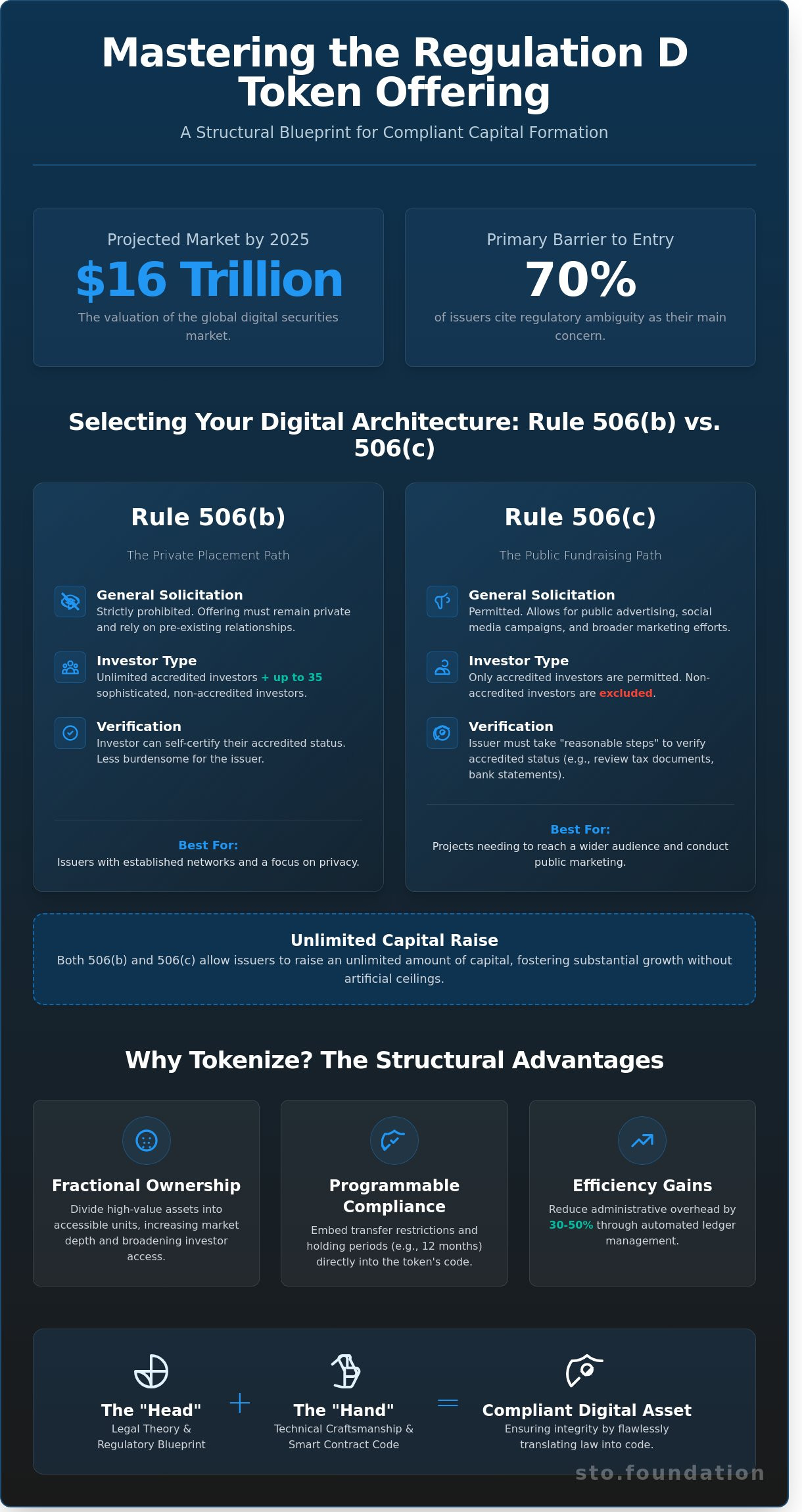
By the end of 2025, the global digital securities market is projected to reach a valuation of $16 trillion, yet 70% of issuers still cite regulatory ambiguity as their primary barrier to entry. You’ve likely felt the weight of this uncertainty as you weigh the substantial legal fees of SEC registration against the operational burden of verifying accredited investors. It’s a common challenge for those who value both technological innovation and the foundational principles of financial integrity. This guide provides the structural blueprint you need to master a reg d token offering, allowing you to bypass the prohibitive costs of full registration while ensuring your project stands on a bedrock of compliance.
We’ll provide the clarity you’re looking for by breaking down the specific mechanics of Rules 506(b) and 506(c). You’ll learn how to leverage automation to handle complex investor verification and discover a roadmap that connects your technical vision with established legal frameworks. Our analysis explores the cost-benefit ratio of different exemptions and guides you in selecting a platform that secures your future growth through 2026 and beyond.
Key Takeaways
- Evaluate the structural differences between Rule 506(b) and 506(c) to select the digital architecture that best aligns with your specific investor outreach strategy.
- Discover how smart contract technology automates regulatory enforcement, ensuring seamless adherence to the 12-month holding period and other SEC requirements.
- Follow a structured roadmap for a compliant reg d token offering, moving precisely from initial asset valuation to the finalization of your Private Placement Memorandum.
- Bridge the gap between academic legal theory and practical technical application by utilizing infrastructure that harmonizes the connection of “head and hand.”
- Gain insights into the future of private placements in 2026 and why Regulation D remains the gold standard for securing institutional capital in the digital age.
Understanding the Reg D Token Offering: The Pillar of Private Placements
Regulation D serves as a foundational safe harbor under the Securities Act of 1933. It provides a structured pathway for entities to raise capital without the exhaustive requirements of a full SEC registration. In the 2026 digital economy, the reg d token offering has solidified its position as the primary vehicle for US-based capital formation. This framework allows for the issuance of digital securities that represent ownership in a variety of asset classes, from real estate to private equity. While traditional private placements rely on manual, paper-based ledgers, tokenized offerings utilize distributed ledger technology to ensure precision and transparency.
The architecture of a successful offering requires a disciplined synthesis of legal theory and technical craftsmanship, a concept we define as the connection between the “Head” and the “Hand.” The legal “Head” provides the structural blueprint and regulatory compliance. The technical “Hand” executes this vision through smart contract development. Without this alignment, the integrity of the digital asset remains vulnerable. A reg d token offering succeeds when the sophisticated legal requirements of the SEC are flawlessly translated into the immutable code of the blockchain.
The Core Philosophy of Exempt Offerings
The SEC maintains a rigorous focus on the balance between capital formation and investor protection. By prioritizing “Accredited Investors,” the commission ensures that participants in high-innovation assets possess the financial resilience to manage inherent risks. Filing a Regulation D (SEC) Form D provides the necessary transparency to federal regulators without the administrative burden of a traditional IPO. This streamlined process allows for the rapid deployment of capital into emerging sectors while maintaining a high standard of accountability. It’s a system designed for excellence and sustainability in modern finance.
Why Tokenize Under Regulation D?
The transition from traditional certificates to programmable tokens offers significant structural advantages for both issuers and investors. This evolution represents a commitment to technical progress and administrative efficiency. Key benefits include:
- Fractional ownership: Digital tokens allow for the division of institutional-grade assets into smaller, more accessible units. This increases market depth and provides broader access to high-quality investment opportunities.
- Programmable compliance: Transfer restrictions and holding periods are embedded directly into the token’s code. This ensures that the asset remains compliant with SEC rules throughout its entire lifecycle.
- Efficiency gains: Automated ledger management reduces administrative overhead by approximately 30% to 50% compared to manual record-keeping. The elimination of redundant intermediaries speeds up the reconciliation process.
The adoption of this model reflects a mature approach to the digital economy. It moves beyond speculation and enters the realm of professional asset management. By utilizing the Reg D framework, issuers provide a secure environment that honors the traditions of private placement while embracing the tools of the future.
Navigating Rule 506(b) vs. 506(c): Selecting Your Digital Architecture
Selecting the right regulatory framework is a matter of architectural precision. A reg d token offering provides two primary blueprints under the Regulation D exemption. Both paths allow for an unlimited capital raise, a feature established to foster substantial growth without the artificial ceilings found in other exemptions. It’s a deliberate choice between privacy and public reach. The decision hinges on how an issuer intends to communicate with the market and the level of transparency required for their specific investor base.
Rule 506(b): Privacy and Sophisticated Investors
Rule 506(b) prioritizes established networks and private placements. It permits participation from an unlimited number of accredited investors and up to 35 non-accredited participants who must meet the “sophisticated” criteria. This means the investor has sufficient knowledge to evaluate the merits of the investment. However, the 1933 Securities Act prohibits general solicitation under this rule. You can’t post about the offering on social media, mention it in public webinars, or use digital advertising.
Compliance depends on a pre-existing substantive relationship. Issuers often rely on investor self-certification, which creates a specific legal risk profile. If an investor’s status is later found to be inaccurate, the burden of proof rests on the issuer’s diligence. This “quiet” path suits projects with a closed circle of high-net-worth individuals who value discretion over broad market visibility.
Rule 506(c): General Solicitation in the Age of Blockchain
Rule 506(c) represents the modern standard for a reg d token offering seeking global reach. Since its introduction via the JOBS Act in 2012, it has allowed issuers to advertise publicly across digital platforms. This transparency requires a trade-off. Every investor must be a verified accredited investor. The SEC mandates “reasonable steps” for verification, moving beyond simple self-certification.
Verification involves reviewing tax returns, bank statements, or obtaining letters from CPAs. Most institutional-grade platforms now integrate third-party KYC and accreditation services to automate this process. This integration ensures the integrity of the digital architecture while allowing for aggressive marketing strategies. Understanding these nuances is essential for those looking to advance their knowledge of asset tokenization and build a resilient financial structure. Founders who want to separate fact from fiction in this space will also benefit from debunking the myths of SEC compliant STOs before committing to a specific regulatory path.
Rule 504: The Limited Alternative
Rule 504 serves as a niche entry point for localized or smaller-scale projects. It limits the total raise to $10 million within a 12-month period, a figure updated by the SEC in late 2020 from the previous $5 million limit. While it offers more flexibility regarding investor types, its scalability is restricted by this cap.
Rule 504 is rarely the first choice for scalable tokenization because it often requires state-level “Blue Sky” law compliance, which adds layers of administrative complexity. Most professional issuers bypass 504 in favor of Rule 506 to leverage the pre-emption of state laws and the potential for much larger capital inflows. The focus remains on excellence and the long-term viability of the digital asset’s foundation.
Programmable Compliance: How Technology Enforces Reg D Requirements
The evolution from manual legal verification to automated smart contract enforcement represents a fundamental shift in the reg d token offering landscape. Historically, compliance relied on the diligent but slow work of transfer agents and legal counsel to verify every trade. Today, the ERC-1400 security token standard provides a precise technical framework that embeds these legal requirements directly into the asset’s architecture. This standard allows for the creation of “partitioned” tokens, which carry specific metadata and restrictions that govern their movement across the blockchain.
A critical component of this technological bridge is the enforcement of Rule 144 under the Securities Act of 1933. This rule typically requires a 12-month holding period for restricted securities before they can be resold in the public market. Smart contracts automate this process through on-chain locks. These locks ensure that tokens remain non-transferable until the exact timestamp of the restriction’s expiration is reached, removing the risk of human error or premature liquidation. Identity management systems work in tandem with these contracts, maintaining a whitelist of verified, accredited investors who’ve passed rigorous background checks.
Automated Transfer Restrictions
Smart contracts function as digital gatekeepers, evaluating every transaction attempt before it’s recorded on the ledger. If a trade involves an unverified wallet or occurs during a restricted period, the protocol rejects the transfer instantly. This level of precision allows for the management of secondary market trading within the strict bounds of a reg d token offering without constant human intervention. On-chain code replaces traditional escrow for compliance by programmatically validating every movement of value against a predefined set of legal rules.
- Pre-trade Validation: The protocol checks the buyer’s and seller’s eligibility status in real-time.
- Jurisdictional Control: Transfers can be restricted based on the investor’s country of residence to meet local regulations. Staying current on OFAC sanctions crypto news is essential for ensuring these jurisdictional controls remain aligned with the latest enforcement actions.
- Volume Limits: Systems can enforce caps on the number of shareholders to stay within specific regulatory exemptions.
The Digital Registry of Shareholders
A security token acts as a real-time, immutable cap table, offering a single source of truth for the issuer. This digital registry eliminates the discrepancies that often plague manual spreadsheets or fragmented databases. By integrating AML/KYC data directly into the security token lifecycle, issuers maintain a 100% accurate record of ownership at every stage. This infrastructure doesn’t just track ownership; it automates essential corporate actions. Dividends and voting rights are distributed programmatically to the addresses listed on the registry, ensuring that the connection between the investor’s “hand” and the issuer’s “head” remains direct and transparent. This architectural approach ensures that every participant meets the necessary eligibility criteria throughout the entire duration of the investment cycle.
The Roadmap to a Compliant Reg D Token Launch
Executing a successful reg d token offering requires a disciplined transition from abstract value to digital reality. This journey follows a structured five-step methodology that bridges the gap between traditional finance and blockchain architecture. It begins with the “Head” phase, where the foundation of the project is established through rigorous asset selection and structural valuation. Issuers must determine if the underlying asset, such as a commercial real estate project or a private equity fund, possesses the necessary transparency to support a digital security.
- Step 1: Asset Selection: Identifying the underlying value and defining the economic rights of the token holders.
- Step 2: Legal Onboarding: Engaging specialized counsel to draft the Private Placement Memorandum (PPM) and subscription agreements.
- Step 3: Technical Deployment: Programming security token smart contracts to automate compliance and transfer restrictions.
- Step 4: Investor Verification: Implementing a rigorous process to confirm accredited status and complete KYC/AML checks.
- Step 5: Issuance: Executing the capital call and distributing tokens via a dedicated STO platform.
This sequence ensures that the “Hand” of the technical execution perfectly follows the “Head” of the legal strategy. Every phase must align to maintain the integrity of the exemption.
Drafting the Private Placement Memorandum (PPM)
The PPM serves as the definitive legal document for any reg d token offering. It’s not merely a list of disclosures; it’s a blueprint of the offering’s structural logic. For digital assets, this document must include specific sections on digital custody risks and smart contract vulnerabilities. If a coding error occurs in the smart contract, the PPM should define the remediation process. It’s vital that the legal prose matches the technical code. If the tokenomics dictate a 12-month lock-up period, the PPM and the smart contract must reflect this identical constraint to avoid regulatory friction.
Investor Onboarding and Verification
High-net-worth investors demand a frictionless user experience that mirrors the sophistication of modern wealth management. The onboarding portal must handle sensitive KYC documents with bank-grade security while streamlining the accredited investor verification process. According to SEC guidelines, the burden of proof for accreditation rests on the issuer. Once the initial sale concludes, the focus shifts to the secondary market. Issuers must ensure that the digital architecture continues to enforce transfer restrictions as tokens move between eligible wallets.
Post-Offering Compliance
Compliance is an ongoing commitment rather than a one-time event. Issuers must file Form D with the SEC within 15 days of the first sale of securities. Failing to meet this specific deadline is a common pitfall that can lead to administrative complications or the loss of the exemption status. Digital investor relations platforms now allow for automated reporting and transparent distribution management. For a comprehensive overview of these requirements, read our detailed analysis on Navigating SEC Compliance for Security Tokens.
Ready to build a solid foundation for your digital security project? Explore the resources and educational initiatives at the STO Foundation.
STO Foundation: Excellence in Reg D Infrastructure
The Security Token Offering Foundation (STO Foundation) serves as the architectural backbone for issuers seeking to merge traditional financial rigor with blockchain efficiency. We believe that a successful reg d token offering requires more than just smart contracts; it demands a synergy between conceptual strategy and practical execution. This philosophy, which we define as the connection between “Kopf und Hand” (head and hand), ensures that every digital security is built upon a foundation of structural integrity and regulatory compliance. By bridging the gap between academic theory and technical craftsmanship, we provide a stable environment for capital formation.
Our platform specializes in automating the rigorous workflows required by Rule 506(c) of the Securities Act of 1933. Since the implementation of the JOBS Act in 2012, the burden of verifying accredited investor status has shifted to the issuer. Our infrastructure streamlines this process through integrated verification modules, reducing the administrative overhead that often plagues manual compliance checks. This automation allows institutional issuers to focus on their core business while our systems handle the complex logic of transfer restrictions and investor onboarding. We view this digital framework as a form of “Baukultur,” where the goal is to build a sustainable and aesthetically sound financial architecture that stands the test of time.
A Holistic Approach to Tokenization
Success in the digital asset space isn’t defined by the code alone. It’s defined by the regulatory framework that supports it. Our approach extends beyond the deployment of tokens to include the entire lifecycle of the security. We prioritize sustainability in digital design, ensuring that assets remain compliant even as global regulations evolve. This long-term perspective is essential for institutional players who manage real-world assets. To understand the broader context of these developments, we recommend exploring The Definitive Guide to Asset Tokenization. This resource provides a deep dive into how physical value is translated into the digital realm with precision and care.
Ready to Transform Your Assets?
Choosing the right path for a reg d token offering requires a partner who understands the nuances of both craft and capital. The STO Foundation acts as a mentor and guide for visionary issuers, offering the expertise needed to navigate complex private placement exemptions. We don’t just provide software; we offer a partnership rooted in the tradition of excellence and the pursuit of innovation. If you’re ready to transition from traditional structures to a modernized digital architecture, our experts are prepared to assist. Let’s build the future of finance together, ensuring your assets are managed with the dignity and professionality they deserve. Contact us today to begin your journey toward a robust digital security offering.
Mastering the Architecture of Digital Capital
The evolution of capital markets demands a synthesis of traditional legal rigor and modern technological precision. By 2026, the distinction between Rule 506(b) and 506(c) has become a foundational choice for issuers seeking to leverage digital architecture. A successful reg d token offering now relies on programmable compliance to automate investor verification and transfer restrictions. This structural excellence ensures that real-world asset tokenization remains both secure and scalable. Research from the Boston Consulting Group indicates that the tokenization of global illiquid assets could reach $16 trillion by 2030. It’s clear that the bridge between theory and practice is built through technical craftsmanship. The STO Foundation provides the necessary infrastructure to navigate these complexities with confidence. Our team offers SEC compliant STO frameworks and automated workflows and deep expertise in Reg D and Reg S frameworks to support your project’s growth. We’ve built the foundation for real-world asset tokenization so you can focus on your vision. Success in the digital age requires a partner who values both innovation and stability. Issuers operating in this environment must also monitor the latest OFAC sanctions crypto news to protect the structural integrity of their digital investments as enforcement actions continue to reshape the compliance landscape heading into 2027.
Launch your compliant Reg D offering with STO Foundation today.
Frequently Asked Questions
What is the primary difference between Reg D and Reg S token offerings?
The distinction lies in the geographical location of the investors and the regulatory jurisdiction. A reg d token offering targets the United States domestic market, allowing issuers to raise capital from American investors under specific SEC exemptions. Conversely, Regulation S governs offers and sales of securities that occur outside the United States, ensuring the transaction remains offshore and doesn’t involve directed selling efforts within the American public.
Can non-accredited investors participate in a Reg D token offering?
Non-accredited investors can only participate if the issuer utilizes Rule 506(b), which permits up to 35 such individuals. These participants must be “sophisticated,” meaning they have enough legal and financial knowledge to weigh the risks. It’s important to note that most modern issuers prefer Rule 506(c). This specific rule allows for general advertising but strictly limits the reg d token offering to verified accredited investors only.
How much does it cost to launch a Reg D compliant security token?
Launching a compliant offering involves legal, technical, and administrative expenses that often range from $50,000 to $150,000 according to 2023 industry benchmarks from Security Token Advisors. These funds cover the preparation of the Private Placement Memorandum, SEC Form D filings, and the development of smart contracts. Issuers also face recurring costs for investor verification services and digital asset custody solutions to maintain regulatory standards.
Is a Reg D offering considered a “public” sale of tokens?
A Reg D offering isn’t a public sale; it’s a private placement. While Rule 506(c) allows companies to advertise their offering to the general public, the actual sale of securities is restricted. Only individuals or entities meeting the SEC’s accredited criteria can finalize the investment. This differs from an Initial Public Offering where securities are registered for sale to any member of the general population.
How is accredited investor status verified in a digital offering?
Issuers must take “reasonable steps” to verify status by reviewing financial documentation or obtaining third-party confirmation. This process involves checking tax returns for an annual income of $200,000 or verifying a net worth exceeding $1 million, excluding a primary residence. Many platforms now use automated API services that cross-reference credit records and bank data to confirm these thresholds within minutes, ensuring the offering stays compliant with SEC Rule 501.
What happens if a Reg D token is sold to a non-verified investor?
Selling to a non-verified investor in a Rule 506(c) offering can invalidate the entire registration exemption. If the SEC determines the exemption is lost, the issuer might be forced to offer a rescission, which means refunding all invested capital to every participant. Furthermore, the company could face civil penalties or be barred from using similar exemptions for five years under “bad actor” disqualification provisions.
Do Reg D tokens have to be registered with the SEC eventually?
Registration isn’t required unless the issuer triggers the thresholds established in Section 12(g) of the Securities Exchange Act of 1934. A company must register its tokens if it has more than $10 million in assets and the securities are held by more than 2,000 persons. Until the organization reaches these specific growth markers, the tokens function as exempt securities and don’t require the exhaustive reporting of a public company.
Can Reg D tokens be traded on secondary exchanges?
Investors can trade these tokens on specialized Alternative Trading Systems after a mandatory holding period. Under Rule 144, these digital assets are usually restricted for 12 months from the date of purchase. Once this one-year period concludes, the tokens can be listed on regulated platforms like tZERO or INX, providing liquidity while ensuring the secondary market remains within the boundaries of federal securities laws.