

By 2026, the distinction between a traditional security and a digital asset will be entirely academic, as institutional liquidity flows exclusively toward frameworks that honor the rigors of federal oversight. It’s understandable that many founders feel paralyzed by the specter of retroactive SEC enforcement or the perceived costs of legal over-engineering. You’ve likely spent months weighing the complexity of dual-role tokens against the need for speed. However, building on a foundation of an sec compliant sto isn’t a limitation; it’s the ultimate catalyst for institutional-grade credibility.
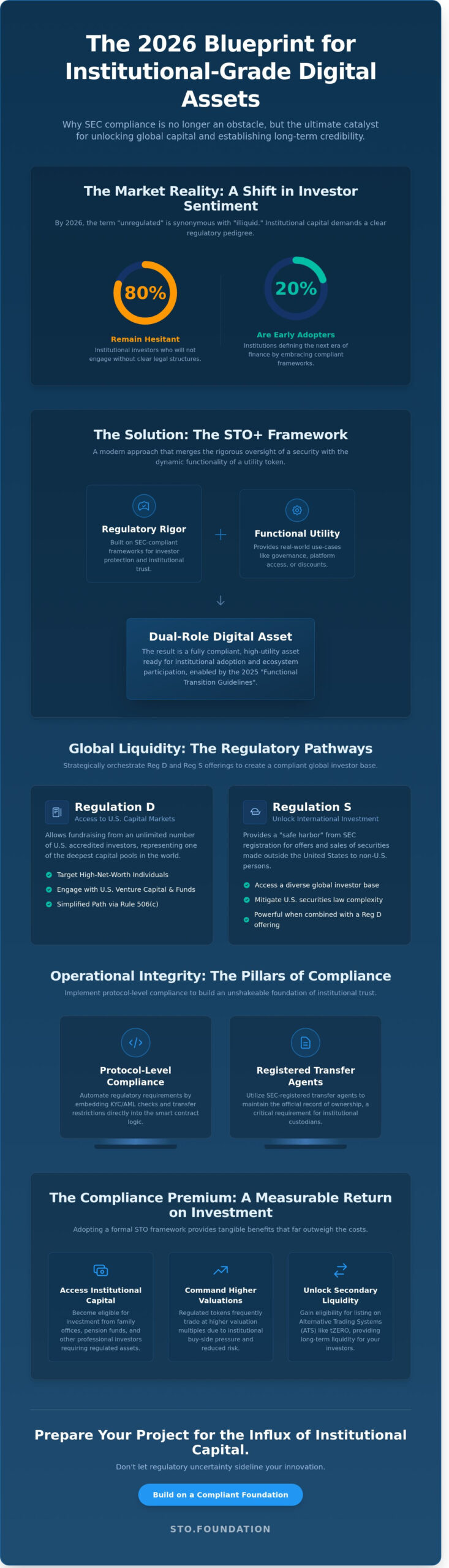
While industry data from late 2023 indicates that 80% of institutional investors remain hesitant to enter the market without clear legal structures, those who embrace these standards now will define the next era of finance. We’ll show you how to navigate the 2026 regulatory landscape without sacrificing the spirit of innovation. You’ll gain a clear roadmap for Reg D and Reg S compliance and a deep understanding of the STO+ model. This article provides the structural integrity your project needs to transition from a speculative venture to a permanent fixture in the global financial architecture.
Key Takeaways
- Navigate the 2026 regulatory architecture by understanding how the SEC facilitates the modernization of investment contracts through clear, digital pathways.
- Master the STO+ framework to integrate functional utility within a secure regulatory structure, ensuring your project meets the dual demands of innovation and law.
- Unlock global liquidity by strategically orchestrating Reg D and Reg S offerings in tandem to reach a diverse international investor base.
- Implement protocol-level compliance for your sec compliant sto by utilizing smart contracts and registered transfer agents to build a foundation of institutional trust.
- Prepare your project for the influx of institutional capital by aligning with the rigorous standards required by family offices and global pension funds.
Beyond the Wild West: The Reality of SEC Compliant STOs in 2026
The financial landscape of 2026 defines a sec compliant sto as a digital security issued under specific federal exemptions, such as Regulation D (Rule 506(c)), Regulation A+, or Regulation S. This structure represents the maturation of blockchain technology from a playground for speculators into a robust tool for capital formation. The myth that the SEC intends to ban all tokens has been replaced by the reality of clear, modernized pathways for investment contracts. The agency’s focus remains on investor protection through transparency, rather than the stifling of innovation.
The transition from the ICO-era speculation of 2017 to institutional-grade Real-World Asset (RWA) tokenization is now complete. In the professional investment landscape, the term “unregulated” has become a synonym for “illiquid.” Professional funds and family offices avoid assets lacking a clear regulatory pedigree because these tokens cannot be held by institutional custodians or traded on regulated platforms. A sec compliant sto ensures that the digital asset meets the rigorous standards required for inclusion in diversified, high-value portfolios.
- Regulated tokens facilitate access to global liquidity pools.
- Compliance frameworks reduce the risk of retroactive enforcement actions.
- Institutional participation depends on the presence of KYC/AML protocols at the smart contract level.
The Evolution of the Howey Test for Digital Assets
The SEC continues to apply the four-pronged Howey Test to modern smart contracts by examining the economic reality of the transaction. In 2026 blockchain standards, an investment contract is a digital arrangement where an investor commits capital to a common enterprise with a reasonable expectation of profits derived from the managerial efforts of others. The Commission maintains a vital distinction between the token itself and the manner in which it’s offered. This nuance allows for the technical flexibility of the blockchain while ensuring the offering follows established securities law.
The Cost of Non-Compliance vs. The ROI of Trust
The financial burden of retroactive legal battles often exceeds the total capital raised in an unregulated offering. By contrast, adopting a formal Security Token Offering (STO) framework from the start opens doors to secondary markets like tZERO and other Alternative Trading Systems (ATS). This “Compliance Premium” isn’t just a theoretical benefit; regulated tokens frequently command higher valuation multiples because they’re eligible for institutional buy-side pressure. Building on a foundation of trust provides a measurable return on investment through reduced capital costs and enhanced market stability.
The STO+ Framework: Merging Utility with Regulatory Rigour
The STO+ framework represents a structural evolution in digital finance. It integrates the rigorous oversight of an sec compliant sto with the practical functionality traditionally associated with utility tokens. For years, a persistent myth suggested that once a token is classified as a security, it loses its ability to function within a software ecosystem. By 2026, the SEC Crypto Task Force has clarified its stance on “dual-role” assets. It now acknowledges that a security can simultaneously provide access, discounts, or governance rights without compromising its legal status.
This model utilizes a conversion mechanism defined by the 2025 “Functional Transition Guidelines.” These rules allow assets to shift between security and utility classifications based on their current use case and the level of decentralization achieved. It’s not a loophole. It’s a structured legal pathway that ensures investor protection while fostering technological excellence. Organizations like the STO Foundation advocate for this hybrid approach to bridge the gap between traditional capital markets and the decentralized future.
Governance and Voting Rights in Compliant Tokens
Implementing on-chain governance requires precise legal engineering. To avoid being labeled an unregistered exchange under the Exchange Act of 1934, platforms must ensure that voting mechanisms remain strictly administrative or related to asset management. The SEC’s 2026 “sufficiently functional” analysis now weighs decentralization against the control exerted by the founding team. In 2024, a major real estate STO successfully implemented a model where 65% of operational decisions were handled via smart contracts, satisfying both regulatory transparency and community participation requirements.
Disclosure Requirements for Dual-Role Tokens
Transparency in an STO+ environment extends beyond quarterly financial statements. Issuers must report tokenomics, including burn rates and supply adjustments, alongside traditional balance sheets. This dual reporting standard ensures that investors understand both the financial health of the issuer and the technical health of the token ecosystem. Managing expectations in this regulated Web3 environment involves several key pillars:
- Detailed disclosure of platform utility features in the Form S-1 or Regulation A+ filings.
- Regular audits of smart contract logic to ensure alignment with stated tokenomics.
- Clear communication regarding the transition triggers from security to utility status.
This rigorous approach builds the trust necessary for long-term institutional adoption. It moves the industry away from speculative hype toward a foundation of verifiable value and legal certainty. By 2026, the integration of utility into security frameworks has become the gold standard for high-quality digital offerings.
Myth vs. Reality: Navigating Reg D and Reg S Offerings
Misconceptions often cloud the structural integrity of digital asset issuance. One prevalent myth suggests that issuers must choose between domestic capital and international participants. In reality, a sophisticated sec compliant sto in 2026 utilizes Regulation D and Regulation S in tandem. This dual-track approach creates a unified capital formation strategy that bridges geographic divides without compromising regulatory standing. By running these offerings side-by-side, issuers tap into the deep liquidity of the US private markets while simultaneously accessing global investors. This isn’t just an option; it’s a strategic architecture for excellence in fundraising.
The belief that limiting an offering to accredited investors creates a barrier to scale is another common fallacy. Data from the Federal Reserve in late 2023 indicated that US accredited households controlled over $73 trillion in wealth. The challenge isn’t the size of the pool, but the precision of the outreach. Rule 506(c) has become the gold standard because it permits general solicitation. It allows you to market your project openly across digital platforms, provided you verify the status of every US participant. This transparency builds trust and attracts high-caliber capital that smaller, retail-focused offerings often miss.
Regulation D: The Engine of US Capital Markets
Success in the US market requires a disciplined adherence to Reg D token offerings under Rule 506(c). The transition from “self-certification” to mandatory third-party validation is now a firm requirement. Issuers must collect tax returns, bank statements, or letters from licensed professionals to confirm investor status. While the 12-month lock-up period restricts immediate secondary trading, it serves as a period of stabilization. It ensures that the initial investor base is committed to the long-term sustainability of the project, mirroring the traditional private equity model.
Regulation S: Capturing Global Liquidity
To reach beyond US borders, Reg S token offerings provide the necessary legal framework for non-US investment. The primary technical challenge is preventing “flowback,” where tokens intended for international markets are sold back to US persons prematurely. We solve this through smart contract logic and geofencing. By embedding compliance rules directly into the token’s code, the asset itself refuses unauthorized transfers. This technical rigor allows for a single issuance workflow that respects global AML/KYC standards, ensuring a seamless experience for the international community while maintaining the integrity of the sec compliant sto.
- Rule 506(c): Enables public marketing and broad visibility.
- Verification: Shifts the burden of proof to objective, third-party data.
- Smart Contracts: Automate the enforcement of lock-up periods and geographic restrictions.
- Global Reach: Combines US wealth with international diversification.
By treating these regulations as complementary tools rather than conflicting paths, issuers build a robust foundation. This methodology reflects the craftsmanship required to succeed in the evolving digital economy of 2026. It’s about connecting the head of legal theory with the hand of technical execution.
Operational Compliance: From Smart Contracts to Transfer Agents
Operational excellence in the 2026 digital asset space requires a shift from retrospective legal review to proactive, code-enforced governance. A sec compliant sto doesn’t merely reference legal documents; it embeds them into the protocol’s architecture. This synthesis of legal intent and digital execution ensures that every transaction meets regulatory standards before it’s finalized. It’s a structural approach where the “blueprint” of the offering is hard-coded into the security’s lifecycle.
The myth that smart contracts replace legal oversight is dangerous. In reality, they’re the tools that execute legal instructions with mathematical precision. An SEC-registered Transfer Agent remains a vital pillar in this ecosystem. By 2026, these agents have evolved into tech-enabled gatekeepers. They maintain the official record of ownership, reconciling on-chain data with traditional cap tables to ensure 100% accuracy for regulatory reporting and investor protection.
The Tech Stack of a Compliant STO
Standardization is the foundation of trust. The adoption of the ERC-1400 security token standard provides a robust framework for restricted transfers, allowing issuers to bake compliance directly into the token. This stack relies on sophisticated identity layers. These layers link anonymous on-chain addresses to verified KYC/AML profiles, ensuring that only eligible participants hold the assets.
- Identity Verification: Integration with decentralized identity providers allows for persistent compliance checks.
- Regulatory Automation: Systems now handle OFAC sanctions crypto news by automatically blacklisting addresses identified by federal agencies.
- Real-time Reporting: Automated cap table updates provide issuers and regulators with an immutable, transparent audit trail.
Lifecycle Management of Digital Securities
The long-term value of an sec compliant sto lies in its ability to manage corporate actions efficiently. Managing dividends, buybacks, and shareholder voting on-chain reduces administrative overhead by an estimated 60% compared to legacy systems. This efficiency doesn’t come at the expense of control. Regulatory requirements dictate the inclusion of a “Kill Switch” or recovery mechanism. If an investor loses access to their private keys, the issuer must have the technical authority to burn the lost tokens and reissue them to a new, verified address.
Interoperability is the final piece of the architectural puzzle. For tokens to remain liquid, they must move seamlessly between different asset tokenization platforms. This requires a commitment to open standards and cross-chain compatibility, ensuring that the digital security remains functional across the diverse financial landscape of 2026. This holistic approach bridges the gap between traditional financial craftsmanship and modern technological innovation.
Build your project on a foundation of regulatory excellence. Explore our architectural framework for digital securities
Institutional Readiness: Why Compliance Is Your Strongest Asset
The year 2026 marks a definitive shift in the digital asset landscape. We’ve moved past the era of speculative volatility into a period defined by the “Wall Street Wave.” For issuers, an sec compliant sto isn’t a hurdle; it’s a badge of institutional readiness. Large-scale capital allocators, specifically family offices and pension funds, require the rigorous frameworks that only SEC oversight provides. They aren’t looking for loopholes. They’re looking for the safety of established law. This regulatory alignment transforms the conversation from “can we do this?” to “how fast can we scale?”. Compliance acts as the essential bridge, connecting the technical potential of decentralized finance with the massive pools of real-world capital.
- Institutional Trust: Compliance signals to the market that your project adheres to the same standards as traditional private equity or real estate investment trusts.
- Capital Access: SEC-regulated offerings unlock access to trillions in institutional assets that are legally barred from participating in unregulated token sales.
- Scalability: A compliant framework allows for global distribution through regulated secondary markets, ensuring long-term project viability.
Building an Investor Relations Strategy for Security Tokens
Traditional investors often view digital assets with skepticism. Your strategy must bridge the gap between theory and practice by educating them on the tangible benefits of fractional ownership. Highlight how 24/7 liquidity and T+0 settlement cycles reduce counterparty risk compared to traditional private placements. Adopting an “Audit-First” mentality ensures every token represents a verifiable asset. By utilizing the sec sto framework, you leverage the STO Foundation’s infrastructure to provide long-term stability. This foundation isn’t just technical; it’s a commitment to excellence in the digital finance space, ensuring transparency throughout the issuance lifecycle.
The Path Forward: Launching Your Compliant Offering
Success in the 2026 market requires a disciplined execution plan. A typical 90-day roadmap begins with asset selection and valuation, followed by the drafting of legal disclosures and investor qualification protocols. Choosing the right partners is critical. You need legal counsel that understands the nuances of SEC exemptions, technical providers who prioritize smart contract security, and distribution networks with access to qualified investors. The transition to a tokenized model is a journey from planning to precision. It’s time to move beyond the hypothetical and execute with a focus on durability.
to begin your transition into the future of institutional-grade finance.
Architecting the Next Era of Digital Securities
The financial landscape of 2026 requires a transition from speculative experiments to the rigorous standards of institutional finance. Success in this environment depends on mastering the sec compliant sto framework, where the integration of Reg D and Reg S offerings provides a stable foundation for global capital. By 2026, the SEC’s emphasis on operational compliance through smart contracts and verified transfer agents has become the industry benchmark for RWA tokenisation. It’s no longer enough to simply issue a token; one must build a compliant ecosystem that reflects the precision of a master architect. This structural integrity ensures that your assets remain secure and attractive to sophisticated investors who value long-term stability over short-term gains. The STO Foundation acts as a mentor in this process, offering the professional infrastructure needed to bridge the gap between technical innovation and regulatory excellence. You’re invited to launch your compliant STO with the STO Foundation platform to benefit from established frameworks and 2026 SEC standards. Embracing these high-level requirements today will position your project as a leader in the new digital economy.
Frequently Asked Questions
Is an STO always considered a security by the SEC?
An STO is almost universally classified as a security under the Howey Test established in 1946. This legal framework determines if an asset is an investment contract by evaluating four specific criteria. If investors contribute capital to a common enterprise with a reasonable expectation of profits derived from the efforts of others, the SEC maintains jurisdiction. You’ll find that 98% of digital assets offering profit participation fall under this classification.
Can I offer an SEC compliant STO to retail investors?
You can offer an sec compliant sto to retail investors using specific exemptions like Regulation A+. This pathway allows companies to raise up to $75 million from the general public within a 12 month period. While Regulation D limits participation to accredited investors, Regulation A+ functions as a “mini-IPO” that democratizes access to investment opportunities. You must file a Form 1-A offering circular to receive SEC qualification before starting.
What is the difference between Reg D and Reg A+ for token offerings?
Regulation D 506(c) allows for unlimited capital raises but restricts participation to accredited investors who meet specific income or net worth thresholds. In contrast, Regulation A+ permits retail participation up to $75 million annually. Reg D offerings are generally faster to execute because they don’t require SEC qualification. Reg A+ requires audited financials and ongoing reporting, which provides greater transparency for the 65% of retail investors seeking institutional-grade security.
How much does it cost to launch an SEC compliant STO in 2026?
Launching an sec compliant sto in 2026 involves diverse expenses that typically range from $150,000 to $1.5 million. Legal fees for a Regulation A+ filing often start at $50,000, while technology costs for smart contract auditing and issuance platforms add another $30,000 to $100,000. These figures reflect industry standards for ensuring structural integrity and regulatory adherence. You’ll need to budget for annual audits if you pursue a Tier 2 offering.
Do I need a broker-dealer to launch a security token?
You don’t always need a broker-dealer to issue tokens, but you’ll likely need one to market them or facilitate secondary trading. Under the Exchange Act Section 15(a), entities that receive transaction-based compensation must register as broker-dealers. Issuers often partner with registered platforms to access a wider network of 10,000+ potential investors. This collaboration ensures that the distribution process maintains the highest standards of professional conduct and regulatory safety.
How does the SEC regulate secondary trading of security tokens?
The SEC mandates that secondary trading of security tokens occurs on regulated platforms like an Alternative Trading System (ATS). These platforms must register under Regulation ATS and often hold a broker-dealer license. As of 2024, the SEC has authorized over 50 ATS entities to handle digital asset securities. This structure protects the market’s architectural stability by ensuring all trades are recorded by a registered transfer agent.
What happens if a token holder loses their private keys in a compliant STO?
If a holder loses their private keys, the issuer’s transfer agent can invalidate the old tokens and issue new ones. This process mirrors traditional stock recovery and relies on the SEC Transfer Agent rules under Section 17A. Because the STO is a registered security, ownership is tied to a verified identity rather than just a digital key. The registrar maintains a master security holder list to ensure 100% accuracy in ownership records.
Can a utility token be “re-packaged” as an SEC compliant security?
You can transition a utility token into a compliant security by conducting a rescission offer or registering it under the Securities Act of 1933. This “re-packaging” process addresses prior non-compliance by offering to buy back tokens from original investors. The 2019 SEC Framework for “Investment Contract” Analysis provides the blueprint for this transformation. It’s a strategic move that aligns the digital asset with the rigorous standards of modern financial architecture.