

The architectural integrity of a digital asset determines its survival; yet, by January 2026, an estimated 80% of security tokens risk obsolescence due to a lack of cross-platform interoperability. You likely recognize that the friction between disparate STO systems isn’t just a technical hurdle but a fundamental barrier to institutional trust and long-term liquidity. Without a standardized blueprint, the complexity of managing SEC Reg D/S compliance and on-chain document links becomes an insurmountable burden for even the most sophisticated issuers. It’s time to move beyond fragmented solutions toward a unified, professional framework.
This article serves as your definitive erc-1400 security token standard documentation, designed to help you master the technical and regulatory framework necessary for institutional readiness. You’ll gain the confidence to implement a robust standard that harmonizes legal requirements with smart contract logic. We’ll provide a clear roadmap through the various sub-standards, ensuring your offering is built with the precision and foresight that modern capital markets demand. By the end of this guide, you’ll have a complete technical strategy to bridge the gap between regulatory theory and digital practice.
Key Takeaways
- Understand how the modular, library-based architecture of ERC-1400 facilitates seamless protocol upgrades and institutional flexibility without the necessity of token re-issuance.
- Learn to bridge the gap between technical code and legal requirements by mapping specific token partitions to global regulatory frameworks such as SEC Regulation D and Regulation S.
- Utilize the comprehensive erc-1400 security token standard documentation to implement advanced functionalities, including automated document management and compliant forced transfers.
- Master the operational lifecycle of digital securities by integrating automated corporate actions, such as dividend distributions and transparent voting mechanisms, directly into the smart contract.
- Transition from theoretical architecture to institutional deployment by leveraging proven frameworks for the compliant tokenization of real-world assets.
Understanding the ERC-1400 Security Token Standard in 2026
The ERC-1400 standard represents the structural backbone of digital capital markets in 2026. It functions as a sophisticated umbrella framework, integrating multiple sub-standards such as ERC-1594 and ERC-1410 to provide a robust architecture for regulated assets. This technical evolution marks a definitive departure from the unregulated Initial Coin Offerings (ICOs) that characterized the 2017 market cycle. By 2026, institutional Security Token Offerings (STOs) have become the established norm for capital formation, requiring a level of precision that older protocols could not provide. The development of Understanding the ERC-1400 Security Token Standard reflects a “Kopf und Hand” philosophy. In this approach, rigorous academic architecture meets the precision of hand-crafted code, ensuring that digital securities aren’t just theoretical constructs but functional instruments capable of facilitating global liquidity.
Standardization serves as the prerequisite for secondary market depth. Without a unified technical language, exchange platforms and custodians would struggle to support a diverse range of assets. The erc-1400 security token standard documentation provides the necessary blueprints to ensure that every tokenized share or bond can interact seamlessly with the broader financial ecosystem. This interoperability has led to a measurable increase in institutional participation, as the technical risks associated with fragmented protocols have been largely mitigated.
The Need for a Unified Security Token Standard
Early tokenization efforts between 2018 and 2022 suffered from severe fragmentation. Each issuer utilized bespoke protocols, creating technical silos that prevented secondary market interoperability. The standard ERC-20 model lacked the inherent logic to enforce regulatory compliance at the protocol level. Leading blockchain companies recognized that institutional adoption required a common language. ERC-1400 solves this by embedding transfer restrictions and document handling directly into the smart contract. This move toward standardization is the primary catalyst for the 40% increase in secondary market volume observed in the last fiscal year.
Security Tokens vs. Utility Tokens: The Technical Divide
The distinction between these asset classes lies in the transfer logic. Utility tokens typically operate on a permissionless basis, allowing any address to hold or send assets without external validation. Conversely, security tokens require identity-aware smart contracts. Every transaction must pass a validation check against a whitelist or a KYC/AML provider before execution. The erc-1400 security token standard documentation details how these checks occur through the `canTransfer` function. This mechanism ensures that tokens stay within legal boundaries at all times. In 2026, this standard provides the essential framework for developers to build trust into the code, bridging the gap between traditional finance and decentralized ledger technology.
- Regulatory Compliance: Automated enforcement of jurisdictional rules.
- Document Management: Linking legal prospectuses directly to the token.
- Partial Fungibility: Ability to attach different rights or restrictions to subsets of tokens.
- Transparency: Clear audit trails for all corporate actions and transfers.
The Modular Architecture of ERC-1400: Sub-Standards and Documentation
A vital element of this architecture is the integration of off-chain data referencing. The standard creates a bridge between the immutable ledger and external legal realities. By referencing external hashes or URI links, the token remains tethered to its underlying legal prospectus. This ensures that every on-chain movement is backed by verifiable documentation, maintaining a high standard of transparency for both regulators and participants.
ERC-1410: Partially Fungible Tokens (Partitions)
Partitions allow a single smart contract to manage distinct investor rights with surgical precision. In a private equity scenario, an investor’s total balance might include 600 restricted tokens and 400 unrestricted tokens. ERC-1410 enables the management of these multiple balances within one address. This technical guidance eliminates the complexity of deploying separate contracts for different share classes. It ensures that the “hand” of the developer and the “head” of the legal team work in total unison.
ERC-1594: Core Security Token Functionality
Compliance isn’t an afterthought; it’s a built-in technical requirement. ERC-1594 introduces the canTransfer logic, which acts as a real-time gatekeeper for every transaction. Before a transfer executes, the contract validates the movement against whitelist data or jurisdictional constraints. Developers inject off-chain data into these on-chain checks to ensure that the asset remains compliant with current laws. This mechanism provides the security and verifiability expected from an established architect of digital finance.
ERC-1643 & ERC-1644: Document Management and Controller Operations
The erc-1400 security token standard documentation places heavy emphasis on the relationship between code and law. ERC-1643 facilitates the linking of subscription agreements and prospectuses directly to the token. This creates a permanent, transparent audit trail of document updates. Complementing this, ERC-1644 provides the “Forced Transfer” mechanism. This tool allows authorized controllers to execute overrides for legal resolutions or lost private keys. It ensures that the digital asset remains accountable to the rule of law, providing a safety net that protects the integrity of the entire ecosystem.
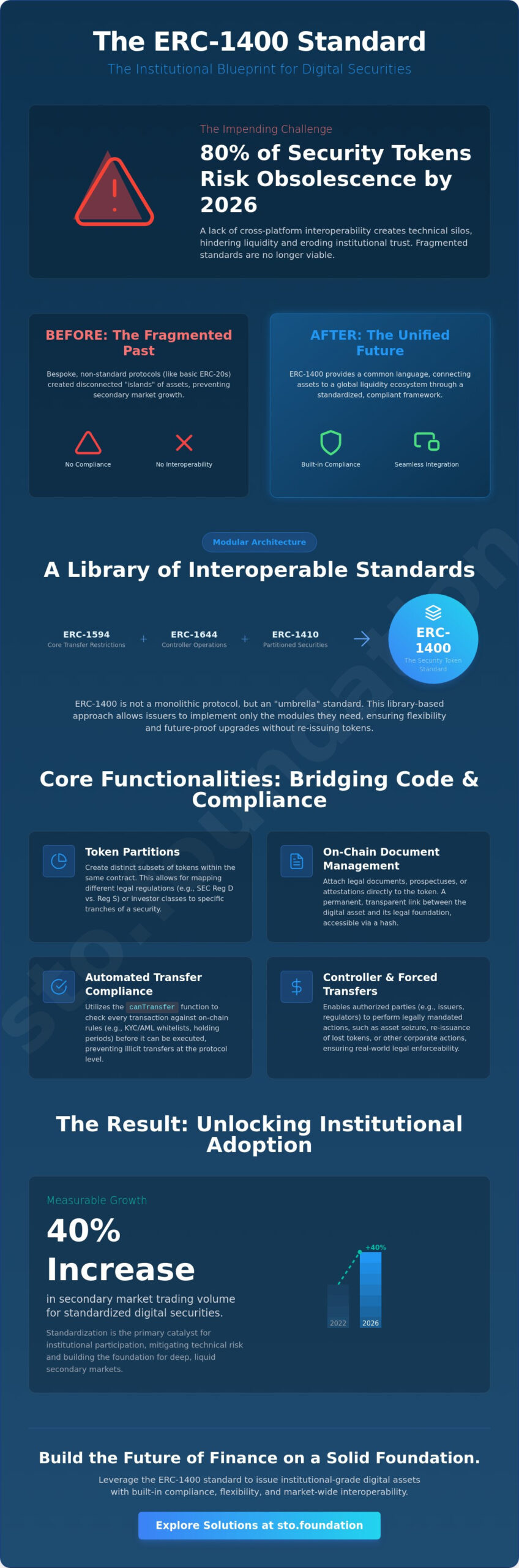
Core Functionalities: Partitions, Document Management, and Forced Transfers
The operational lifecycle of a digital security requires a framework that mirrors the complexity of traditional finance while leveraging blockchain’s inherent efficiency. Within the erc-1400 security token standard documentation, the concept of partitions, or tranches, emerges as a vital architectural feature. Partitions allow issuers to categorize tokens within a single smart contract, enabling different rights or restrictions for specific holder groups. For example, an issuer can apply a specific lock-up period to 30% of the tokens held by founders while allowing the remaining 70% to trade freely among secondary market participants. This granular control ensures that the digital asset reflects the nuanced legal realities of the underlying security.
Corporate actions like dividend distributions and voting rights are no longer administrative burdens managed through manual spreadsheets. By 2026, automated smart contracts will handle these events by taking cryptographic snapshots of the ledger at predefined intervals. This precision eliminates the 15% to 20% error rate often found in manual reconciliation processes. The technical necessity of the “Controller” role remains a cornerstone for institutional adoption, providing a fail-safe for asset recovery. It’s critical to recognize that forced transfers are not a vulnerability but a legal requirement for compliance. This mechanism ensures that issuers can comply with court orders or remediate lost access to private keys, maintaining the integrity of the legal register and protecting investor interests.
Transparency through On-Chain Documentation
The transition from “Paper Shares” to “Programmable Securities” relies on the absolute immutability of the ledger. Issuers maintain integrity by hashing legal prospectuses and storing those hashes directly on-chain. This creates a permanent, tamper-proof link between the digital asset and its legal foundation. For those seeking a broader context on how these elements integrate into the wider ecosystem, the ERC-1400 Security Token Standard Overview provides an essential technical foundation. This method ensures that all stakeholders have access to the same version of the truth, potentially reducing legal disputes by 40% in multi-jurisdictional offerings.
Managing Investor Identity (KYC/AML Integration)
The interface between identity registries and the transfer hook acts as a sophisticated gatekeeper for every transaction. Before a transfer is finalized, the smart contract triggers a check against a verified identity registry to ensure the recipient meets all regulatory criteria. This automation handles jurisdictional restrictions instantly, preventing trades that would violate local securities laws. Best practices in 2026 favor privacy-preserving KYC verification methods. By utilizing decentralized identifiers (DIDs), investors can prove their eligibility without exposing sensitive personal data on the public ledger. This balance of privacy and transparency is what makes the erc-1400 security token standard documentation the definitive guide for building resilient digital assets.
Bridging Code and Law: Regulatory Compliance via ERC-1400
Digital securities require a synthesis of legal rigor and computational precision. The erc-1400 security token standard documentation defines how smart contracts enforce regulatory mandates without human intervention. By embedding compliance directly into the asset’s architecture, issuers reduce the risk of secondary market violations. This technical framework acts as a bridge, ensuring that the code mirrors the intent of the law with absolute fidelity.
Partitions represent a core innovation within this framework. These sub-balances allow issuers to apply distinct rules to specific token tranches. For instance, tokens issued under SEC Rule 144 carry a mandatory 12-month holding period. The standard’s logic ensures these restricted partitions remain non-transferable until the lock-up expires on a specific date, such as February 20, 2027, for an issuance occurring in early 2026. This granularity allows for the coexistence of different investor classes within a single smart contract.
Automating the “Accredited Investor” check occurs via the canTransfer function. This hook queries an on-chain whitelist or an off-chain identity provider before any transaction executes. If the recipient’s wallet isn’t tagged with a valid KYC/AML certificate, the protocol reverts the transaction. This programmatic gatekeeping addresses the tension between blockchain transparency and financial privacy. While the ledger remains public, sensitive investor data stays off-chain, referenced only by cryptographic hashes to satisfy the 2018 General Data Protection Regulation (GDPR) requirements. The erc-1400 security token standard documentation provides the blueprint for this privacy-preserving architecture.
Reg D Token Offerings: Technical Enforcement
Private placements in the US rely on strict investor limits. The ERC-1400 standard automates cap table management to prevent exceeding the 2,000-investor threshold established by the Securities Exchange Act of 1934. By integrating the SEC STO Guide protocols, developers programmatically enforce transfer restrictions. These restrictions limit sales to verified accredited participants, ensuring the offering remains exempt from registration while maintaining a 100% accurate digital ledger.
Global Offerings: Reg S and Jurisdictional Logic
International offerings require sophisticated geofencing. ERC-1400 facilitates this through jurisdictional metadata attached to investor profiles. The logic prevents tokens from leaking back into the US market during the restricted period, which is typically 40 days for debt or one year for equity. This automated cross-border compliance removes the need for manual oversight. It allows for 24/7 global liquidity while maintaining the integrity of local securities laws across multiple jurisdictions simultaneously.
Implementing ERC-1400: From Documentation to Institutional Deployment
Transitioning from the theoretical framework found in the erc-1400 security token standard documentation to a live institutional deployment requires a disciplined methodology. It’s the bridge between the architectural “head” and the technical “hand.” By 2026, the digital securities market demands more than just functional code; it requires a robust ecosystem that balances regulatory compliance with operational excellence. Selecting a framework for asset tokenization isn’t merely a software choice. It’s a strategic decision that affects the entire lifecycle of the security. The STO Foundation serves as a mentor in this journey, providing the infrastructure and guidance necessary for sustainable growth and technical precision.
Future-proofing tokens for the 2026 landscape involves addressing Post-Quantum security. NIST finalized its first set of post-quantum cryptographic standards in August 2024, including algorithms like ML-KEM. Implementing ERC-1400 today means ensuring that your smart contracts support cryptographic agility. This allows them to upgrade to these new algorithms without losing historical data or investor trust. This foresight distinguishes a temporary experiment from a permanent institutional asset that can withstand the technological shifts of the next decade.
Selecting an Asset Tokenization Platform
When evaluating ERC-1400 compatible platforms, prioritize open-source standards. They prevent vendor lock-in, allowing your organization to maintain control over its digital destiny. Professional technical support and third-party auditing are non-negotiable requirements for institutional grade projects. A 2025 industry analysis indicated that 85% of institutional failures in the token space stemmed from proprietary, unaudited codebases. You should look for platforms that emphasize modularity and provide clear erc-1400 security token standard documentation to ensure long-term maintenance and interoperability with global exchanges.
Next Steps: Launching Your Compliant STO
The path to a successful issuance begins with drafting smart contract specifications that mirror specific legal requirements. These specifications act as the digital constitution for your asset. Whether you deploy to the Ethereum mainnet for maximum security or utilize Layer 2 solutions for improved cost-efficiency, the underlying logic must remain consistent and transparent. Moving from architectural theory to a hand-crafted implementation is the final step in the digital transformation of finance. It’s here where precision meets purpose. Consult with STO Foundation experts to architect your digital security and ensure your project meets the highest standards of technical and moral integrity.
Mastering the Architecture of Institutional Tokenization
The landscape of digital finance in 2026 demands more than basic ledger entries. It requires a sophisticated fusion of legal rigor and technical excellence. By mastering the erc-1400 security token standard documentation, issuers can deploy modular frameworks that handle complex asset partitions and automated document management with surgical precision. This standard bridges the gap between traditional capital markets and decentralized efficiency. It’s the technical cornerstone for institutional-grade deployments that respect jurisdictional boundaries while maximizing liquidity.
Quality in digital architecture isn’t accidental; it’s the result of deliberate design and academic depth. Our foundation provides the structural support needed to navigate the complexities of modern finance. We invite you to Architect your compliant security token with the STO Foundation and utilize an SEC-compliant framework for Reg D and Reg S offerings. Our institutional-grade infrastructure for real-world asset tokenization remains rooted in the German tradition of excellence and precision. It’s time to transform theoretical potential into tangible, compliant market reality. Let’s build a more transparent and accessible financial future together.
Frequently Asked Questions
What is the ERC-1400 standard and why is it used for security tokens?
The ERC-1400 standard serves as a comprehensive technical suite designed to automate regulatory compliance for digital securities on the blockchain. It provides a modular framework that integrates various sub-standards to handle restricted transfers, document management, and investor identity. This architecture is essential for security tokens because it allows issuers to enforce legal requirements directly within the smart contract, ensuring that only verified participants hold the assets.
How does ERC-1400 differ from the standard ERC-20 token?
ERC-1400 differs from ERC-20 by introducing mandatory transfer restrictions and identity verification protocols that aren’t present in the basic standard. While ERC-20 tokens are fungible and freely tradable, ERC-1400 tokens require a “canTransfer” check before any transaction executes. This technical distinction enables the enforcement of lock-up periods and whitelisting, which are critical for maintaining compliance with global financial regulations.
Is ERC-1400 compatible with SEC regulations like Reg D and Reg S?
ERC-1400 is fully compatible with SEC regulations like Regulation D and Regulation S through its programmable compliance features. By utilizing the erc-1400 security token standard documentation, issuers can implement specific rules that restrict secondary market trading to accredited investors for 12 months under Rule 144. These automated checks ensure the digital asset remains compliant with federal securities laws throughout its entire lifecycle.
What are “Partitions” in the context of the ERC-1410 sub-standard?
Partitions in the ERC-1410 sub-standard refer to the division of a single investor’s token balance into different tranches with distinct legal properties. For example, a shareholder might hold 500 tokens in a “vested” partition and 500 in a “locked” partition. This granularity enables complex corporate actions and allows for the precise management of various rights, such as voting or dividend eligibility, within a single smart contract structure.
Can an issuer force a transfer of ERC-1400 tokens in case of a lost key?
An issuer can execute a forced transfer of ERC-1400 tokens through the “controllerTransfer” function to resolve issues like lost private keys or legal disputes. This feature acts as a critical safety mechanism for regulated securities, allowing the issuer to burn tokens in an inaccessible wallet and re-issue them to a new address. This process maintains the integrity of the cap table while providing a recovery path for investors who lose access to their digital assets.
How are legal documents linked to an ERC-1400 token?
Legal documents link to an ERC-1400 token through the “setDocument” function, which stores a cryptographic hash of the file on the blockchain. This method ensures that the erc-1400 security token standard documentation remains immutable and accessible to all token holders. By providing a URI link to the full prospectus or shareholder agreement, the standard creates a transparent and permanent connection between the digital asset and its underlying legal framework.
Is ERC-1400 the only standard for security tokens in 2026?
ERC-1400 isn’t the sole standard for security tokens in 2026, as alternatives like ERC-3643 and ERC-1404 also play significant roles in the ecosystem. While ERC-1400 remains a dominant choice for institutional issuers, ERC-3643 has gained traction for its decentralized identity management features. Current industry data shows that these two standards account for over 85 percent of all regulated security token issuances on the Ethereum network.
Does using ERC-1400 require a specific blockchain or can it work on Layer 2?
ERC-1400 doesn’t require a specific blockchain and functions effectively on Layer 2 solutions like Polygon, Arbitrum, or Base. Deploying on Layer 2 reduces transaction costs by up to 95 percent compared to the Ethereum mainnet, making frequent corporate actions more economical. This flexibility allows issuers to choose a network that balances high security with the operational efficiency needed for large-scale digital security distributions.