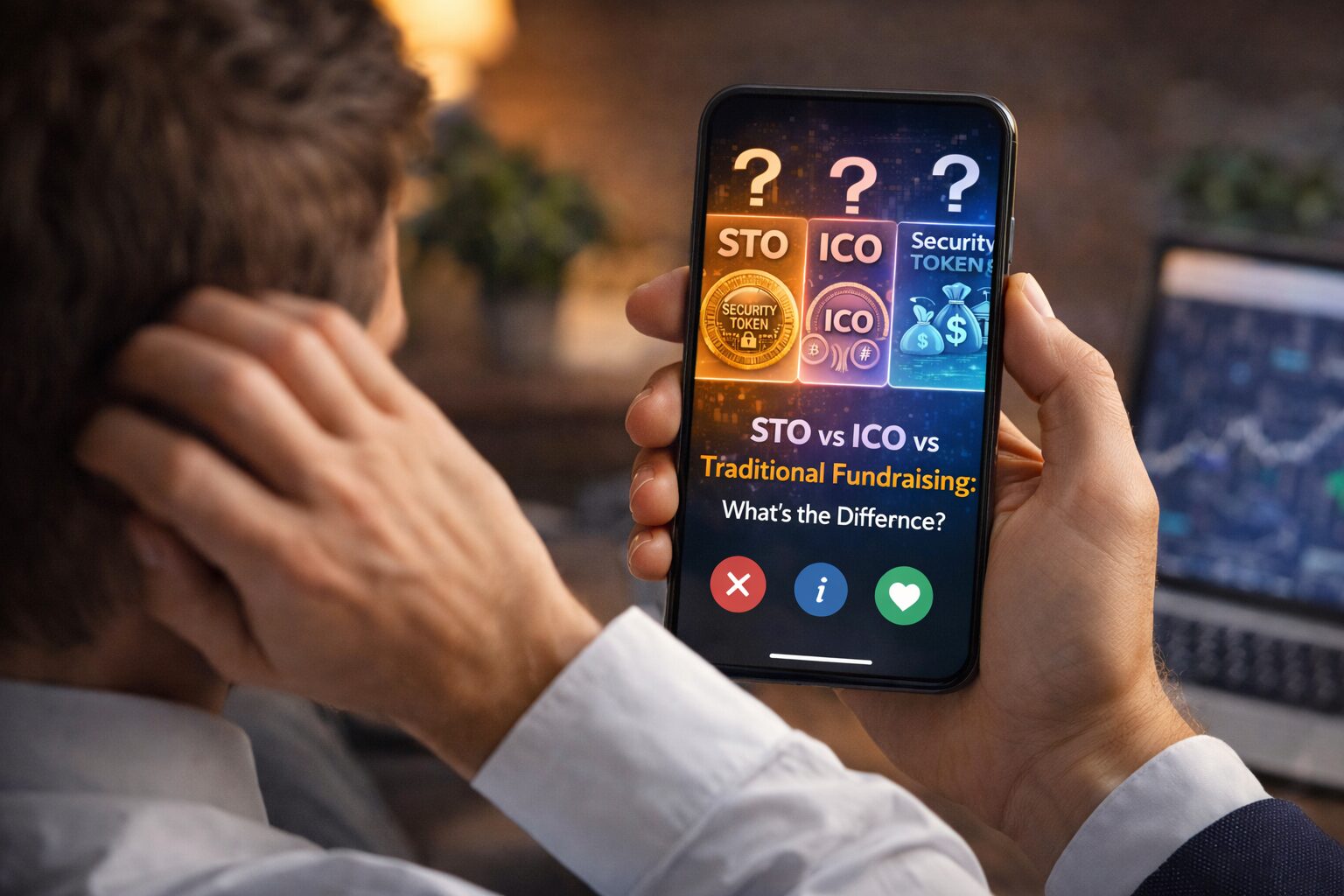
Most founders exploring Security Token Offerings don’t start there.
They typically begin with one of three familiar paths:
- Venture capital
- Initial Coin Offerings (ICOs)
- Traditional private placements
And somewhere along the way, they hear: “You should look into STOs.”
The problem? Most comparisons you’ll find online are either oversimplified—or completely misleading.
Understanding the real differences between these models is critical, because choosing the wrong path early can cost you time, capital, and even regulatory risk.
The Three Capital Raising Models
1. Traditional Fundraising
This includes:
- Venture capital (VC)
- Angel investors
- Private equity
- Regulation D offerings
How it works:
You sell equity or debt in your company through established legal frameworks, typically to a limited pool of investors.
Key characteristics:
- Highly regulated (SEC compliance required)
- Limited investor access
- Illiquid (long lock-up periods)
- Intermediary-driven (lawyers, banks, brokers)
2. Initial Coin Offerings (ICOs)
ICOs exploded in popularity between 2017–2018.
How they worked:
Projects issued “utility tokens” that were not supposed to represent ownership—but were often marketed as investment opportunities.
Key characteristics:
- Minimal initial regulation (at the time)
- Open to global investors
- Fast capital formation
- Little to no investor protections
What changed:
The SEC determined that many ICOs were actually unregistered securities offerings, leading to enforcement actions, fines, and loss of investor trust.
Today, the ICO model as it originally existed is largely non-viable in the U.S.
3. Security Token Offerings (STOs)
STOs emerged as a response to the ICO era.
How they work:
You issue tokenized securities that comply with U.S. securities laws from day one.
Key characteristics:
- Fully regulated
- Built-in investor verification (KYC/AML)
- Digitized ownership via blockchain
- Potential for compliant secondary trading
The Core Differences That Actually Matter
1. Regulatory Exposure
- Traditional fundraising: Fully compliant
- ICOs: Often non-compliant (high risk)
- STOs: Designed for compliance
2. Investor Access
- Traditional: Limited
- ICOs: Broad/global
- STOs: Expanded but regulated
3. Liquidity
- Traditional: Very limited
- ICOs: Immediate but uncontrolled
- STOs: Structured and compliant (when executed correctly)
4. Infrastructure Complexity
- Traditional: Legal-heavy
- ICOs: Technically simple
- STOs: Both legally and technically complex
Why “Hybrid Thinking” Doesn’t Work
A common mistake founders make is trying to combine elements from different models.
This approach fails because regulatory strategy must come first, not last.
Once you choose a path, it dictates how you structure, market, and execute your offering.
When an STO Makes the Most Sense
STOs tend to work best when:
- Raising a meaningful amount of capital
- Seeking broader investor access
- Working with assets that benefit from liquidity
- Willing to operate within strict compliance
The Hidden Tradeoff Most Founders Miss
STOs reduce regulatory risk—but increase execution complexity.
They require more upfront planning, but can lead to stronger long-term outcomes.
Why This Decision Is Strategic
This is not just a technology decision.
It’s a capital formation strategy that impacts your entire business.
Where Founders Get Stuck
Common questions include:
- Which exemption should I choose?
- Can I market internationally?
- Do I need a broker-dealer?
- How do I structure the token?
These are execution-level decisions, not surface-level questions.
Final Thoughts
ICOs showed what was possible.
Traditional finance showed what was required.
STOs combine both.
Want Help Choosing the Right Path?
Inside the foundation, we help members:
- Choose the right regulatory pathway
- Structure offerings correctly
- Avoid costly mistakes
- Connect with vetted partners