
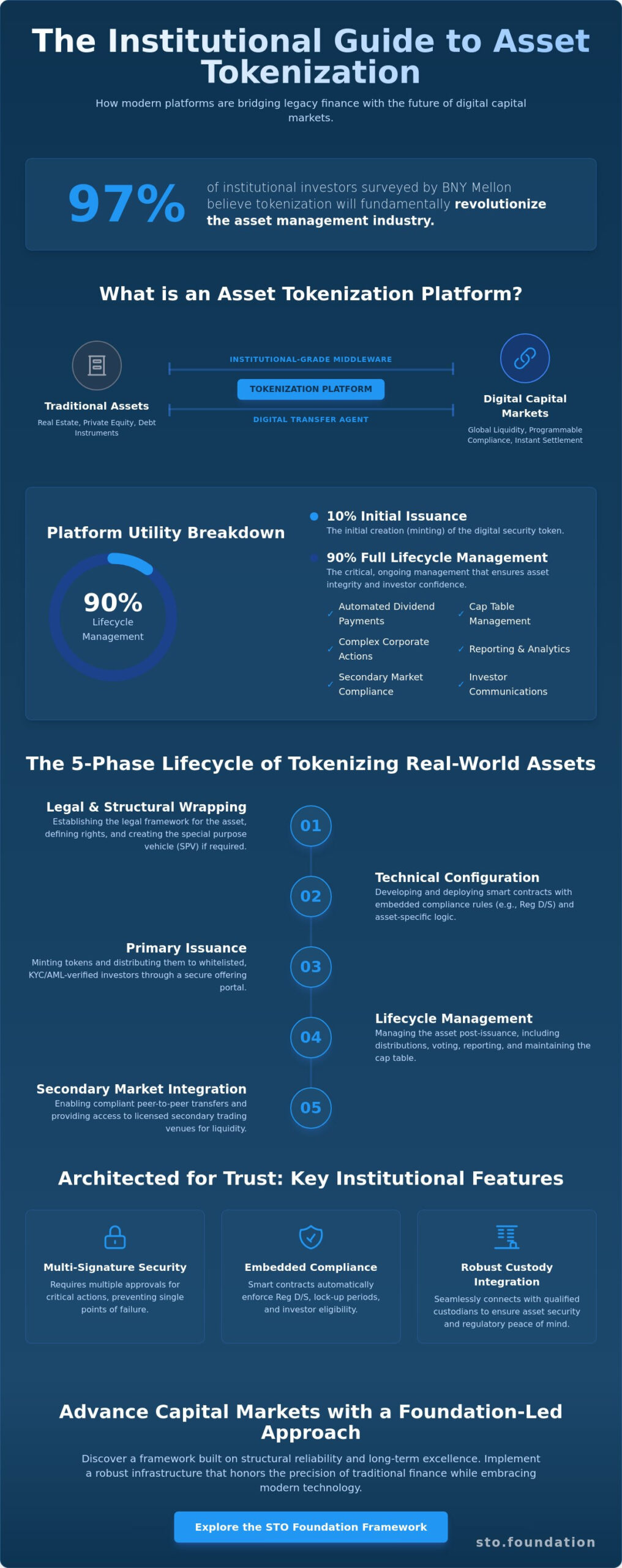
Why do 97% of institutional investors surveyed by BNY Mellon believe that tokenization will fundamentally revolutionize the asset management industry by 2026? You’ve likely observed that traditional methods of managing illiquid assets are reaching their structural limits. The inherent friction of manual settlement and the absence of secondary market liquidity create significant capital inefficiencies that can’t be ignored. Selecting a compliant asset tokenization platform is now a strategic necessity for institutions seeking to bridge the gap between legacy financial architecture and the digital future.
You’re right to prioritize regulatory certainty, especially as the SEC’s enforcement actions regarding digital assets reached a record high in 2023. This guide offers a clear roadmap for transforming real-world assets into secure, investable digital securities while ensuring strict adherence to Reg D and Reg S frameworks. We’ll explore the technical and legal integration required to move from issuance to full lifecycle management. You’ll gain the confidence to implement a robust infrastructure that honors the precision of traditional financial craftsmanship while embracing the sustainable progress of modern technology.
Key Takeaways
- Understand how an institutional-grade asset tokenization platform serves as the essential middleware to bridge real-world assets with digital capital markets.
- Learn why integrating regulatory frameworks directly into smart contracts is the fundamental requirement for secure and compliant security offerings.
- Identify the critical security features, such as multi-signature protocols and robust custody integration, that distinguish professional infrastructure from retail tools.
- Master the five-phase lifecycle of tokenization, navigating the transition from legal asset wrapping to the technical execution of smart contracts.
- Discover how a foundation-led approach ensures long-term excellence and structural reliability in the advancement of global capital markets.
What is an Asset Tokenization Platform in 2026?
By 2026, the definition of an asset tokenization platform has matured from a simple minting engine into a sophisticated layer of institutional-grade middleware. It functions as the technological and legal framework that converts the economic rights of tangible assets into digital security tokens. This transformation requires a precise synthesis of technical excellence and regulatory foresight. It’s no longer sufficient to merely generate a token; the infrastructure must ensure that every Tokenized real-world asset maintains its legal integrity throughout its entire lifecycle. This evolution reflects a shift toward a more holistic architecture, where the digital representation is inseparable from its underlying physical or financial foundation.
Bridging Traditional Finance (TradFi) and On-Chain Markets
The platform acts as a vital conduit, synchronizing off-chain asset data with smart contract execution in real time. This synchronization provides the immutability required to establish trust among institutional investors who manage significant capital allocations. In this ecosystem, the platform ensures that property titles, debt instruments, or private equity shares are reflected accurately on distributed ledgers. An asset tokenization platform serves as the digital transfer agent of the future, providing a single source of truth for ownership and compliance.
Beyond Simple Issuance: The Middleware Layer
Industry data from 2025 indicates that the initial issuance represents only 10% of a platform’s total utility. The remaining 90% involves managing the persistent relationship between the physical asset and its digital avatar. This requires a “head and hand” approach to infrastructure development, where the intellectual rigor of legal compliance meets the practical application of blockchain technology. Without this ongoing management layer, the connection between the token and the asset risks fragmentation, leading to legal ambiguity and reduced investor confidence.
Institutional platforms now handle complex corporate actions, automated dividend distributions, and secondary market liquidity protocols. They provide the necessary bridge between traditional custodians and on-chain ledgers, ensuring that assets don’t become siloed in disconnected databases. By integrating KYC (Know Your Customer) and AML (Anti-Money Laundering) checks directly into the smart contract layer, these platforms maintain a standard of excellence that mirrors the most rigorous requirements of traditional financial stewardship. This structural integrity allows for a seamless flow of capital, fostering a global market that is both transparent and highly efficient. The result is a robust framework that supports the sustainable growth of digital finance while honoring the established principles of asset management.
Regulatory Frameworks: SEC Compliance as a Structural Foundation
In the architecture of digital finance, compliance represents the structural load-bearing walls. A professional asset tokenization platform treats regulatory requirements as immutable code rather than a secondary layer. By 2026, the distinction between experimental and institutional platforms is defined by the depth of their legal integration. According to McKinsey on tokenization, the transition toward digitized assets requires a robust lifecycle management approach that begins with strict regulatory adherence at issuance. This technical rigor ensures that every digital security issued is grounded in legal reality, providing the safety that institutional fiduciaries demand.
Navigating Reg D and Reg S Offerings
The platform enforces investor accreditation requirements automatically, ensuring that only verified participants access specific private placement tranches. Managing transfer restrictions and lock-up periods through on-chain logic is a standard requirement for maintaining Regulation D compliance. Smart contracts act as digital escrow agents, preventing unauthorized secondary market trades before the mandatory holding periods conclude. This synergy between global legal standards and blockchain transparency creates a reliable framework for capital formation. It’s no longer necessary to rely on manual audits when the asset tokenization platform validates every participant’s eligibility in real-time against a whitelist of verified identities.
On-Chain Compliance and Investor Protection
Adhering to SEC compliant STO standards is a prerequisite for institutional adoption in 2026. Programmable compliance allows a platform to block prohibited transfers before they occur, acting as an automated gatekeeper that reduces the risk of regulatory fines. Regulation S allows for global capital participation without compromising local laws by restricting sales to non-U.S. persons under specific jurisdictional conditions. This level of precision protects both the issuer from regulatory scrutiny and the investor from illicit market activity. Automated KYC/AML checks are integrated directly into the minting process, ensuring that the digital cap table remains clean from the first day of issuance. Building on such a secure foundation is the only way to achieve excellence in digital asset management.
The role of whitelisting within smart contracts cannot be overstated. It ensures that the token itself contains the rules of its own movement. If an investor’s credentials expire or if they attempt to transfer an asset to an unverified wallet, the smart contract simply rejects the transaction. This proactive approach to investor protection moves the industry away from reactive legal enforcement and toward a model of preventative, code-based governance. It’s a shift that mirrors the transition from traditional craftsmanship to the precision of modern architectural engineering.
Key Features of an Institutional-Grade Tokenization Platform
Institutional capital requires a foundation built on more than just basic minting capabilities. While retail tools focus on simplicity, an asset tokenization platform designed for 2026 must mirror the rigorous architecture of traditional finance. This involves a shift from simple smart contracts to a comprehensive ecosystem of multi-signature security and deep custody integration. Professional investors expect assets to reside within a secure framework that utilizes Hardware Security Modules (HSM) and segregated account structures. According to FDIC Remarks on Tokenization, the evolution of real-world asset representation demands a focus on risk management that aligns with established regulatory expectations. It’s not enough to simply issue a token; the infrastructure must support the entire weight of institutional compliance.
Managing the lifecycle of a digital security isn’t a one-time event. It’s a continuous process of maintenance and precision. Platforms must handle complex corporate actions like dividend distributions to 5,000 fractional owners or managing automated tax withholdings across different jurisdictions. This level of technical craftsmanship ensures that the technology serves the strategic goals of the investment. When the “hand” of digital execution meets the “head” of financial strategy, the result is a reliable system for long-term wealth preservation.
Technical Standards and Interoperability
Interoperability prevents the creation of liquidity silos that hinder market growth. By adopting the ERC-1400 security token standard, platforms ensure that assets remain compatible across various secondary markets and custodial providers. Security isn’t static; it requires quarterly smart contract audits and the integration of decentralized oracles. These oracles provide real-time Net Asset Value (NAV) data. This ensures the digital representation reflects the physical reality of the underlying asset at all times. Standardized protocols allow for a seamless flow of capital, much like the precision found in modern architectural blueprints.
Post-Issuance Servicing and Investor Relations
Efficiency in the digital age is measured by the automation of investor relations. An institutional asset tokenization platform replaces manual spreadsheets with on-chain shareholder voting and transparent reporting dashboards. This fosters a sense of trust and verifiability that legacy systems can’t match. Distributing yields to a global pool of investors can be executed in seconds via smart contracts. This often reduces administrative costs by 30% to 40% compared to traditional methods. The platform provides a clear, documented path for tax compliance and regulatory reporting, acting as a digital mentor for the issuer throughout the asset’s lifespan. It’s about creating a sustainable environment where investors feel secure and informed.
The 5-Phase Lifecycle of Tokenizing Real-World Assets
The transition from a tangible property to a digital instrument requires a meticulous blend of legal craftsmanship and technical architecture. An asset tokenization platform serves as the bridge between these two disciplines, ensuring that the integrity of the physical asset remains intact while gaining the agility of a digital security. It’s a journey that transforms static value into a dynamic, liquid instrument through a structured five-phase process.
- Phase 1: Asset Structuring. This initial stage focuses on the legal wrapping of the asset. Issuers typically form a Special Purpose Vehicle (SPV) to isolate the asset and define ownership rights. Establishing a robust legal foundation during this phase is vital to preventing regulatory friction or jurisdictional disputes as the token moves through its lifecycle.
- Phase 2: Technical Configuration. Here, the “head” of the architect designs the smart contracts. These digital protocols automate compliance rules, such as KYC/AML checks and transfer restrictions, directly into the token’s code.
- Phase 3: The Offering. The platform hosts the Security Token Offering (STO) via a dedicated investor portal. This phase handles the primary issuance, where capital is raised and tokens are distributed to verified participants.
- Phase 4: Post-Issuance Management. Once tokens are live, the platform manages corporate actions. This includes automated dividend distributions, investor voting, and real-time reporting.
- Phase 5: Secondary Trading. The final phase facilitates liquidity by connecting the tokens to compliant exchanges, allowing investors to exit or increase their positions.
From Physical Asset to Digital Security
Successful tokenization occurs when the “hand” of the craftsman, representing the physical reality of the asset, meets the “head” of the architect, representing the digital framework. This synergy ensures the legal link between the token and the underlying real-world asset is unbreakable. By 2024, institutional adoption has shown that 85% of successful issuances rely on this rigorous pre-technical structuring. A precise legal architecture in Phase 1 acts as a shield against future regulatory challenges, ensuring the project’s long-term excellence and sustainability.
Unlocking Liquidity in Secondary Markets
A primary benefit of an asset tokenization platform is its ability to enable fractional ownership. By lowering entry barriers, platforms invite a broader range of participants into high-value markets. We’re seeing a fundamental shift from isolated, private ledgers toward the institutional evolution of digital capital markets. This progression provides the necessary data for secondary market price discovery, moving beyond the static valuations of the past. The platform provides a transparent record of trades, which supports market stability and fosters trust among institutional mentors and investors alike.
Explore how our initiatives support the future of building culture and innovation at sto.foundation.
Advancing Capital Markets with the STO Foundation Framework
The STO Foundation represents a vital bridge between traditional craftsmanship and the digital frontier. Our asset tokenization platform isn’t merely a financial tool; it’s an extension of a long-standing commitment to baukultur and sustainable excellence. Unlike commercial entities driven by quarterly gains, our non-profit stifterische roots, established by Siegfried and Elfriede Denzel, prioritize the long-term integrity of the global capital markets. This foundation-led model offers a level of safety that’s rare in the volatile fintech space. We view the digital transformation of assets as a modern form of architecture. It requires the same precision, durability, and ethical consideration as any physical structure. By synthesizing academic theory with practical application, we ensure every tokenized instrument meets the highest standards of institutional reliability for the 2026 landscape.
Institutional partners find a unique sanctuary in our framework. It’s a space where the “head and hand” philosophy translates into code that’s both sophisticated and functional. We’re inviting leaders to participate in a financial future that values transparency over opacity. This isn’t just about moving numbers on a ledger. It’s about creating a more efficient ecosystem where capital flows toward projects that demonstrate genuine quality and social utility. Our governance ensures that the platform remains a neutral, stable environment for high-value asset issuance.
A Legacy of Professional Mentorship
Our approach to technology is inseparable from our history of supporting the next generation of architects and craftsmen. We believe the security of an asset tokenization platform depends entirely on the values of those who build it. By fostering education and providing robust infrastructure, we’re training the financial architects who’ll manage the markets of 2026. This mentorship mindset ensures our systems aren’t just efficient; they’re purposeful. We focus on quality-oriented capital markets where transparency is a fundamental requirement. It’s about creating a legacy that transcends individual transactions and contributes to a healthier, more resilient global economy.
Next Steps for Asset Issuers
Institutional partners must look beyond short-term market trends to achieve lasting success. Evaluating your asset portfolio for tokenization potential requires a partner that understands regulatory longevity and technical precision. We invite you to move past speculative cycles and embrace a framework built for the next decade of finance. Consider these strategic steps:
- Analyze asset liquidity and investor demand within your current portfolio holdings.
- Prioritize compliance frameworks that align with 2026 international standards and regional regulations.
- Collaborate with an institution that values the human element and professional ethics in digital finance.
Ready to lead the shift toward a more transparent financial future? Explore the STO Foundation platform and our commitment to institutional excellence.
Architecting the Next Era of Capital Markets
The financial landscape of 2026 demands a transition from experimental pilots to robust, institutional-grade execution. Success in this evolving market relies on a structural foundation where SEC compliance, specifically through Reg D and Reg S frameworks, serves as the primary pillar for trust. Integrating a sophisticated asset tokenization platform allows your organization to manage the 5-phase lifecycle of real-world assets with absolute transparency. Since our founding in 2005, the STO Foundation has cultivated a legacy of professional excellence, treating financial infrastructure with the same rigor as architectural masterpieces. We’ve built our systems to support institutional-grade real-world assets, ensuring every offering adheres to the highest standards of technical precision. It’s vital to partner with an entity that understands the fusion of traditional reliability and future-oriented innovation. By choosing a specialized framework designed for long-term stability, you secure a position at the forefront of global baukultur. We’re ready to help you build a legacy that lasts for decades.
Launch your compliant asset offering with STO Foundation
Frequently Asked Questions
What is the primary role of an asset tokenization platform?
An asset tokenization platform serves as the digital architecture for the conversion of tangible and intangible rights into immutable ledger entries. This infrastructure facilitates the entire lifecycle of a security token, from the initial technical minting to the ongoing governance of investor relations. Research by the Boston Consulting Group indicates that the market for tokenized assets will reach $16.1 trillion by 2030. It’s a transformative shift that bridges the gap between traditional financial craftsmanship and modern technological excellence.
How does an STO platform ensure SEC compliance for Reg D offerings?
Security token platforms ensure SEC compliance for Reg D offerings through the integration of automated verification protocols. These systems strictly enforce Rule 501 requirements, which limit participation to accredited investors. The software also manages Rule 144 holding periods, preventing secondary transfers for the mandatory 6 or 12 month duration. By embedding these legal constraints directly into the code, the issuer maintains a high standard of regulatory integrity without the need for constant manual intervention.
Can any real-world asset be tokenized using your infrastructure?
Almost any real-world asset can undergo tokenization if a robust legal framework supports its digital representation. Common examples include commercial real estate, private equity, and fine art. In 2024, the success of the BlackRock BUIDL fund, which surpassed $500 million in assets under management, demonstrated the viability of tokenizing US Treasury bills. The infrastructure’s versatility allows for the fractionalization of diverse holdings, provided they comply with specific jurisdictional requirements and sustainability standards.
What is the difference between a tokenization platform and a crypto exchange?
A asset tokenization platform focuses on the primary issuance and lifecycle management of securities, whereas a crypto exchange facilitates secondary market trading. The platform handles the foundational minting of tokens and the onboarding of investors. In contrast, an exchange or Alternative Trading System (ATS) provides the liquidity pool for buyers and sellers. Under SEC guidelines, these entities perform distinct functions. The issuance platform serves as the essential minting architecture that ensures the asset’s long-term compliance and stability.
How are dividends and corporate actions managed for tokenized assets?
Smart contracts manage dividends and corporate actions by executing pre-programmed logic when specific conditions are met. This automation reduces administrative overhead by 30% to 50% compared to traditional manual processing methods. For instance, the ERC-3643 standard allows for the automated distribution of payouts directly to the wallets of verified token holders. The system records every action on the blockchain. This provides a transparent audit trail for all stakeholders and fosters a culture of accountability and precision.
Is a broker-dealer license required to use an asset tokenization platform?
Technology providers don’t necessarily need a broker-dealer license, but the entity facilitating the sale of securities must comply with SEC Section 15(a). If a firm engages in the business of effecting transactions in securities for others, a license is mandatory. Many issuers partner with registered broker-dealers to handle the solicitation and placement of their offerings. It’s essential to distinguish between the software provider and the regulated financial intermediary to ensure the project’s legal foundation remains secure.
Which blockchain standards are best for institutional security tokens?
Institutional security tokens often utilize the ERC-3643 or ERC-1400 standards due to their built-in compliance features. These protocols allow for permissioned transfers, ensuring that only whitelisted investors can hold the assets. The ERC-3643 standard, also known as the T-REX protocol, has been implemented in over 80 countries as of 2024. These frameworks provide the necessary security architecture to meet the rigorous demands of global financial regulators while supporting the sustainable development of digital capital markets.
What are the costs associated with launching a tokenized asset offering?
Costs for launching a tokenized offering include legal fees, technology licensing, and marketing expenses. Industry data from 2023 suggests that legal costs for a standard Reg D offering can range from $25,000 to $60,000 depending on the complexity of the structure. Technology providers typically charge an implementation fee plus ongoing maintenance costs for the infrastructure. Issuers should also budget for KYC/AML verification services, which often cost between $2 and $10 per investor to maintain high excellence in compliance.