

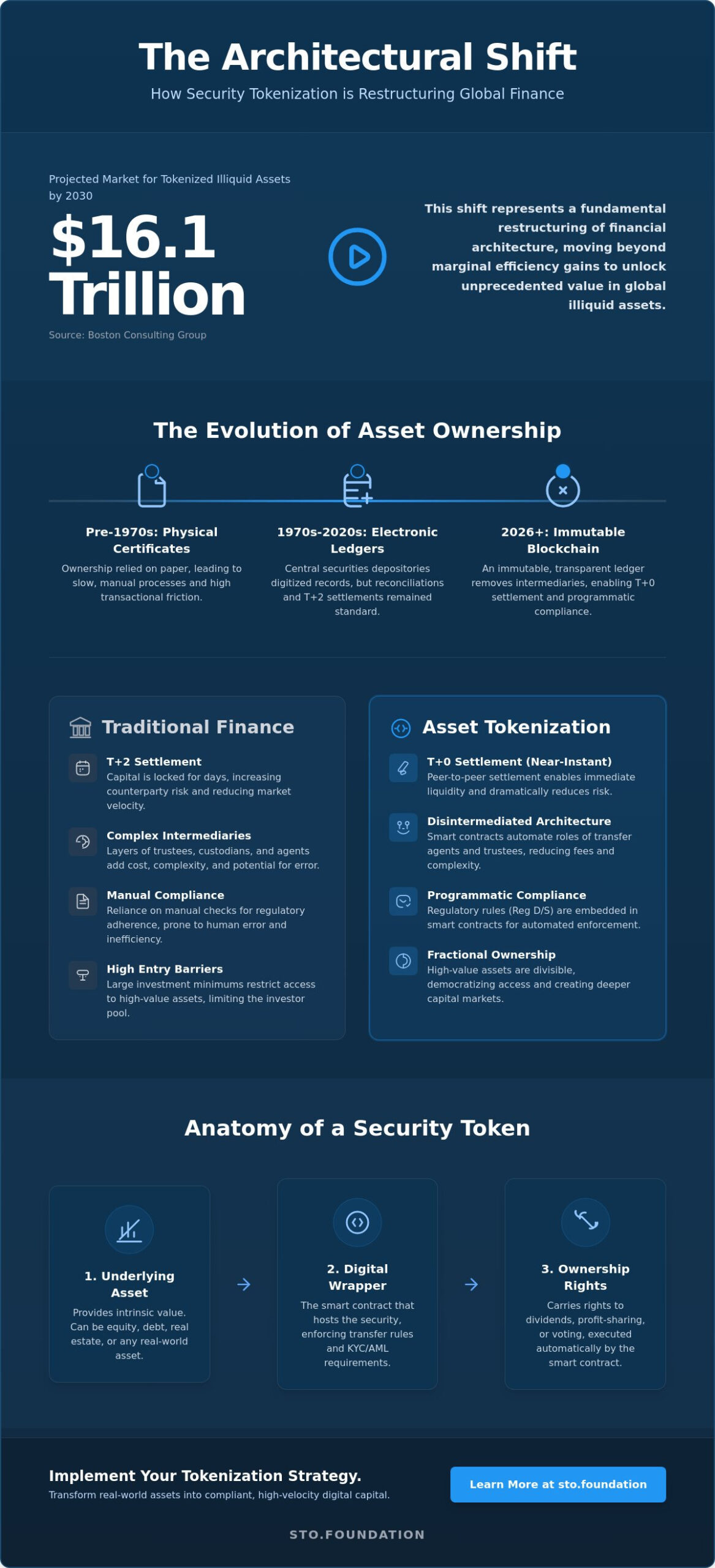
By 2030, the Boston Consulting Group projects that the tokenization of global illiquid assets will represent a 16.1 trillion dollar opportunity, driven largely by the institutional adoption of security tokens. This shift isn’t just a marginal improvement in efficiency. It represents a fundamental restructuring of the financial architecture through the lens of digital excellence and precision.
You likely recognize that traditional capital markets, burdened by T+2 settlement cycles and manual compliance processes, lack the capacity for the support of a high velocity global economy. The confusion between utility assets and regulated securities remains a source of professional friction, yet the establishment of a stable, compliant foundation is now a strategic necessity. This guide serves as a professional mentor for the mastery of regulatory and strategic requirements in the transformation of real-world assets into digital capital. We’ll examine the specific mandates of Reg D and Reg S, clarify the STO framework, and provide a structured roadmap for your organization’s tokenization journey.
Key Takeaways
- Understand the evolution of digital capital by distinguishing between cybersecurity authentication and the representation of ownership in tangible assets.
- Discover how smart contract architecture facilitates automated distributions and corporate actions within a sophisticated on-chain environment.
- Navigate the complex 2026 regulatory landscape to ensure your security tokens remain compliant with SEC Regulation D and S frameworks.
- Identify the essential criteria for selecting an STO platform that effectively bridges the divide between traditional finance and blockchain innovation.
- Develop a comprehensive strategy to transform real-world assets into compliant digital capital, ensuring long-term security and institutional excellence.
Security Tokens Defined: The Evolution of Digital Capital
The mastery of digital finance requires a precise understanding of its structural components. While the term token often appears in cybersecurity to describe multi-factor authentication methods, security tokens represent a distinct financial evolution. These instruments are blockchain-based digital representations of ownership in real-world assets. They combine the rigorous legal framework of traditional securities with the technical efficiency of distributed ledger technology. The issuance of these assets, often facilitated through a Security Token Offering (STO), ensures that digital capital remains compliant with existing regulatory standards while benefiting from modern architectural integrity.
The history of capital markets is a progression toward greater transparency and speed. Before the 1970s, ownership relied on physical paper certificates. The industry then moved to electronic ledgers managed by central securities depositories. By 2026, this evolution has reached its logical peak: the immutable blockchain record. This shift removes the need for reconciliations between disparate private databases. Institutional adoption has accelerated because the foundational technology has matured. The full implementation of the Basel Committee’s prudential standards on cryptoassets in early 2025 provided the necessary certainty for global banks to integrate security tokens into their core portfolios by 2026.
The Core Components of a Security Token
A security token isn’t a single layer; it’s a synthesis of three critical elements. First, the underlying asset provides the intrinsic value, whether it’s equity in a firm, a debt instrument, or a fraction of a commercial real estate project. Second, the digital wrapper acts as the technical host. This code ensures that the security follows specific rules, such as transfer restrictions or KYC requirements. Finally, the token carries inherent ownership rights. These include the right to receive dividends, participate in profit-sharing, or exercise voting power. These rights are executed automatically through smart contracts, ensuring precision and reducing human error in corporate actions.
Tokenization vs. Traditional Securitization
Traditional securitization involves complex layers of intermediaries, from trustees to transfer agents, which often increases administrative costs. Tokenization simplifies this architecture by enabling peer-to-peer settlement. This change reduces the typical T+2 settlement cycle to T+0, providing immediate liquidity. A 2023 report from BCG estimated that tokenized assets could represent 10% of global GDP by 2030, a projection that looks increasingly accurate as we move through 2026. Fractional ownership is another key differentiator. It allows high-value assets, like a 50 million dollar infrastructure project, to be divided into smaller, accessible units. This democratization opens the market to a broader pool of institutional and professional investors who previously faced high entry barriers.
The Architecture of Tokenization: How Real-World Assets Go On-Chain
The transition from physical assets to digital securities requires a meticulous structural framework. This process, often defined as tokenization, isn’t merely a technological shift; it’s a fundamental reimagining of asset ownership and transferability. By 2026, the integration of distributed ledger technology has matured, allowing for a seamless bridge between tangible value and digital representation. The on-chain environment provides a transparent ledger where the history and current state of every asset are verifiable in real time, creating a foundation of trust for institutional participants.
The Role of Smart Contracts in Compliance
Smart contracts serve as the automated executors of the token’s governance rules. These self-executing protocols handle complex corporate actions like dividend distributions and cap table updates with surgical precision. They hard-code transfer restrictions directly into the asset’s digital DNA, ensuring only accredited investors participate in specific offerings. This methodology allows for the seamless management of investor rights without the need for constant human intervention. By embedding regulatory requirements into the code itself, smart contracts eliminate manual compliance errors through programmatic enforcement of transfer logic.
- Hard-coded restrictions: Automatic blocking of trades to non-whitelisted wallets or jurisdictions.
- Automated distributions: Direct payment of yields to token holders based on real-time ownership data.
- Dynamic cap tables: Instantaneous updates to the registry of shareholders upon every successful transaction.
Asset Tokenization Standards and Interoperability
The industry has coalesced around the ERC-1400 standard as the definitive benchmark for security tokens. Its modular design allows issuers to add or remove features like document management or partial redemptions without rebuilding the core architecture. This standardization is vital for the efficiency of tokenized platforms, as it ensures that assets remain liquid and recognizable across various secondary markets. Standardized protocols allow different systems to communicate, which is essential for the broad adoption of digital finance.
True excellence in this field requires robust interoperability. Investors expect their assets to move freely between different blockchain companies and institutional custody solutions. Identity integration remains the cornerstone of this movement. By 2026, protocol-level KYC/AML checks have become standard, ensuring that every transaction meets global jurisdictional requirements. This digital architecture links physical custody, often held by regulated banks, with the on-chain representation. It creates a “golden record” that’s immutable and transparent. For those seeking to master these digital structures, exploring the educational resources of the STO Foundation provides a solid foundation for future-oriented asset management.
The bridge between physical custody and digital representation relies on the role of the “oracle” and the licensed custodian. These entities verify that the underlying asset exists and matches its digital twin. This verification ensures that the security tokens held in a digital wallet represent a valid claim on a real-world building, share, or debt instrument. The result is a system where the precision of the code meets the stability of traditional finance.
Security Tokens vs. Utility Tokens and Traditional Equities
The structural integrity of a financial instrument defines its resilience and long-term viability. Security tokens represent a fundamental evolution in this architecture, acting as a bridge between the precision of traditional equity and the technological agility of blockchain. Unlike speculative assets, these instruments derive value from underlying tangible or intangible assets, providing a stable foundation for institutional portfolios. The legal framework relies heavily on the Howey Test, a standard established by the 1946 Supreme Court case SEC v. W.J. Howey Co. This test determines if a transaction constitutes an investment contract by evaluating the expectation of profits from the efforts of others. This distinction is vital for maintaining the safety of stocks while integrating the efficiency of cryptographic systems.
Security Tokens vs. Utility Tokens
Utility tokens provide access to a specific digital ecosystem, functioning much like a membership key or a voucher. In contrast, security tokens represent a formal, legal claim on assets, debt, or profits. This difference in intent necessitates rigorous regulatory oversight. While early initial coin offerings often bypassed formal procedures, modern Security Token Offerings require detailed filings and adherence to strict disclosure requirements. This alignment with established law is clarified in the SEC statement on digital asset securities, which outlines the necessity of compliance for robust investor protection. Value drivers for these assets remain rooted in the performance of the underlying entity rather than speculative network demand, which significantly mitigates the extreme volatility often associated with utility coins.
Digital Securities vs. Traditional Stock Market Shares
Traditional equities operate within the constraints of legacy systems that often hinder capital flow. Standard exchanges maintain fixed hours and a T+2 settlement cycle, meaning transactions take 48 hours to finalize. Digital securities optimize this process through T+0 settlement, allowing for immediate finality and the reduction of counterparty risk. This transition from manual reconciliation to automated ledger updates reflects the connection between theoretical architecture and practical execution.
- 24/7 market availability: Trading occurs continuously, removing the friction of opening and closing bells and allowing for global participation.
- Settlement efficiency: The shift from T+2 to T+0 settlement improves liquidity and capital efficiency for institutional holders.
- Direct ownership: Records on the public ledger provide transparent, immutable proof of holdings, eliminating the need for multiple layers of intermediaries.
- Operational excellence: Smart contracts automate compliance and dividend distribution, ensuring that the management of security tokens remains precise and cost-effective.
The transition to digital securities isn’t merely a technological upgrade. It’s a commitment to a more transparent and accessible financial baukultur. By combining the rigorous protections of the traditional stock market with the 24/7 functionality of blockchain, these assets provide a secure environment for the next generation of institutional investment.
Navigating the 2026 Regulatory Landscape: SEC, Reg D, and Reg S
Compliance serves as the architectural backbone of every successful digital issuance. Establishing a robust sec sto framework allows issuers to access institutional capital while maintaining the highest standards of legal integrity. In 2026, the integration of automated AML/KYC protocols into the token lifecycle ensures that every transfer meets regulatory mandates without manual intervention. This digital architecture bridges the gap between traditional finance and blockchain efficiency by embedding compliance rules directly into the smart contract. It’s a method that prioritizes safety and transparency for all participants.
Regulation D: Private Placements in the Digital Age
Issuers targeting U.S. capital frequently utilize Rule 506(c) of Regulation D. This specific exemption permits general solicitation, which means sponsors can market their security tokens to the public provided all actual purchasers are verified accredited investors. The verification process requires rigorous documentation of income or net worth, often facilitated by third-party attestation services to ensure precision. Under Rule 144, these securities are typically subject to a one-year holding period before they can be resold in the secondary market. This restriction preserves the offering’s status as a private placement and prevents premature public distribution.
Regulation S: Reaching the Global Investor Base
Regulation S provides a vital safe harbor for offerings conducted entirely outside the United States. It’s the primary mechanism for tapping into European and Asian liquidity pools with security tokens. Issuers must ensure that no “directed selling efforts” occur within the U.S. and that all investors are non-U.S. persons. To prevent illegal flowback into the American market, smart contracts programmatically restrict transfers to U.S. wallets for a specific distribution compliance period, often ranging from 40 days to one year depending on the asset class.
Combining Reg D and Reg S creates a dual-tranche structure that maximizes global reach. This synergy allows for a unified capital raise that respects the sovereignty of local jurisdictions while streamlining the administrative burden. By leveraging these exemptions, issuers can build a diverse, international cap table with the same level of confidence found in traditional markets. It’s about creating a sustainable foundation for growth that honors both the letter and the spirit of the law. For a comprehensive understanding of how these regulatory frameworks integrate with distributed ledger technology, the STO Foundation’s definitive guide to institutional asset tokenization provides the rigorous infrastructure and regulatory clarity needed to bridge legacy legal structures with modern digital issuance.
Implementing Your Tokenization Strategy with STO Foundation
The transition from conceptual architecture to technical execution requires a foundation built on precision and regulatory excellence. Selecting a robust sto platform isn’t merely a technical choice; it’s the establishment of a digital ledger that must withstand decades of scrutiny. STO Foundation serves as the bridge between traditional capital markets and the efficiency of distributed ledgers. We provide the structural framework needed to transform illiquid assets into security tokens.
The lifecycle of a Security Token Offering (STO) begins with a rigorous asset audit. This process ensures the underlying value, whether in real estate or private equity, is verified before the first block is minted. Following the audit, the issuance phase utilizes modular smart contracts to encode compliance directly into the asset. This journey concludes with secondary market trading, where 24/7 liquidity replaces the multi-week settlement cycles common in the 2020 era.
Infrastructure for Compliant Issuance
Compliance isn’t a static goal but a continuous operational requirement. Our infrastructure facilitates automated workflows for investor onboarding, ensuring KYC and AML checks are completed within minutes rather than days. Real-time cap table management allows issuers to maintain a single source of truth, reflecting ownership changes instantly. Integration with licensed custodians and broker-dealers provides the security institutional investors demand. These systems ensure that 100% of transactions remain within the boundaries of jurisdictional law.
Future-Proofing Your Digital Assets
The regulatory environment of 2026 requires flexibility. Modular smart contracts allow for the adaptation of security tokens as global standards evolve. This adaptability ensures that assets remain compliant across different trading venues, fostering deep secondary market liquidity. By aligning technical excellence with a clear professional stance, we help issuers navigate the complexities of digital finance.
For issuers looking to tokenize real estate or private equity, the path forward involves a commitment to both innovation and tradition. Institutional participants seeking to understand the full scope of tokenized real estate as a compliant digital property asset class will find that the convergence of regulatory frameworks and blockchain infrastructure is reshaping how property capital is raised and managed. The STO Foundation acts as an experienced mentor, guiding the development of the next generation of financial instruments. To begin the transformation of your portfolio, consult with STO Foundation to begin your tokenization journey.
Leading the Institutional Shift Toward Digital Equity
The transition to security tokens marks a permanent evolution in how capital markets function. By 2026, the widespread adoption of SEC-compliant frameworks for Reg D and Reg S offerings has established a definitive roadmap for global institutions. This digital architecture ensures that real-world assets move on-chain with the professional precision required by modern regulatory standards. It’s no longer a question of if tokenization will occur, but how leaders will implement these strategies to ensure long-term stability and excellence.
Building a robust offering requires more than just code; it demands an infrastructure grounded in institutional-grade security and smart contract automation. The STO Foundation provides the specialized expertise needed to bridge the gap between traditional finance and the digital future. Our platform provides the necessary tools for asset tokenization, ensuring every issuance meets the highest standards of compliance. You can launch your compliant STO with the STO Foundation platform today to secure your place in this emerging landscape. We’re here to support your journey toward financial innovation and the creation of enduring value.
Frequently Asked Questions
What is the primary difference between a security token and a cryptocurrency?
Security tokens represent a digital claim on an underlying physical or financial asset, such as equity, debt, or real estate. While cryptocurrencies like Bitcoin primarily serve as decentralized mediums of exchange, security tokens derive their value from the performance of the external asset they represent. These assets are strictly governed by established financial regulations to ensure investor protection.
The distinction lies in the regulatory framework. Cryptocurrencies often lack a direct link to a legal entity or asset. In contrast, security tokens function as digital contracts that grant holders specific rights, including profit sharing or voting power within an organization.
Are security tokens legal and regulated by the SEC?
Security tokens are legal financial instruments subject to the jurisdiction of the U.S. Securities and Exchange Commission (SEC) under the Securities Act of 1933. Issuers must comply with registration requirements or qualify for specific exemptions such as Regulation D, Regulation A+, or Regulation S. The SEC utilizes the Howey Test, established in 1946, to determine if a digital asset qualifies as an investment contract.
How does asset tokenization improve liquidity for real estate?
Asset tokenization improves liquidity by enabling the fractionalization of large properties into smaller, more accessible units. According to a 2023 report by Boston Consulting Group, the tokenization of illiquid assets is projected to reach a $16 trillion market by 2030. This process allows for 24/7 trading on secondary markets, reducing the traditional 30 to 60 day real estate closing period to nearly instantaneous settlements. For a deeper examination of how this applies specifically to property assets, the institutional framework for tokenized real estate in 2026 outlines the precise infrastructure and regulatory standards required for compliant digital property issuance.
Can individual investors buy security tokens or only institutions?
Both individual and institutional investors can acquire security tokens, though participation often depends on the specific regulatory exemption chosen by the issuer. Under Regulation D (Rule 506c), participation is restricted to accredited investors who meet the 2024 SEC threshold of a $1 million net worth, excluding their primary residence. Other frameworks, like Regulation A+, allow for broader participation from retail investors in the digital securities market.
What is an STO and how does it differ from an IPO?
A Security Token Offering (STO) is a fundraise where ownership interest is recorded on a blockchain, whereas an Initial Public Offering (IPO) utilizes traditional stock exchanges and centralized clearing houses. STOs provide a more efficient issuance process, potentially reducing administrative costs by 40% through the use of smart contracts. While an IPO requires extensive manual oversight, an STO automates compliance and ledger management.
What happens if I lose access to the wallet holding my security tokens?
The loss of a private key doesn’t result in the permanent loss of security tokens because the issuer maintains a centralized register of ownership. Through rigorous KYC and AML protocols, the issuer can verify your identity and invalidate the lost tokens on the blockchain. A replacement set is then minted and sent to your new wallet address, ensuring your investment remains secure regardless of technical mishaps.
How are dividends paid to security token holders?
The distribution of dividends occurs automatically via smart contracts that execute payments directly to the holders’ digital wallets. These payments are typically made in stablecoins or fiat currency, ensuring that 100% of eligible investors receive their pro-rata share based on the ledger’s snapshot. This automated approach removes the need for traditional intermediaries, streamlining the financial architecture of the investment.
Is a security token the same as an NFT?
A security token is a fungible financial instrument representing a share in an asset, whereas a Non-Fungible Token (NFT) represents a unique, non-interchangeable digital item. Security tokens are designed for investment purposes and are regulated as securities. NFTs serve as certificates of authenticity for specific assets like digital art or collectibles, lacking the uniform financial structure and profit-sharing rights inherent in security tokens.