

By the close of 2026, the traditional distinction between a physical deed and a digital security will have effectively vanished. For decades, the industry has accepted that high-value property must remain an illiquid asset, locked behind high entry barriers and slow, manual settlement processes. You’re likely aware that these frictions prevent the efficient allocation of capital and limit the reach of even the most prestigious architectural projects. It’s a challenge that demands a fusion of traditional stewardship and modern technological innovation to ensure the built environment remains a viable investment for the next generation.
This guide demonstrates how tokenized real estate is finally resolving these legacy constraints by transforming property into a programmable, compliant, and globally accessible digital asset. We’ll provide a clear roadmap for fractionalizing property assets according to the regulatory standards expected in 2026. You’ll discover the specific infrastructure required for institutional issuance and how the convergence of international law is creating a secure environment for digital property. This exploration bridges the gap between the timeless craft of building and the future of digital finance, ensuring that excellence in the physical world is matched by efficiency in the virtual one.
Key Takeaways
- Understand the fundamental transition from physical property to digital securities through the strategic legal wrapping of assets within Special Purpose Vehicles.
- Learn how tokenized real estate enhances market liquidity by enabling fractional ownership and lowering entry barriers for high-value commercial portfolios.
- Discover methods to reduce administrative overhead through the implementation of automated cap table management and programmable blockchain protocols.
- Master the complexities of the 2026 regulatory landscape, focusing on essential SEC compliance and the practical application of Regulation D for private placements.
- Identify how to bridge the gap between traditional real estate craftsmanship and digital innovation using the STO Foundation’s framework for academic and technical excellence.
The Evolution of Tokenized Real Estate in 2026
The year 2026 marks a definitive era where the migration of physical assets to distributed ledgers has matured into a standard financial practice. Tokenization is the process of creating digital securities on a blockchain that represent ownership of a physical property. This transition reflects a fundamental shift from speculative crypto-assets to regulated digital securities, providing a robust framework for institutional participation. Real estate serves as the primary frontier for Real-World Asset (RWA) tokenization because of its inherent stability and high capital requirements. The 2026 market landscape demonstrates this maturation, with data indicating that over $300 billion in global property assets have successfully moved on-chain to enhance capital efficiency.
The technical foundation of this movement relies on secure data protocols. Understanding Tokenization (data security) is essential for comprehending how sensitive ownership records are converted into immutable digital identifiers. This ensures that the underlying property rights remain protected while the asset becomes accessible in a digital format. By aligning cryptographic security with existing legal mandates, the industry has established a reliable bridge between traditional property law and modern technology.
From Illiquid Assets to Programmable Securities
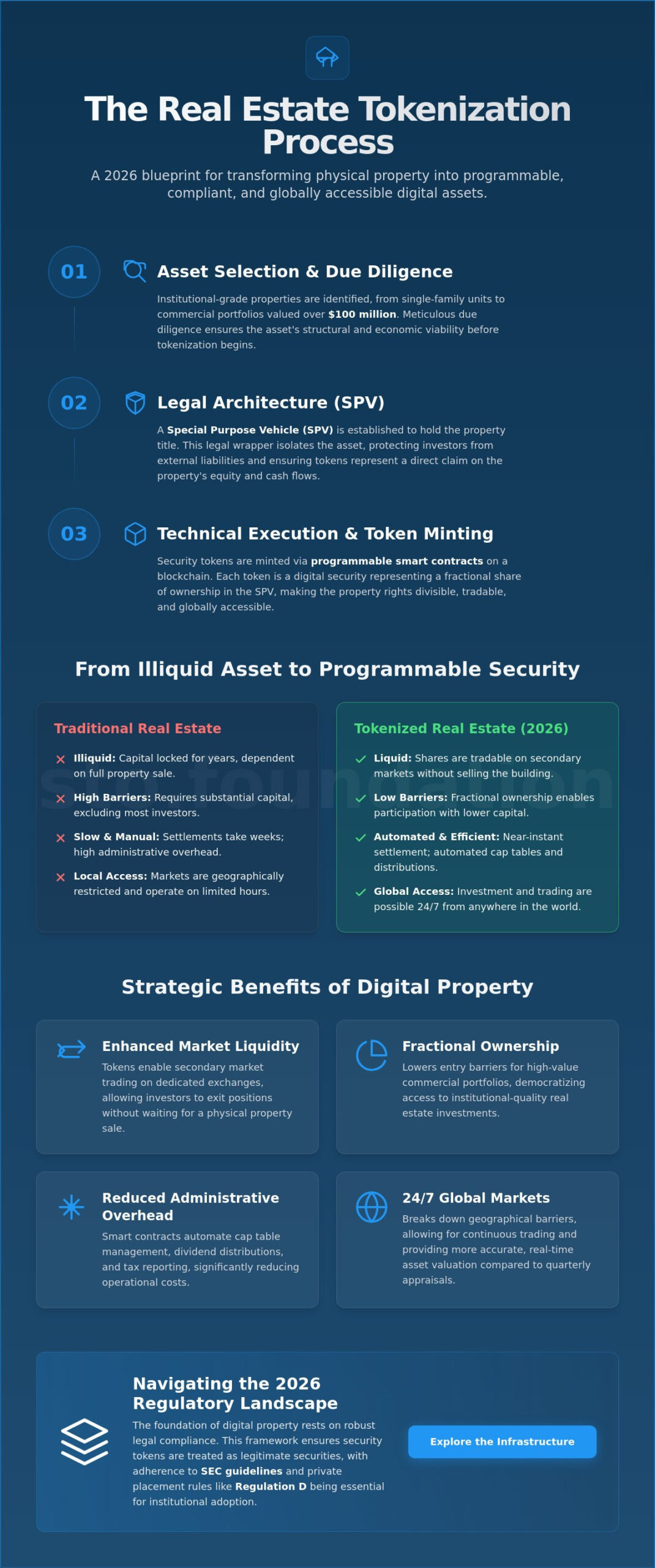
The primary hurdle in traditional real estate has always been the lock-up problem, which restricts capital for years. Through the implementation of tokenized real estate, these once-static holdings are transformed into fluid instruments. Tokens enable secondary market trading on dedicated exchanges, allowing investors to exit positions without waiting for a physical sale of the building. This liquidity is further enhanced by the role of programmable equity.
Smart contracts now automate complex administrative tasks, such as dividend distributions and tax reporting, based on pre-defined logic. Within this framework, tokenized real estate is the convergence of property law and distributed ledger technology. This synergy allows for several operational improvements:
- Automated distribution of rental income to thousands of global holders.
- Real-time cap table management without manual reconciliation.
- Fractional ownership structures that maintain high legal compliance.
The Institutional Adoption Curve
Institutional interest has shifted from cautious observation to active infrastructure migration. Pension funds and Real Estate Investment Trusts (REITs) are increasingly utilizing on-chain systems to reduce overhead and improve transparency. The adoption of 24/7 global markets has fundamentally altered property valuation, as real-time trading data provides a more accurate reflection of asset worth than quarterly appraisals. This shift is part of a broader trend toward asset tokenization within institutional portfolios, where diversification is achieved through programmable, high-yield property tokens. By 2026, the integration of these digital securities into standard accounting software has removed the final barriers to entry for conservative asset managers.
How the Real Estate Tokenization Process Works
The transformation of physical property into a digital asset follows a structured methodology that bridges traditional craftsmanship with modern financial technology. It begins with asset selection. Institutional investors identify properties ranging from single-family residential units to commercial portfolios exceeding $100 million in value. This phase requires meticulous due diligence to ensure the asset’s structural integrity and economic viability.
Legal architecture forms the next layer. A Special Purpose Vehicle (SPV) is established to hold the property title. This entity acts as the legal wrapper, ensuring that the tokenized real estate represents a direct claim on the underlying asset’s cash flows and equity. By isolating the property within an SPV, the process protects investors from external liabilities associated with the parent organization. This structural clarity is essential for maintaining the security and verifiability expected of an established institution.
The technical execution involves minting security tokens via smart contracts. These digital instruments don’t just represent value; they enforce governance. Automated AML/KYC workflows verify participant identities before any transfer occurs. This creates a secure environment where institutional standards meet the efficiency of the blockchain. For those dedicated to advancing the standards of digital property management, this precision is non-negotiable.
Technical Standards: ERC-1400 and Beyond
The adoption of the ERC-1400 security token standard is critical for real estate assets. Unlike standard utility tokens, ERC-1400 allows for hard-coded transfer restrictions. This ensures that tokens only move between whitelisted addresses, maintaining regulatory compliance throughout the asset’s lifecycle. While fungible fractional tokens allow for shared ownership in large commercial buildings, property-specific NFTs are increasingly used for unique architectural landmarks where individual unit identity is paramount.
The Role of Oracles and Data Verification
Maintaining the link between off-chain physical reality and on-chain digital value requires robust data verification. Oracles serve as the bridge, feeding real-time occupancy rates and rental income into the smart contract. This transparency creates an immutable audit trail for every stakeholder. In 2024, the integration of real-time property valuations through decentralized data feeds has reduced reporting delays by 85 percent. This ensures that the token’s value reflects the current state of the building’s performance, fostering a culture of excellence and trust in the tokenized real estate ecosystem.
Strategic Benefits of Digital Property Ownership
The transition to tokenized real estate represents a fundamental shift in the architecture of property investment. By 2026, the institutional adoption of blockchain technology has moved past the experimental phase into a standard for excellence in asset management. Fractional ownership allows investors to participate in high-value commercial projects, such as Grade A office towers in Frankfurt or London, with capital commitments significantly lower than traditional $20 million minimums. This democratization of the capital stack ensures that the craftsmanship of large-scale architecture is no longer reserved solely for the largest sovereign wealth funds.
Digital ledgers provide a level of precision that manual cap table management cannot match. Every transaction is recorded on a permissioned ledger, creating an immutable audit trail. This transparency reduces the risk of disputes and ensures that distributions are handled with mathematical accuracy. Automated systems now manage thousands of international investors with the same ease as a single institutional partner. By accessing a global pool of accredited investors, developers can secure funding in hours rather than months. The core advantages include:
- Lowered Barriers: Entry points for prime commercial assets have dropped from eight-figure sums to units as small as $10,000.
- Precision Management: Automated cap tables eliminate the 15% error rate often found in manual spreadsheet-based tracking.
- Absolute Transparency: Public or permissioned ledgers offer a single version of truth for all stakeholders.
- Global Capital Access: Real-time participation from verified investors across different jurisdictions.
Unlocking Secondary Market Liquidity
The illiquidity of property has historically forced a 10-year holding period on most institutional funds. By 2026, specialized security token exchanges have matured, providing a venue for the constant exchange of property-backed tokens. This environment creates a liquidity premium, as investors are often willing to pay a 20% premium for assets they can exit quickly. Liquidity transforms real estate from a buy-and-hold asset into a dynamic component of a diversified portfolio. Markets like the Singapore Exchange (SGX) and Switzerland’s SDX have proven that digital assets can maintain high trading volumes without compromising regulatory integrity.
Operational Efficiency and Cost Reduction
Traditional property transfers often involve a “middleman tax” of 3% to 6% in closing costs and legal fees. Tokenization reduces these expenses by utilizing smart contracts as digital compliance officers. These protocols verify investor credentials and tax status instantly, allowing for T+0 settlement cycles instead of the standard 30-day closing window. By removing the friction of manual verification, we observe a shift toward a more sustainable and efficient building culture where capital flows directly into the physical development and preservation of assets. This streamlined approach reflects a commitment to excellence in the modern financial landscape.
Navigating the 2026 Regulatory Landscape
Institutional adoption of tokenized real estate hinges on a rigorous adherence to established legal frameworks. By 2026, the era of regulatory ambiguity has concluded. The Securities and Exchange Commission (SEC) maintains a firm stance: property-backed tokens are securities. This classification necessitates a disciplined approach to compliance that mirrors traditional capital markets while utilizing the efficiencies of distributed ledger technology.
Issuers primarily rely on two pillars for US-based offerings. Regulation D, specifically Rule 506(c), allows for private placements to an unlimited number of accredited investors. For capital raises involving international participants, Regulation S provides the necessary exemption for offshore transactions. These regulations aren’t merely checkboxes; they’re the structural integrity of the digital asset ecosystem. In 2026, KYC (Know Your Customer) and AML (Anti-Money Laundering) protocols are integrated directly into the token’s protocol layer. This ensures that assets can’t be transferred to unverified wallets, maintaining a closed-loop system of accountability and trust.
SEC Compliant STOs: A Framework for Success
A well-structured sec sto framework acts as the gold standard for institutional trust. It bridges the gap between innovative finance and the permanence of the built environment. To maintain this standard, issuers must conduct rigorous accredited investor verification. This process involves third-party audits of financial standing to meet SEC requirements. Additionally, Rule 144 mandates a 12-month lock-up period for most private placements. This restriction prevents premature secondary market volatility and aligns with the long-term horizon typical of real estate investments.
Investor Protection and Data Sovereignty
Smart contracts now handle the heavy lifting of legal enforcement. These digital agreements automatically block trades that violate regional selling restrictions or investor caps. It’s a blend of blockchain transparency and necessary privacy. While the ledger records the transaction, sensitive investor data remains off-chain or encrypted. Crucially, the token must remain a legally recognized representation of the underlying deed. Legal precedents established in early 2025 have solidified this connection, ensuring that tokenized real estate holders possess enforceable rights equivalent to traditional owners.
STO Foundation: Infrastructure for Global Real Estate
The STO Foundation serves as the structural backbone for the next generation of property investment. We don’t just provide technology; we cultivate a culture of excellence that mirrors the precision of traditional craftsmanship. By 2026, the shift toward tokenized real estate requires more than just software. It demands a robust institutional framework that aligns regulatory compliance with technical feasibility. Our platform offers a secure environment for global issuance, ensuring that every digital asset maintains the integrity of the underlying physical property. We view ourselves as a bridge, connecting the established principles of the real estate industry with the efficiency of distributed ledger technology.
Our commitment to academic excellence ensures that every project we support is grounded in rigorous research and proven methodology. We believe that a secure investment landscape is built on three pillars:
- Regulatory Precision: Adhering to global compliance standards to protect both issuers and investors.
- Technical Reliability: Utilizing audited smart contracts that reflect the complex realities of property ownership.
- Educational Support: Providing the knowledge necessary for institutions to transition from legacy systems to digital assets.
Bridging Head and Hand in Tokenization
Success in this sector relies on the seamless integration of theoretical legal architecture and practical blockchain execution. We call this the “Head and Hand” approach. It’s a philosophy that ensures complex property portfolios aren’t just digitized, but are structurally sound for long-term holding. Our mentor-led programs provide developers with the specific expertise needed to navigate digital security issuance. This isn’t a hands-off process; it’s a collaborative journey where academic rigor meets the reality of the code. By combining these disciplines, we create tokenized real estate solutions that are as durable as the buildings they represent.
Scaling Your Real Estate Portfolio On-Chain
Developers entering the market in 2026 must look beyond simple asset representation. Scaling effectively involves building a network that supports liquidity and secondary market trading. You’ll need to integrate with leading blockchain companies to ensure your ecosystem remains resilient. The STO Foundation provides the roadmap for this transition. Whether you’re managing a single commercial asset or a diverse residential fund, our framework supports your growth. We invite you to schedule a consultation to evaluate your portfolio’s readiness for the digital age. Together, we can build a future where property investment is accessible, liquid, and fundamentally secure.
Securing the Next Era of Architectural and Financial Excellence
The transformation of global property markets through tokenized real estate isn’t a distant prospect; it’s the 2026 reality for institutions prioritizing precision and transparency. Success in this landscape depends on the seamless fusion of traditional baukultur and advanced digital infrastructure. By anchoring assets in Reg D and Reg S compliant frameworks, investors bridge the gap between legacy financial systems and the efficiency of the blockchain. This structural evolution demands a commitment to excellence that respects both the craft of building and the rigor of international securities law.
The STO Foundation facilitates this transition by providing a stable, institutional-grade environment. Our expertise in bridging traditional finance and digital securities ensures that every project benefits from a foundation of safety and reliability. It’s time to align your portfolio with the technological progress shaping the future of global investment. Explore the STO Foundation infrastructure for compliant real estate tokenization. We look forward to supporting your path toward sustainable digital growth and professional mastery in the property sector.
Frequently Asked Questions
What is tokenized real estate and how does it differ from a REIT?
Tokenized real estate represents direct fractional ownership of a specific property via blockchain, whereas a Real Estate Investment Trust (REIT) is a company that manages a portfolio of various assets. Tokens provide granular control over individual buildings and architectural projects. While REITs must distribute 90% of taxable income to shareholders by law, tokens use smart contracts to automate these payouts directly to investors. This directness fosters a closer connection between the investor and the physical craftsmanship of the asset.
Is tokenized real estate legal in the United States and Europe in 2026?
Yes, digital property assets operate under established frameworks like the EU’s Markets in Crypto-Assets (MiCA) regulation and the US SEC’s Regulation D. As of January 2026, MiCA provides a unified licensing regime across 27 member states for asset-referenced tokens. The SEC oversees these as digital securities, ensuring they meet the same compliance standards as traditional financial instruments. These legal structures provide the security and reliability expected from established institutional investments.
How do investors receive rental income or dividends from tokenized property?
Investors receive distributions automatically through smart contracts that execute based on the property’s performance data. These payments are typically issued in stablecoins or central bank digital currencies directly to the holder’s digital wallet. In 2025, industry reports indicated that 85% of institutional platforms utilized these automated payout cycles. It’s a mechanism that eliminates the administrative delays found in traditional property management and ensures a transparent flow of capital to the investor.
Can I sell my real estate tokens on a secondary market immediately?
You can trade tokens on regulated Alternative Trading Systems or Multilateral Trading Facilities once any mandatory holding periods expire. Regulation D 506(c) offerings in the US typically require a 12 month lock-up period before secondary resale is permitted. After this period, blockchain technology enables 24/7 liquidity for participants. It’s a significant shift from the 6 month average timeline required to sell a physical building in the traditional market.
What happens to the tokens if the property is sold or damaged?
The smart contract governing the tokenized real estate assets dictates the distribution of insurance proceeds or sale capital to all token holders. If a property is sold, the underlying Special Purpose Vehicle is liquidated and funds are dispersed proportionally. Insurance policies, often integrated into the digital twin of the building, cover physical damage. In 2024, the adoption of parametric insurance increased by 30% to provide faster payouts for such events.
Do I need to be an accredited investor to buy tokenized real estate?
Requirements depend on the specific regulatory exemption used by the issuer, such as Regulation A+ which allows non-accredited participation. While Regulation D offerings remain restricted to individuals with a net worth exceeding $1 million, Regulation CF allows retail investors to contribute up to specific annual limits. By 2026, 45% of European real estate STOs have utilized “prospectus light” regimes to include a broader range of participants in architectural funding.
How is the value of a real estate token determined on-chain?
Token value is derived from independent third-party appraisals that are uploaded to the blockchain via decentralized oracles. These oracles provide data feeds reflecting the Net Asset Value of the physical property. According to 2025 RICS standards, digital assets must undergo quarterly valuations to maintain transparency for all stakeholders. This ensures that the on-chain price accurately reflects the tangible quality and market standing of the architectural asset.
What are the tax implications of investing in digital property securities?
Tax authorities generally treat tokenized real estate as a security, meaning income is subject to capital gains or dividend taxes. In the US, the IRS treats these as specified digital assets under the Infrastructure Investment and Jobs Act of 2021. Investors receive a Form 1099-DA for reporting purposes. It’s essential to track the cost basis accurately, as the automated nature of blockchain transactions provides a precise audit trail for tax compliance.