

According to a 2023 report by the Boston Consulting Group, the tokenization of global illiquid assets is projected to reach a $16 trillion valuation by 2030. This transition represents a fundamental evolution in asset management, demanding a fusion of traditional financial wisdom and modern technological precision. You’re likely aware that the path to digital liquidity is fraught with regulatory hurdles and technical complexities that can feel overwhelming. Choosing the right sto platform is the essential first step in building a secure, compliant bridge between physical assets and the digital future.
It’s clear that the stakes for compliance are high, as a single oversight can lead to significant financial and reputational setbacks. This guide provides the professional blueprint you need to master the selection and utilization of an STO platform with confidence. We’ll examine the specific requirements for technical excellence and the roadmap for a successful digital security offering. You’ll gain a structured understanding of how to implement these tools to transform real-world assets into verified, compliant digital securities.
Key Takeaways
- Distinguish between simple token issuance and the comprehensive ecosystem of a modern sto platform to ensure professional asset management.
- Identify the technical benchmarks and security audits necessary to build a robust, enterprise-ready infrastructure for digital securities.
- Master a structured framework for coordinating legal, technical, and marketing disciplines throughout the entire tokenization lifecycle.
- Learn to automate complex international compliance standards by integrating Reg D and Reg S workflows into your digital architecture.
- Evaluate why long-term infrastructure stability and strategic partnerships are more vital for success than the underlying code.
Defining the Modern STO Platform in 2026
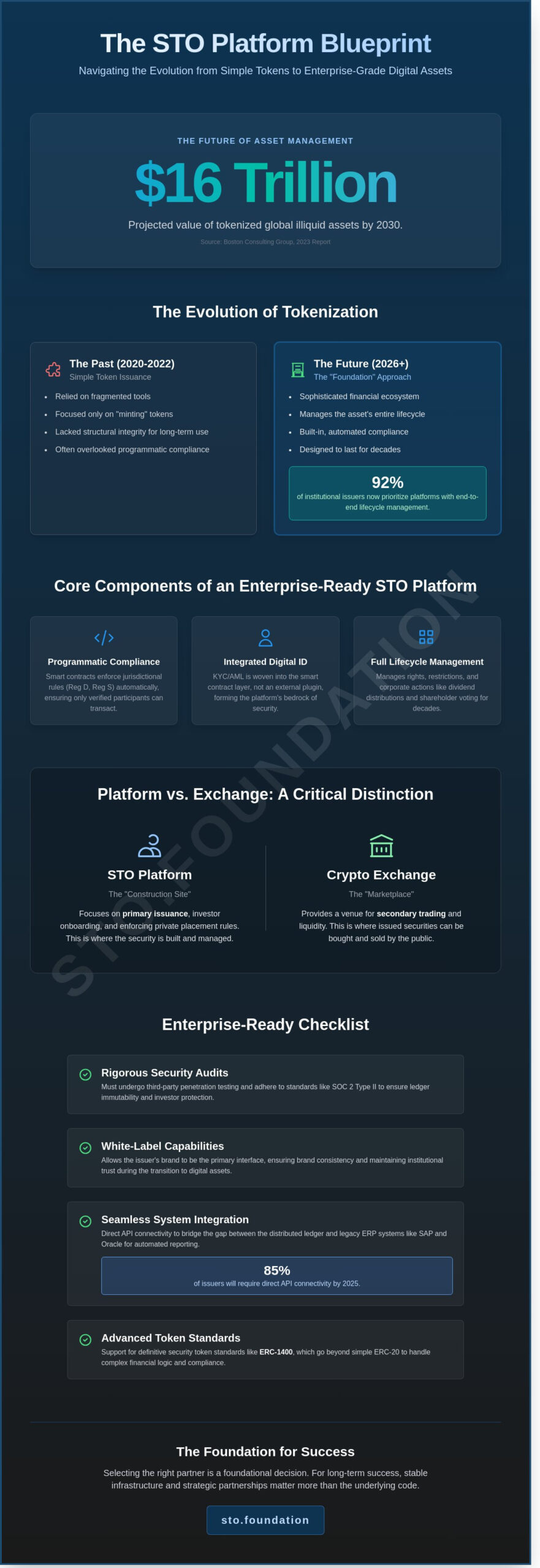
By 2026, the definition of a comprehensive sto platform has evolved from a mere technical utility into a sophisticated financial ecosystem. In the experimental 2020-2022 era, many issuers relied on fragmented tools to mint tokens. These early attempts often lacked the structural integrity required for long-term asset management. Today, the industry adheres to a “Foundation” approach, where the platform serves as the permanent architectural base for a security’s entire lifecycle. This shift reflects the 2024 regulatory updates that transitioned digital assets from the periphery to the center of institutional finance. To grasp the depth of these instruments, one must first understand the fundamental mechanics of What is a Security Token Offering (STO)? within this modern context.
A professional security token platform isn’t just a minter; it’s a steward of compliance and investor relations. While a simple minter creates a digital representation of an asset, a full-stack platform manages the complex rights, restrictions, and corporate actions associated with that asset. 92% of institutional issuers now prioritize platforms that offer end-to-end lifecycle management over isolated issuance tools. This preference stems from the need for sustainability. Assets tokenized in 2026 are built to last decades, requiring an infrastructure that can adapt to changing legal climates and technological upgrades without compromising the underlying security. For a comprehensive understanding of how security tokens are reshaping institutional capital markets, the regulatory mandates and strategic frameworks involved are essential reading for any serious issuer.
Core Components of a Compliant Issuance Infrastructure
Digital identity and KYC/AML integration form the platform’s bedrock. These aren’t external plugins but are woven directly into the smart contract layer to ensure that only verified participants can hold or transfer assets. In 2026, compliance is programmatic. Smart contracts are designed as specialized financial blueprints, enforcing jurisdictional rules automatically. The transfer agent plays a vital role here, acting as the bridge between decentralized ledgers and traditional legal registers to maintain an immutable and accurate cap table at all times.
STO Platform vs. Crypto Exchange: Why the Difference Matters
Distinguishing between an issuance platform and a secondary exchange is critical for regulatory clarity. The platform focuses on primary issuance, investor onboarding, and the enforcement of private placement rules. It’s the “construction site” where the security is built and managed. In contrast, an exchange provides the marketplace for liquidity. Selecting a robust sto platform requires a focus on investor protection mechanisms, such as recovery functions for lost keys and automated dividend distributions, which are unique to security environments and rarely found in standard crypto exchange architectures.
Evaluating Core Features: What Makes an STO Platform Enterprise-Ready?
The selection of an sto platform represents a foundational decision for any institution aiming to digitize its asset base. It’s not merely a software choice; it’s the implementation of a digital architecture that must support the weight of institutional capital. A robust platform provides the structural integrity required to transform illiquid assets into precise, tradable units. Security audits aren’t optional extras. They’re the cornerstone of trust. Enterprise-grade solutions undergo rigorous third-party penetration testing and adhere to SOC 2 Type II standards to ensure the ledger’s immutability.
White-label capabilities allow an organization to maintain its professional identity. This brand consistency is vital for established firms that have spent decades building a reputation for excellence. The platform should function as a silent partner, providing the technical engine while the issuer’s brand remains the primary interface for the investor. This continuity ensures that the transition from traditional finance to blockchain-based systems feels like an evolution rather than a disruption.
Integration with existing financial reporting and accounting software is a non-negotiable requirement. An enterprise-ready sto platform must bridge the gap between legacy ERP systems and the distributed ledger. By 2025, industry data suggests that 85% of institutional issuers will require direct API connectivity to platforms like SAP or Oracle. This connectivity ensures that fractional ownership data flows seamlessly into tax reports and balance sheets without manual intervention.
The Security Token Standard: Beyond Simple ERC-20
The ERC-1400 standard has emerged as the definitive blueprint for the next generation of digital assets. While ERC-20 tokens revolutionized simple transfers, ERC-1400 introduces the granular control necessary for regulated securities. By 2026, this standard will be the benchmark for sophisticated financial instruments because it allows for partially fungible tokens and document management within the smart contract itself.
Programmable compliance is the most critical feature of this architectural framework. It ensures that every transaction adheres to jurisdictional requirements automatically. This includes the integration of SEC Guidance for Security Token Offerings directly into the code. When compliance is hard-coded, the risk of human error in secondary market trading is virtually eliminated. Interoperability between institutional subnets and public blockchains further ensures that these assets remain liquid across different ecosystems.
Investor Management and Cap Table Automation
Managing thousands of fractional owners requires a level of precision that manual spreadsheets can’t achieve. Automation of dividend distributions and voting rights transforms the administrative burden into a streamlined digital process. Real-time cap table updates provide a transparent view of ownership at any given second, which is essential for maintaining the “Baukultur” of modern finance.
A seamless user experience is the bridge between technical complexity and investor participation. Non-technical users shouldn’t need to understand private keys or gas fees to participate in an offering. The platform’s interface must be intuitive, reflecting the same quality and care found in a well-designed architectural project. Organizations looking to master these digital structures can find additional resources through the foundational programs
The Step-by-Step Guide to Launching on an STO Platform
The transition from a tangible asset to a digital security requires a synthesis of intellectual rigor and technical precision. This journey isn’t merely a technological shift; it’s a structural evolution that demands coordination between legal counsel, technology providers, and strategic marketers. To ensure the integrity of the issuance, the project must move through a sequence of deliberate phases, mirroring the traditional craftsmanship of building a lasting architectural monument. A reliable sto platform serves as the digital foundation, providing the necessary tools to bridge the gap between theoretical planning and operational execution.
Phase 1: Asset Preparation and Legal Structuring
Success begins with the rigorous valuation of the underlying asset, whether it’s commercial real estate, corporate equity, or debt instruments. Real estate remains a dominant asset class, accounting for a significant portion of the tokenization market, which Boston Consulting Group projects will reach $16 trillion by 2030. Legal teams must draft a Private Placement Memorandum (PPM) that aligns with the specific rules of the chosen sto platform. This phase defines the tokenomics, including total supply, initial pricing, and the specific rights granted to investors. It’s the “head” of the project, where the intellectual framework is established to ensure long-term compliance and investor trust.
Phase 2: Technical Configuration and Minting
Once the legal architecture is settled, the “hand” of technical execution takes over. Developers upload regulatory requirements, such as jurisdictional restrictions and holding periods, directly into the platform’s smart contract engine. Using standards like ERC-3643 ensures that compliance is automated and immutable. Before the public launch, the minting process undergoes rigorous testing in a sandbox environment to simulate various market conditions. It’s vital to confirm that the platform integrates seamlessly with institutional-grade custody solutions, providing a secure environment for the digital assets before they reach the distribution phase.
Phase 3: Investor Onboarding and Distribution
The distribution phase focuses on the seamless transition of tokens to the investor’s control. The platform dashboard manages the KYC/AML whitelisting process, ensuring every participant meets regulatory standards. During the sale, the system handles automated fund collection and executes the delivery of tokens to verified wallets. These tokens carry embedded transfer restrictions, preventing secondary market trades that would violate the original legal framework. This automated stewardship maintains the project’s excellence by reducing human error in the distribution chain.
Post-launch management requires a “head and hand” approach to maintain the asset’s lifecycle. This includes managing corporate actions, distributing dividends, and facilitating secondary trading where applicable. Ongoing maintenance ensures the digital structure remains as robust as the day it was minted, reflecting the responsible and quality-oriented nature of professional asset management.
Regulatory Architecture: Integrating Reg D and Reg S Workflows
The core value of a sophisticated sto platform lies in its ability to transform legal prose into immutable code. Compliance isn’t a post-trade check; it’s a prerequisite for every transaction. By utilizing smart contracts, the platform ensures that tokens remain in the hands of authorized participants, preventing illicit secondary market transfers before they occur. This on-chain enforcement reduces the administrative burden on issuers and provides a transparent audit trail for regulatory bodies. It bridges the gap between theoretical legal frameworks and practical execution, ensuring that the “hand” of the technology follows the “head” of the legal strategy.
Automating Regulation D for US Accredited Investors
For offerings targeting US capital, Regulation D, particularly Rule 506(c), provides a clear framework for general solicitation. The platform automates the verification process, requiring investors to upload proof of income exceeding $200,000 annually or a net worth over $1 million, excluding their primary residence. Smart contracts enforce the mandatory 12-month lock-up period required under Rule 144. This ensures tokens can’t be traded or transferred until the holding period expires. Integrated marketing tools within the sto platform manage 506(c) compliance by tracking every touchpoint, ensuring that only verified accredited investors gain access to sensitive offering documents. This systematic approach mirrors the precision required in architectural planning, where every detail must meet strict safety standards.
Navigating Regulation S for Global Capital Markets
Expanding a capital raise to international markets requires strict adherence to Regulation S. The platform employs geofencing and IP-based restrictions to prevent US persons from accessing Reg S portals. Compliance logic within the smart contract handles different distribution compliance periods, which often last 40 days for debt or one year for equity. The system manages multiple currencies and stablecoin payments, automatically converting values to ensure investment limits aren’t exceeded. By integrating local European and Asian securities laws into the KYC/AML workflow, the platform creates a unified gateway for global liquidity. It simplifies the complexity of diverse jurisdictions, providing a stable foundation for international growth.
Reporting remains a critical pillar of regulatory standing. The platform simplifies SEC filings by generating automated reports for Form D and ongoing EDGAR requirements. This level of transparency fosters trust with regulators and investors alike. It’s not just about meeting a minimum standard; it’s about pursuing excellence in financial craftsmanship. Issuers who prioritize this level of structural integrity find themselves better positioned for long-term success in the digital asset space.
Selecting the Right Partner: Why Infrastructure Matters More Than Code
Choosing an sto platform requires looking beyond the immediate user interface. True digital architecture demands a fusion of theoretical excellence and practical craftsmanship. This philosophy, rooted in a tradition of stewardship, treats every tokenized asset as a structure that must endure for decades. It’s the difference between a temporary scaffold and a permanent foundation. When you select a partner, you’re not just buying a software license; you’re commissioning the digital bedrock of your financial future.
Evaluating long-term viability involves assessing the provider’s commitment to academic rigor. A platform built on hasty code will crumble under the weight of evolving regulations. Instead, prioritize partners who view blockchain architecture as a form of modern craftsmanship. They should demonstrate a clear bridge between the “head” of technical theory and the “hand” of practical implementation. This ensures that the infrastructure remains resilient as global markets shift toward full digitization. Institutions navigating this landscape can benefit from the STO Foundation’s definitive guide to institutional asset tokenization, which provides the rigorous infrastructure and regulatory clarity needed to transform real-world assets into compliant digital securities.
The Value of a Foundation-Led Ecosystem
A foundation-led ecosystem serves as a stable anchor for asset owners. Unlike venture-backed startups that may pivot or dissolve when market winds change, a non-profit foundation prioritizes the sustainability of the infrastructure. This structure fosters a mentor-mentee relationship rather than a purely transactional one. You’ll gain access to a community that values the holistic development of the industry. For a deeper exploration of how these principles apply to real-world assets, consult our Asset Tokenization Guide. This resource details the transition from traditional ownership to modern on-chain management.
Preparing for the Future of On-Chain Finance
Secondary market readiness is a prerequisite for any serious sto platform. By 2030, projections from organizations like the Boston Consulting Group suggest that tokenized assets could represent a $16 trillion market. Your infrastructure partner must provide the technical flexibility to interface with global exchanges and liquidity pools. Compliance isn’t a decorative feature; it’s the load-bearing wall of your offering. Integrating SEC-compliant protocols from day one protects your reputation and your investors’ capital. You can find specific technical requirements in our SEC STO Guide, which outlines the necessity of compliant digital securities.
Final Infrastructure Checklist:
- Institutional Integrity: Does the provider have a proven track record of ethical stewardship?
- Regulatory Adaptability: Is the code flexible enough to accommodate 2026 and 2027 legal updates?
- Interoperability: Can the tokens move seamlessly between different compliant ecosystems?
- Academic Rigor: Is the platform’s architecture peer-reviewed or based on established financial standards?
- Support Ecosystem: Does the partner offer ongoing mentorship or just a technical help desk?
Selecting a partner is a declaration of your values. By prioritizing craftsmanship and academic excellence, you ensure that your digital assets are built to last, providing security for the next generation of investors.
Architecting the Future of Digital Capital Markets
The evolution of asset tokenization in 2026 demands a shift from experimental code to resilient financial architecture. Selecting an enterprise-ready sto platform isn’t merely a technical choice; it’s a strategic commitment to institutional-grade standards. Successful issuers prioritize the seamless integration of Reg D and Reg S workflows to ensure cross-border compliance. According to the 2024 Global Tokenization Study, 82% of institutional investors now mandate automated regulatory oversight before committing capital. By bridging the gap between traditional financial craftsmanship and digital innovation, your organization can unlock liquidity while maintaining the highest levels of structural integrity.
Building this foundation requires a partner that values the connection between technical theory and market practice. The STO Foundation provides a mentoring-led approach to digital capital markets, ensuring every issuance reflects the excellence of professional architecture. Our infrastructure is built on institutional-grade on-chain blockchain standards, designed to support the next generation of global finance with precision. We’ve refined these processes to help you navigate the complexities of the current regulatory landscape with confidence.
Explore the STO Foundation Infrastructure
We’re ready to help you build a legacy of digital excellence.
Frequently Asked Questions
What is the typical cost of implementing an STO platform?
Implementation costs for an sto platform typically range from $50,000 to $250,000 according to 2023 industry benchmarks from BCG. These figures cover the core technical architecture and smart contract deployment. Additional expenses for legal structuring and marketing often add $100,000 to $300,000 to the total budget. It’s essential to view these costs as an investment in a robust digital foundation for long-term asset management.
How long does it take to go from asset valuation to token launch?
The transition from asset valuation to a live token launch generally requires 3 to 9 months of dedicated preparation. This timeline includes 4 weeks for initial valuation, 8 weeks for legal framework development, and 6 weeks for technical integration. Projects involving complex real estate portfolios or multi-jurisdictional compliance often extend toward the 12-month mark. Precise planning ensures the structural integrity of the offering remains intact throughout the process.
Can an STO platform handle both retail and institutional investors?
A professional sto platform manages both retail and institutional investors by utilizing automated whitelisting and tiered access controls. Institutional participants often require specific KYC/AML protocols that differ from the simplified onboarding used for retail backers. By implementing distinct smart contract permissions, the system ensures that 100% of transactions adhere to the specific regulatory limits of each investor class. This dual-capability fosters a diverse and resilient funding environment.
Is it possible to migrate from one STO platform to another later?
Migration between platforms is achievable through the redeployment of smart contracts or the use of interoperable standards like ERC-3643. While 85% of security tokens currently utilize the Ethereum network, moving to a new provider requires a coordinated snapshot of the ledger to ensure continuity. It’s a technical procedure that demands rigorous testing to maintain the 1:1 parity between digital tokens and the underlying physical assets.
What happens if the platform provider goes out of business?
Investors retain ownership of their assets even if a provider ceases operations because the ownership records exist independently on a decentralized ledger. The underlying legal rights are tied to the smart contract, not the provider’s corporate entity. For instance, if a firm using the ERC-1400 standard fails, the 24/7 availability of the blockchain ensures that the tokenized shares remain verifiable and transferable through any compatible interface.
Do I still need a lawyer if the platform automates compliance?
Legal counsel remains indispensable because automated systems only execute the rules that human experts define. While software handles 90% of the operational compliance tasks, a qualified attorney must verify that the underlying prospectus aligns with local securities laws, such as the EU’s MiCA regulation or the US SEC guidelines. Technology serves as a tool for efficiency, but the legal framework provides the necessary moral and ethical foundation for the project.
Which blockchain is best for a professional STO platform in 2026?
Ethereum and its Layer 2 scaling solutions remain the primary choice for professional deployments heading into 2026. Data from DeFi Llama shows Ethereum controls over 70% of the total value locked in smart contract platforms, providing the deepest liquidity and most mature developer ecosystem. For projects requiring lower transaction costs, Polygon or specialized chains like Polymesh offer tailored features for institutional-grade compliance and high-speed settlement.
How does an STO platform handle dividend payments for tokenized real estate?
The digital system automates dividend distributions by triggering smart contract payments directly to the wallets of verified token holders. If a commercial property generates a 5% annual yield, the system calculates the exact pro-rata share for each of the 500 or 5,000 investors based on their holdings at the time of the snapshot. This process eliminates manual accounting errors and reduces administrative overhead by approximately 60% compared to traditional distribution methods. Institutions seeking a deeper understanding of how security tokens function as regulated digital securities will find the full institutional framework and compliance requirements essential for navigating this evolving landscape.