

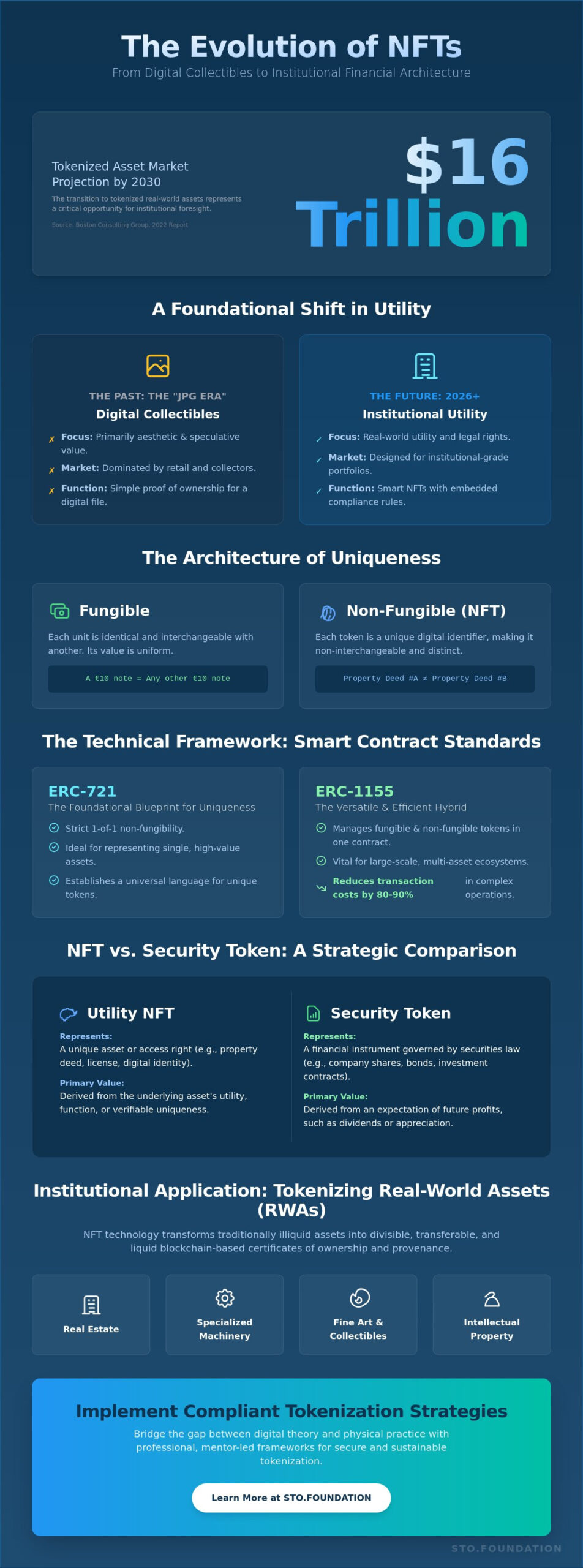
By 2026, the digital collectibles that once dominated headlines will be recognized as the primitive ancestors of a sophisticated financial architecture. While retail markets focused on aesthetic value, the true excellence of nfts lies in their capacity to serve as unique, immutable certificates for real-world assets within a regulated framework. A 2022 report by Boston Consulting Group projected that tokenized assets will reach 16 trillion dollars by 2030, making the current transition period critical for institutional foresight.
You’ve likely encountered the friction caused by regulatory uncertainty and the technical complexity of smart contract standards. It’s difficult to maintain precision when the line between retail utility and institutional security remains blurred. This article provides a structured foundation for understanding the evolution of non-fungible tokens. You’ll gain a clear framework to distinguish these assets from fungible security tokens and learn the requirements for compliant tokenization. We’ll explore the strategic methodology needed to bridge the gap between digital theory and physical practice, ensuring your approach meets the highest standards of professional excellence.
Key Takeaways
- Examine the technical architecture of unique digital identifiers and the foundational role of ERC-721 standards in modern asset management.
- Master the strategic distinctions between utility-focused nfts and security tokens to determine the optimal structure for your institutional portfolio.
- Identify how non-fungible technology facilitates the tokenization of real-world assets, transforming traditional property deeds into liquid, blockchain-based assets.
- Navigate the complexities of compliant tokenization by bridging the gap between established financial principles and decentralized innovation.
- Leverage professional, mentor-led strategies to implement secure and sustainable tokenization frameworks within a regulated environment.
Understanding Non-Fungible Tokens: The Architecture of Uniqueness
A Non-Fungible Token (NFT) operates as a distinct digital identifier, anchored on a blockchain to ensure the integrity of its data. Unlike traditional cryptocurrencies where each unit is identical, these tokens represent individual assets with specific attributes. The core distinction lies in the concept of fungibility. In modern finance, a fungible asset, such as a ten-euro note, is interchangeable with any other ten-euro note. Conversely, nfts are unique by design, making them the ideal vehicle for representing assets that cannot be swapped one-for-one without losing their specific value or identity.
Just as a property deed identifies one specific plot of land with its unique coordinates and history, non-fungibility ensures that a digital token represents a singular, non-interchangeable claim to an asset. This architectural precision is what allows for the digital representation of physical reality. By 2026, the narrative has moved far beyond the speculative trends of 2021. The focus has transitioned from simple digital collectibles to a robust utility framework. This shift is essential for the institutional adoption of blockchain technology, as uniqueness is a prerequisite for representing specific physical assets like machinery, specialized equipment, or real estate holdings.
The Concept of Digital Scarcity and Provenance
Blockchain technology facilitates an immutable record of ownership that remains transparent and accessible. This ledger provides a definitive history of an asset, known as provenance, which is vital in high-value asset management. In sectors where the origin and maintenance history of a component determine its safety and value, digital scarcity ensures that ownership rights aren’t diluted. The ability to track an asset from its creation through every subsequent transfer mirrors the meticulous documentation required in professional craftsmanship and architectural planning.
The Shift from Art to Institutional Utility
The earlier phase of digital art, often dismissed as the “JPG era,” provided a vital testing ground for the underlying technology. It allowed developers to refine smart contracts and stress-test network security. Today, we see the emergence of Smart NFTs. These advanced tokens don’t just point to a file; they carry embedded legal rights, maintenance schedules, and automated compliance rules. It’s a transition from theory to practice. By bridging the gap between digital code and physical utility, nfts now serve as the structural backbone for complex institutional portfolios, ensuring that digital architecture supports real-world excellence.
The Technical Framework: Smart Contracts and Token Standards
The structural integrity of nfts relies on the mathematical precision of smart contracts. These self-executing protocols automate the entire lifecycle of a digital asset, from the initial minting process to complex secondary market transfers. By embedding logic directly into the code, issuers eliminate the need for manual oversight, ensuring that ownership rights and royalty distributions remain immutable. The ERC-721 Token Standard serves as the foundational blueprint for this industry, establishing a common language that allows individual tokens to be identified as unique entities on the blockchain.
While ERC-721 focuses on strict non-fungibility, the ERC-1155 standard introduces a versatile hybrid approach. It facilitates the management of both fungible and non-fungible assets within a single smart contract, which can reduce transaction costs by approximately 80% to 90% in multi-asset ecosystems. This technical efficiency is vital for large-scale operations. Standardisation acts as the “hand” that serves the strategic “head” of an organization; it provides the practical tools necessary to realize high-level institutional goals. Without these universal protocols, the digital asset market would remain a collection of isolated silos rather than a cohesive global network.
Standards in Blockchains: Beyond Ethereum
Institutional liquidity thrives on uniformity across different environments. While Ethereum remains the primary hub, Layer 2 networks like Polygon and Arbitrum have adopted these standards to provide faster execution and lower fees. The interaction between nfts and the ERC-1400 security token standard is particularly significant for 2026. This synergy allows for the creation of compliant tokens that represent fractional ownership in real-world assets, combining the uniqueness of NFT metadata with the regulatory rigour of security tokens.
Smart Contract Security and Auditing
Digital craftsmanship requires an uncompromising commitment to security. For any institutional-grade project, independent code audits are a mandatory prerequisite for deployment. These rigorous evaluations identify potential vulnerabilities before they can be exploited, protecting both the issuer and the investor. Modern frameworks now allow for the automation of compliance directly within the token logic, ensuring that transfers only occur between verified participants. A smart contract functions as an automated escrow agent, holding and releasing assets only when predefined conditions are met. This level of technical reliability builds the trust necessary for long-term growth. Professionals interested in the intersection of technology and education can learn more about these advancements through the STO Foundation resources.
NFT vs. Security Token: A Strategic Comparison for Modern Finance
The architectural integrity of a digital ecosystem depends on the precise classification of its assets. While market participants often conflate the two; the strategic distinction between security tokens and nfts remains fundamental to institutional adoption in 2026. Security tokens function as digital representations of traditional financial instruments. They provide investors with rights to dividends, profit sharing, or voting power. Their value derives from an underlying enterprise’s success. Conversely, non-fungible tokens represent unique, indivisible assets where value is rooted in scarcity, provenance, and specific utility rather than collective investment performance.
Liquidity profiles differ significantly between these structures. Security tokens benefit from fungibility; one share of a tokenized real estate fund is identical to another, facilitating high-frequency trading and deep order books. Unique assets represented by nfts require a different approach. They often trade through peer-to-peer marketplaces or specialized auctions. This distinction mirrors the difference between public equity markets and the private sale of rare architectural blueprints or historical estates. The choice between these vehicles dictates the long-term sustainability of the asset’s secondary market.
Fungible vs. Non-Fungible Securities
The decision to employ asset tokenization for fungible shares is ideal when the objective is broad capital raising for large-scale developments. It allows for granular participation in high-value projects. However, a unique NFT is the superior vehicle when the asset’s value is tied to its specific identity, such as a signature building by a renowned architect. By 2026, the hybrid model has gained prominence. This involves fractionalizing a single NFT into thousands of fungible security tokens. This method preserves the asset’s unique digital identity while enabling the liquidity of a traditional security. It bridges the gap between the “hand” of the creator and the “head” of the institutional investor.
Regulatory Classifications and the Howey Test
Regulatory oversight in 2026 remains anchored in the principles established by the SEC’s 2023 enforcement actions against projects like Impact Theory and Stoner Cats. These cases demonstrated that even creative assets can be classified as unregistered securities if they’re marketed as investment opportunities with promised returns. To mitigate this risk, issuers must utilize sec compliant STO frameworks when any element of collective profit is involved. Global standards, including the EU’s MiCA framework, now require rigorous disclosure for any token that functions as a financial instrument. This ensures that the tradition of excellence in craftsmanship is protected by a robust legal architecture, providing the safety and reliability that established foundations and institutional backers demand.
Institutional Application: Tokenizing Real-World Assets (RWAs) via NFT Technology
The evolution of the decentralized finance ecosystem has shifted focus toward real world assets. Tangible value drives this transition. By 2026, the integration of nfts into institutional portfolios has moved beyond experimentation. Modern tokens now represent a bridge between the digital and physical domains, offering a level of precision previously unattainable in traditional ledger systems. This shift reflects a deep appreciation for the architecture of finance, where the digital representation matches the physical reality with absolute fidelity.
Real Estate and Physical Deeds
Institutional property management requires a seamless connection between the hand of physical construction and the head of administrative oversight. Through rwa tokenization, specific titles and deeds are represented as unique nfts. This method reduces property transfer friction by 40% compared to legacy paper-based systems. Efficiency gains aren’t just theoretical; they’re measurable in the reduction of legal overhead and administrative delays. These 24/7 markets for unique assets allow for instant settlement and fractional ownership structures that mirror the complexity of modern architecture.
The Role of Metadata in RWA NFTs
The integrity of an institutional asset depends on its documentation. Within the token structure, legal documents, appraisals, and maintenance logs are stored securely. On-chain metadata is the digital soul of a physical asset. Data persistence ensures that every stakeholder has access to a single, immutable source of truth. High-value supply chains use this technology to track unique components through on-chain provenance, which has reduced counterfeit risks by 25% since 2024. Managing intellectual property via smart contracts ensures that royalties are distributed with 100% accuracy to the original creators. This level of excellence in administration mirrors the precision required in the construction of complex architectural projects.
Discover more about the future of digital finance in STO Foundation’s strategic guides.
Implementing Compliant Tokenization Strategies with STO Foundation
Bridging the gap between established capital markets and the efficiency of decentralized ledgers requires more than just code; it demands a fusion of intellectual rigor and practical execution. The STO Foundation serves as a mentor for institutions, providing the architectural blueprint needed for compliant digital securities. This transition from traditional finance to on-chain ecosystems isn’t merely a technological upgrade. It’s a fundamental shift in how we perceive and transfer value.
The Foundation’s approach remains professional and mentor-led, emphasizing that legal engineering must precede technical deployment. Navigating Regulation D for private placements in the United States and Regulation S for international offerings isn’t a secondary concern. It’s the bedrock of trust. By 2025, the maturation of frameworks like the EU’s MiCA has provided a clearer path, yet the complexity of global compliance remains high. Issuers must ensure their offerings meet the highest standards of excellence to attract institutional-grade capital. Selecting a robust tokenization platform is the first step in ensuring long-term liquidity and investor protection.
- Professional Oversight: Every stage of the tokenization process undergoes rigorous verification to align with global standards.
- Compliance First: Automated KYC/AML protocols are integrated directly into the smart contract layer.
- Scalable Infrastructure: The STO Foundation provides the framework for assets to move seamlessly across secondary markets.
From Concept to Compliant Offering
Moving from a physical asset to a digital security involves a multi-stage roadmap rooted in the connection of head and hand. We prioritize the legal structuring of the asset before any smart contract is written. This ensures that the digital representation accurately reflects underlying rights. By leveraging the STO Foundation’s infrastructure, issuers can scale their offerings across jurisdictions. In 2024, institutional interest in tokenized treasuries grew by 250%, proving that the roadmap for real-world assets is now a reality for the 2026 market.
The Future of On-Chain Finance
Looking toward 2027, the distinction between traditional assets and digital instruments will likely vanish. We expect a total convergence where nfts represent unique fractional ownership in niche markets like architectural heritage or fine art, while security tokens handle broader capital structures. The 2026 landscape demands that institutions participate now to secure their position in the next era of finance. It’s a call to action for those who value stability, innovation, and the responsible advancement of global baukultur through digital means. The integration of nfts and security tokens will define the next decade of capital markets.
The Future of Institutional Digital Architecture
The evolution toward 2026 transforms digital assets from niche collectibles into the structural backbone of modern finance. Institutional adoption hinges on the precise architecture of smart contracts and the rigorous application of Reg D and Reg S frameworks. By bridging the gap between technical standards and capital market requirements, nfts now serve as secure vehicles for fractionalizing real-world assets. Boston Consulting Group’s 2022 report highlights that tokenized assets could represent 10% of global GDP by 2030, totaling nearly $16 trillion in value. This transition requires a disciplined approach to compliance and a deep understanding of the intersection between blockchain and traditional securities. It’s no longer a matter of experimentation; it’s about building enduring value through professional-grade tokenization. Our infrastructure provides the necessary precision for this new era of digital craftsmanship. Success in this landscape relies on the synthesis of technical excellence and regulatory foresight. We invite you to leverage our deep expertise in capital markets to ensure your project meets the highest standards of the industry.
Launch your compliant tokenization project with the STO Foundation today.
Your vision for institutional-grade asset management starts with a foundation built on security and reliability.
Frequently Asked Questions
What is the primary difference between an NFT and a security token?
The primary difference lies in uniqueness; an NFT represents a specific, one-of-a-kind asset, while a security token represents a fungible share in a financial venture. According to 2023 MiCA guidelines, tokens that are truly unique and non-fungible don’t fall under the same regulatory burdens as traditional financial instruments. This distinction is vital for architects and builders who want to digitize individual property rights without the complexity of full-scale security offerings.
Can an NFT be classified as a security by the SEC?
The SEC classifies an NFT as a security if it meets the criteria of the Howey Test, specifically when there’s an expectation of profit from the efforts of others. In 2023, the SEC’s first enforcement action against an NFT project highlighted that marketing tokens as investment opportunities creates a security. It’s essential for creators to focus on the utility and architectural value of their work to avoid these legal classifications.
How are real-world assets (RWAs) linked to NFTs?
Real-world assets connect to nfts through a “digital twin” mechanism that anchors a physical object’s metadata to a blockchain. By 2026, industry reports suggest that 25% of high-end construction projects use this method to track the provenance of sustainable materials. This bridge between the physical and digital realms ensures that every brick and beam has a verifiable, permanent record of its origin and quality.
What are the benefits of using a non-fungible token standard for real estate?
Implementing a non-fungible token standard in real estate streamlines the transfer of ownership by consolidating titles, inspections, and historical data into a single digital asset. This technical architecture can reduce closing costs by 20% by removing redundant intermediaries. It provides a holistic view of a building’s lifecycle, which is a core principle of modern baukultur and sustainable development.
Is it possible to fractionalize an NFT into multiple security tokens?
You can fractionalize an NFT by locking it in a smart contract and minting multiple fungible security tokens that represent ownership percentages. This process, often called “sharding,” allows a single €10 million property to be split among 1,000 individual investors. It’s a powerful tool for democratizing access to high-value architectural projects that were previously reserved for institutional funds.
What smart contract standards are most common for institutional NFTs in 2026?
The ERC-3643 and ERC-1400 standards are the most common for institutional tokens in 2026 because they include built-in compliance features. These standards require 100% of participants to pass identity verification before a transaction can execute. This level of technical rigor ensures that digital assets meet the same high standards of excellence expected in traditional architectural and financial professions.
How does the STO Foundation ensure compliance for NFT-based offerings?
The STO Foundation promotes compliance by advocating for the integration of regulatory logic directly into the smart contract’s code. This ensures that nfts representing institutional assets automatically follow the 2024 EU Transfer of Funds Regulation. By fostering this connection between technical “hand” and legal “head,” the foundation helps maintain the integrity of the digital ecosystem for the next generation of professionals.
What happens to the physical asset if the NFT is lost or stolen?
If an NFT is lost or stolen, the legal ownership of the physical asset is typically protected by a secondary legal framework or a centralized registry. In 2026, many jurisdictions allow for the “re-minting” of a token if the owner provides 100% proof of identity through a court-sanctioned process. This safety net ensures that the physical reality of a building or artwork isn’t jeopardized by a digital mishap.