The era of stagnant, illiquid capital is ending as the $16 trillion market for tokenized assets by 2030, projected by Boston Consulting Group, prepares to reshape the foundations of global finance. This transformation represents a fundamental shift in how we perceive and manage real world assets through a lens of digital excellence and structural integrity. For those rooted in the traditions of real estate and capital development, the complexity of blockchain often feels like a barrier rather than a bridge. You’ve likely encountered the frustration of high capital costs and the rigid illiquidity that tethers valuable assets to local markets.
We understand these challenges and believe that the future of asset management requires a synthesis of proven craftsmanship and technological progress. This definitive guide illuminates the path toward compliant digital securities, ensuring you can unlock global liquidity and fractional ownership with precision. We’ll explore the mechanics of on-chain integration, analyze the regulatory pathways of Reg D and Reg S, and provide a clear roadmap for your tokenization journey.
Key Takeaways
- Understand the fundamental shift from speculative cryptocurrencies to asset-backed digital securities that represent tangible, high-value investments.
- Learn the rigorous legal and technical steps required to move physical assets on-chain through valuation and Special Purpose Vehicles.
- Discover how the tokenization of real world assets unlocks global liquidity and democratizes access through fractional ownership models.
- Navigate the essential regulatory frameworks, such as Regulation D, to ensure your digital security offering remains compliant and secure.
- Master the “Head and Hand” philosophy to transition from theoretical interest to the practical execution of a robust tokenization strategy.
What Are Real World Assets (RWAs) in the Digital Economy?
Real world assets (RWAs) represent the architectural bridge between traditional capital markets and distributed ledger technology. These digital instruments function as on-chain representations of tangible or financial assets, ranging from residential property to government debt. While early digital currencies relied on speculative demand, RWAs provide a structural foundation backed by physical collateral or legal claims. This transition mirrors the evolution of securitization in the 1970s, but with the added precision of programmable code. It’s a shift from paper-based registries to a dynamic, 24/7 global ledger.
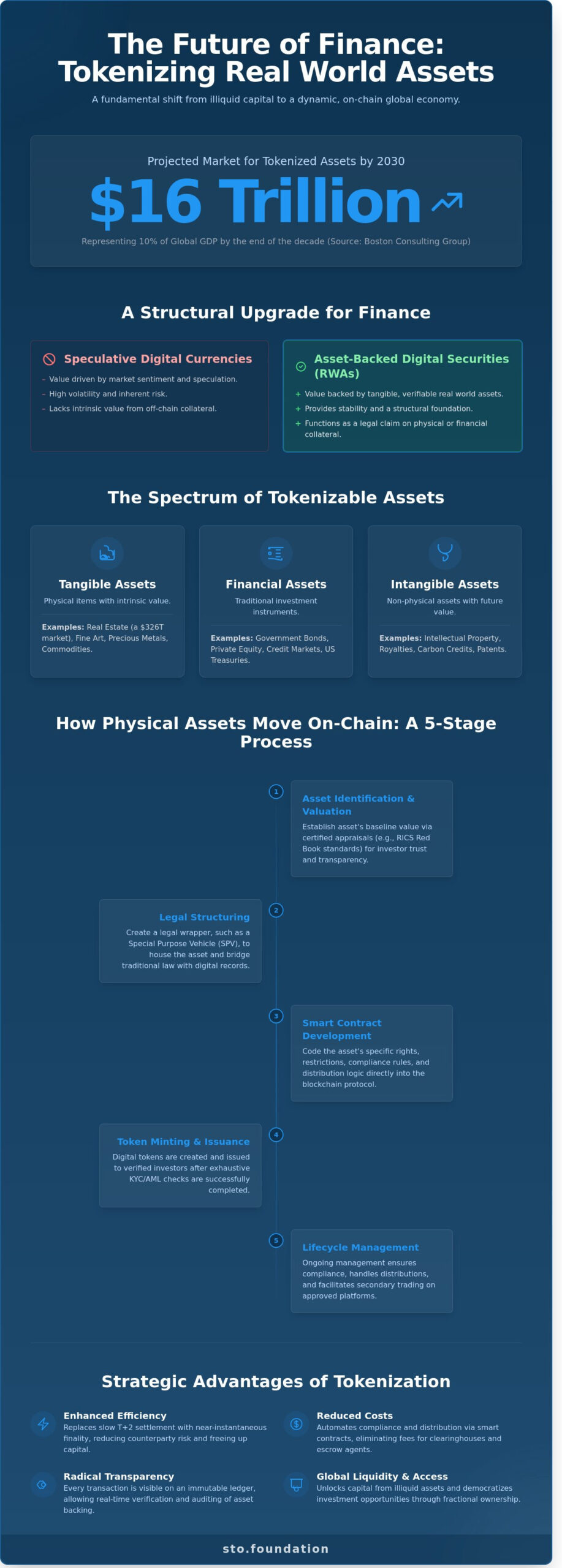
The market potential for this integration is vast. Analysts at Boston Consulting Group (BCG) and 21Shares project that the tokenization of global illiquid assets will reach $16 trillion by 2030. This figure represents approximately 10% of global GDP, signaling a total transformation of how value is stored and transferred. Institutional leaders have already begun laying the groundwork; for instance, BlackRock’s BUIDL fund reached $500 million in assets under management within four months of its March 2024 launch. This momentum proves that the appetite for asset-backed digital securities isn’t a passing trend but a fundamental redesign of financial infrastructure.
The Spectrum of Tokenizable Assets
The scope of tokenization spans three primary categories, each offering unique opportunities for diversification and liquidity:
- Tangible assets: This includes real estate, which accounts for a $326 trillion global market, alongside fine art, precious metals, and industrial commodities.
- Financial assets: Government bonds, private equity, and credit markets are migrating on-chain to enhance accessibility. US Treasuries have become a leading use case, providing a “risk-free” yield to digital native investors.
- Intangible assets: Intellectual property, royalties, and carbon credits benefit from the immutable tracking of ownership. These assets often suffer from fragmentation, a problem blockchain’s unified ledger solves effectively.
Why the Shift to On-Chain Finance is Inevitable
Legacy systems rely on fragmented databases that don’t communicate well. Moving finance on-chain addresses these deep-seated inefficiencies by replacing manual reconciliations with automated protocols. Current settlement cycles in traditional finance often require two business days (T+2) to finalize. Blockchain technology achieves near-instantaneous finality, reducing counterparty risk and freeing up capital that would otherwise be trapped in transit. It’s a more efficient way to build a global economy.
This structural upgrade eliminates the “middleman tax” by automating compliance and distribution through smart contracts. Fees that typically go to clearinghouses or escrow agents are significantly reduced. Transparency becomes a built-in feature rather than an afterthought. Since every transaction remains visible on a public or permissioned ledger, auditors and investors can verify asset backing in real-time. This level of clarity provides the security and reliability essential for global capital markets to scale with integrity.
The Mechanism of Tokenization: How Physical Assets Move On-Chain
Converting a tangible object into a digital representation involves a rigorous five-stage methodology rooted in technical precision and legal integrity. The process begins with Asset Identification and Valuation. Professionals establish the baseline value of the underlying real world assets through certified appraisals; for example, adhering to the 2024 RICS Red Book standards ensures global transparency and trust for potential investors.
Legal Structuring follows this initial assessment. This phase involves creating a Special Purpose Vehicle (SPV) or a legal wrapper to house the asset. In 2021, Luxembourg’s Blockchain Act II solidified the legal standing of such structures, allowing entities to issue securities directly on a ledger. This bridge between traditional law and digital records provides the necessary security for institutional participation. Once the legal framework is established, Smart Contract Development begins. Developers code the specific rights, restrictions, and distribution logic into the blockchain protocol.
The final operational stages involve Token Minting and Issuance followed by Lifecycle Management. Minting occurs only after exhaustive KYC and AML checks are completed for all participants. Post-issuance management ensures that compliance remains active throughout the asset’s lifespan, handling tasks like automated dividend distributions and tax reporting. This structured approach ensures that excellence in financial stewardship matches the physical integrity of the assets themselves.
The Role of Smart Contracts in RWA Management
Smart contracts function as the digital engine for real world assets by automating complex corporate actions. These protocols handle voting rights and profit distributions without the need for manual intermediaries. By utilizing the ERC-1400 standard, issuers can hard-code secondary market restrictions directly into the token. This ensures that assets only move between verified wallets, maintaining 100% regulatory compliance in real-time. This automation reduces administrative overhead by an estimated 30% compared to traditional paper-based systems.
Bridging the Data Gap with Oracles
Blockchains are closed systems that cannot natively access external information. Oracles bridge this gap by providing verified data feeds regarding the physical state of the asset. The implementation of Proof of Reserve (PoR) protocols allows investors to verify that tokens remain fully backed by the underlying collateral at all times. By maintaining a single source of truth between physical registries and digital ledgers, oracles prevent discrepancies and enhance the overall reliability of the tokenized ecosystem. This technical bridge is essential for maintaining the long-term value and stability of the digital representation.
Strategic Advantages: Why Enterprises are Tokenizing RWAs
The transition toward on-chain systems reflects a commitment to structural excellence and capital efficiency. Enterprises aren’t simply adopting new software; they’re re-engineering the foundations of value exchange. By 2030, tokenized real world assets are projected to constitute a $16.1 trillion market according to research from the Boston Consulting Group. This growth stems from the ability to unlock liquidity in sectors that have remained stagnant for decades, such as commercial real estate or infrastructure projects.
Traditional markets operate within rigid, localized hours. On-chain environments provide 24/7 global access, ensuring that capital isn’t restricted by time zones or bank holidays. This constant availability increases market depth. It also provides a public ledger where every ownership transfer is recorded with absolute precision. This transparency creates a “golden record” of truth, which simplifies audits and reduces the risk of fraudulent claims. It’s a more reliable way to manage value.
- Instant Settlement: Reducing settlement times from T+2 days to near-instantaneous finality via smart contracts.
- Global Reach: Connecting capital from over 190 countries without the friction of traditional intermediary banks.
- Immutable Auditing: Providing a verifiable, chronological history for regulatory compliance and stakeholder trust.
Fractional Ownership and Market Democratization
Tokenization breaks high-value assets into smaller, manageable units. A $50 million commercial building that previously required a $1 million minimum entry can now be accessed with a $1,000 investment. This shift expands the investor pool significantly. It moves the market beyond institutional silos to include global accredited investors. This change isn’t just financial; it’s psychological. Investors now perceive ownership as a fluid, digital right rather than a static, paper-heavy burden. It’s about opening doors that were once locked by high capital barriers.
Operational Efficiency and Cost Reduction
Administrative overhead often consumes 20% to 30% of an investment fund’s operational budget. Blockchain technology automates these processes. Smart contracts handle AML and KYC checks automatically, ensuring compliance is baked into the asset itself. This automation simplifies cap table management for complex offerings with thousands of participants. Direct-to-investor models eliminate traditional brokerage fees, which can save issuers up to 40% in total distribution costs. It’s a leaner, more precise way to manage the lifecycle of real world assets while maintaining the highest standards of professional integrity.
Navigating the Regulatory Landscape: Compliance as a Foundation
The transition of real world assets onto the blockchain demands a shift from experimental “sandboxes” to rigorous, institutional-grade frameworks. This evolution is rooted in the recognition that most tokenized assets function as digital securities. They represent fractional ownership in tangible or financial interests, which places them directly under the jurisdiction of global financial regulators. Establishing a “compliance-first” architecture is the only way to ensure the longevity and legitimacy of the ecosystem. This approach mirrors the precision required in traditional structural engineering; without a solid legal base, the entire digital edifice risks collapse.
Effective identity management serves as the primary gatekeeper for these systems. Issuers must implement robust Anti-Money Laundering (AML) and Know Your Customer (KYC) protocols to verify every participant. In a 2023 study by BNY Mellon, 97 percent of institutional investors identified “clear regulatory frameworks” as the most critical factor for adopting tokenization. Verification processes often extend to confirming “Accredited Investor” status, ensuring that participants possess the financial sophistication and capital necessary to manage the risks associated with private placements.
SEC Frameworks for Security Token Offerings (STOs)
In the United States, the Securities and Exchange Commission (SEC) relies on the Howey Test, a standard established in 1946, to determine if an asset is an investment contract. Most developers now favor Regulation D (Reg D), specifically Rule 506(c). This rule allows for general solicitation while requiring that all purchasers be verified accredited investors. For those looking to reach a global audience, Regulation S (Reg S) provides a safe harbor for offerings made to investors outside the US. These frameworks provide the necessary legal certainty that institutional capital requires before committing to real world assets.
The Importance of Global Regulatory Harmonization
Jurisdictions are moving at different speeds to codify these digital shifts. The European Union’s Markets in Crypto-Assets (MiCA) regulation, which entered its final stages of implementation in June 2023, provides a comprehensive roadmap for the region. Meanwhile, financial hubs in Singapore and Hong Kong have established clear licensing regimes for broker-dealers and custodians. These intermediaries are essential; they act as the bridge between decentralized ledgers and traditional finance. As frameworks evolve to integrate with decentralized finance (DeFi) protocols, the focus remains on maintaining the same level of investor protection found in legacy markets.
Success in this sector requires a deep understanding of both technical architecture and legal requirements. Learn how to build a compliant architectural framework for tokenization to ensure your projects stand the test of time.
Implementing Your RWA Strategy: The STO Foundation Approach
Transitioning from the theoretical potential of real world assets to practical, on-chain execution requires a disciplined synthesis of intellectual rigor and technical mastery. We call this the “Head and Hand” philosophy. It represents the vital connection between the academic architecture of finance and the practical craftsmanship of blockchain engineering. Success in this sector isn’t born from speculation. It’s built through structured, professional implementation that respects both the tradition of the craft and the possibilities of the future.
The 2024 financial landscape demands more than just a successful token launch. Research from Roland Berger suggests that tokenized assets will represent a $10 trillion market by 2030. To capture this value, your strategy must encompass the entire asset lifecycle. This includes issuance, ongoing corporate actions, dividend distributions, and the final redemption phase. Focusing only on the initial offering is a mistake that leads to technical debt. A holistic approach ensures the long-term sustainability and excellence that institutional investors expect from modern capital markets.
Choosing the Right Tokenization Platform
Your choice of infrastructure defines the integrity of your digital securities. Technical criteria must prioritize security, scalability, and interoperability. We recommend utilizing the ERC-3643 standard, which integrates decentralized identity directly into the token layer to ensure only qualified investors can hold the asset. Regulatory compliance is the foundation of trust. With the EU’s MiCA regulation becoming fully applicable in December 2024, your platform must provide automated workflows for KYC, AML, and tax reporting. Expert guidance is essential here. Think of your provider as a mentor who guides you through the technical maze and legal hurdles of the digital age, ensuring your project stands on a firm, compliant foundation. For organizations seeking institutional-grade security and rigorous compliance, evaluating tokenization platform infrastructure requires careful analysis of technical architecture and regulatory frameworks.
Building a Future-Proof Digital Security Offering
A robust offering must integrate seamlessly with existing financial systems. Your digital tokens shouldn’t be isolated. They need to communicate with internal ERP systems to ensure real world assets stay accurately represented on the ledger in real-time. Preparation for secondary markets is the next logical step for any serious issuer. By 2025, liquidity will concentrate on regulated venues like the SIX Digital Exchange or Archax. Ensuring your tokens are technically compatible with these venues from the start is a mark of quality. It provides the exit pathways and liquidity that modern investors demand. This forward-thinking approach transforms a simple token into a sophisticated financial instrument capable of lasting value creation. For organizations ready to implement comprehensive RWA tokenization strategies, understanding the complete lifecycle from asset valuation to secondary market integration is essential for long-term success.
Discover how STO Foundation can help you tokenize your real-world assets
Architecting the Next Era of Capital Markets
The shift toward on-chain finance marks a definitive evolution in how global markets value physical holdings. By converting real world assets into fractionalized digital securities, organizations bridge the gap between traditional asset management and modern liquidity. This transformation requires a synthesis of theoretical precision and practical execution, reflecting the essential connection between the head and the hand. Success isn’t accidental; it’s the result of rigorous adherence to SEC-compliant frameworks, specifically Regulation D and Regulation S, which provide the legal certainty required for 2024 institutional standards.
Navigating this complex landscape demands a partner who understands the intricate architecture of capital markets. STO Foundation provides the institutional-grade infrastructure and expert-led mentoring needed to transform physical value into streamlined digital instruments. Our framework ensures your project benefits from a foundation built on security and professional integrity. It’s time to elevate your financial strategy with a team dedicated to the holistic development of the tokenization ecosystem. We’re ready to help you build a legacy of excellence in the digital economy.
Launch your compliant Security Token Offering with STO Foundation
Frequently Asked Questions
What is the difference between an RWA and an NFT?
Real world assets differ from NFTs because they represent ownership in tangible or financial items with intrinsic value, whereas NFTs often focus on digital scarcity or artistic expression. While an NFT might represent a unique digital collectible, an RWA tokenizes a physical building or a government bond. By 2024, the tokenized US Treasury market grew to over $600 million, showing a clear shift toward utility-based tokens over purely aesthetic digital assets.
Are real-world assets on the blockchain legally binding?
Real-world assets on the blockchain are legally binding when structured under specific jurisdictions like the Liechtenstein Blockchain Act of 2020. These frameworks ensure that the digital token carries the same legal weight as a physical deed or contract. Professional issuers use Special Purpose Vehicles to hold the asset, ensuring 100% legal synchronization between the on-chain representation and the underlying physical property.
Which industries benefit the most from RWA tokenization?
The real estate and private equity sectors benefit most from tokenization due to increased liquidity and fractional ownership. In 2023, institutional interest in tokenized real estate led to a projected annual growth rate of 25% through 2030. These industries utilize blockchain to reduce administrative costs by 40%, allowing for more efficient capital allocation in large-scale architectural projects and sustainable infrastructure developments.
What happens if the physical asset is damaged or stolen?
If a physical asset is damaged or stolen, insurance policies and legal safeguards protect the token holders’ interests. Every institutional-grade project maintains 100% insurance coverage for the underlying asset’s valuation. In the event of a total loss, the insurance payout is distributed to token holders according to their proportional ownership, maintaining the financial integrity of the investment.
Can anyone invest in tokenized real-world assets?
Investment accessibility depends on the specific regulatory framework and the investor’s jurisdiction. While platforms like Centrifuge allow retail participation, approximately 70% of offerings require KYC verification to meet anti-money laundering standards. Some high-value architectural or industrial assets remain restricted to accredited investors who meet specific net worth requirements under SEC Regulation D or similar global mandates.
What is the role of a custodian in RWA tokenization?
A custodian’s role is to provide secure storage for the physical asset or the private keys that control the digital tokens. In institutional setups, third-party custodians like Coinbase Custody or Anchorage Digital manage over $10 billion in assets to prevent unauthorized access. They act as the bridge between the physical world and the ledger, ensuring the asset’s physical existence matches its digital record at all times.
How do RWAs generate yield for investors?
Real world assets generate yield through the underlying cash flows of the physical asset, such as rental income from a building or interest from a corporate bond. For example, tokenized private credit currently offers average annual yields between 8% and 12% depending on the risk profile. These returns are distributed automatically to token holders via smart contracts, ensuring precise and transparent profit sharing.
Is RWA tokenization the same as an ICO?
RWA tokenization isn’t the same as an ICO because it involves tokens backed by tangible collateral rather than speculative future utility. While the 2017 ICO boom saw a 90% failure rate for unbacked projects, modern asset-backed offerings focus on established value and regulatory compliance. This approach mirrors the security and reliability of traditional finance, providing a stable foundation for long-term capital growth and institutional participation.