
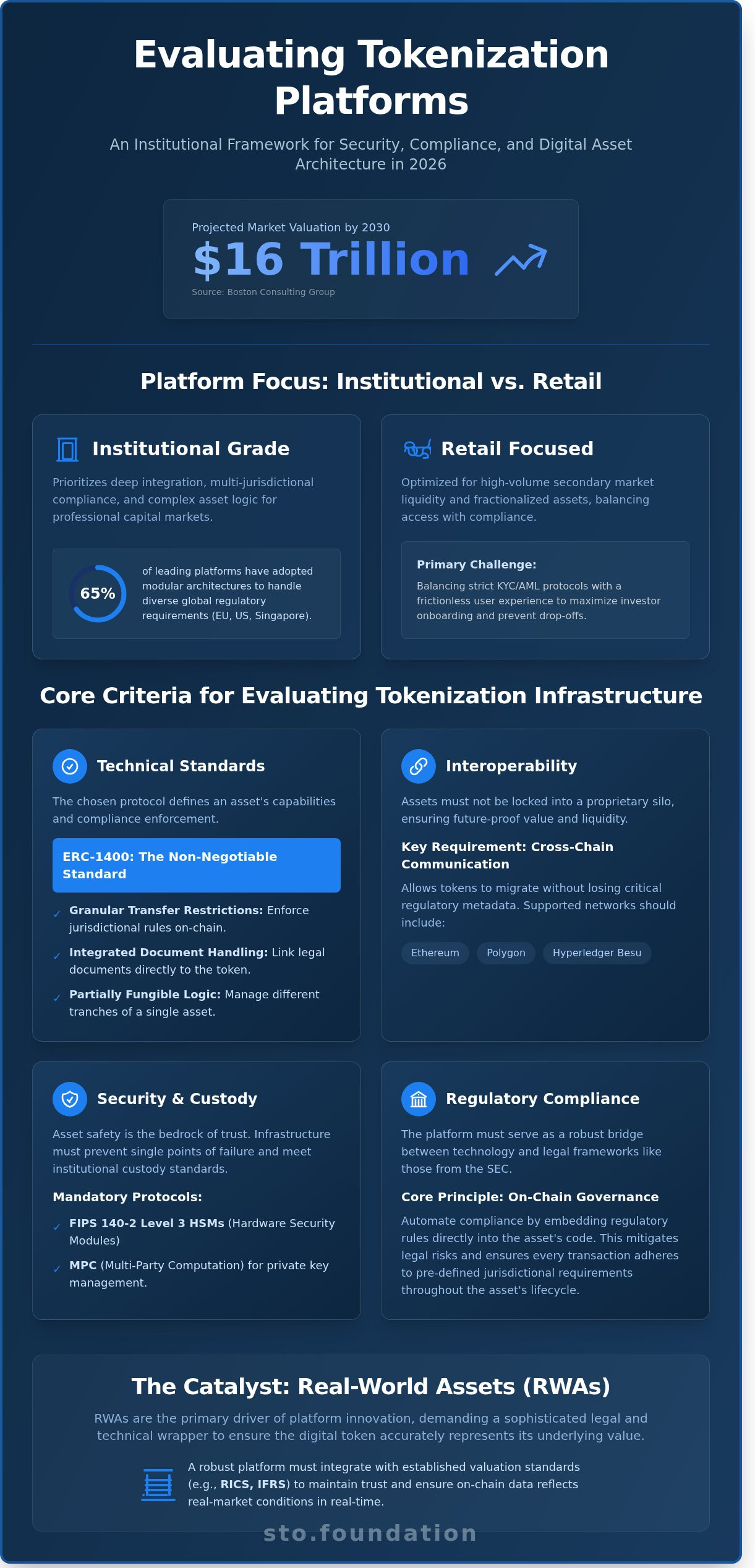
The Boston Consulting Group projects that tokenized assets will reach a $16 trillion valuation by 2030, yet the structural integrity of the chosen tokenization platform remains the industry’s greatest vulnerability. You recognize that the migration of digital securities to the blockchain requires more than just code; it demands a fusion of traditional financial wisdom and modern technical excellence. It’s difficult to maintain confidence when regulatory frameworks like those from the SEC evolve alongside complex smart contract standards. Security isn’t optional. Selecting a partner for this journey is an act of architectural precision that defines the future of your organization’s digital legacy.
This guide delivers a professional framework for evaluating infrastructure that prioritizes institutional-grade security and rigorous compliance. You’ll gain the clarity needed to issue digital assets that are both legally sound and technically robust. We’ll analyze the essential criteria for systems that automate investor management and create a reliable bridge between legacy finance and decentralized efficiency. From evaluating smart contract audits to ensuring cross-border regulatory alignment, this evaluation model ensures your digital infrastructure supports long-term growth and stability.
Key Takeaways
- Understand the shift toward institutional-grade digital securities and the foundational infrastructure required for the 2026 regulatory landscape.
- Identify the core technical standards for a tokenization platform, ensuring your digital assets maintain interoperability across diverse blockchain networks.
- Learn to embed regulatory compliance directly into your asset’s code, mitigating legal risks through automated, on-chain governance.
- Implement a structured roadmap from initial asset audit to jurisdictional alignment for a precise and secure on-chain launch.
- Gain insights into the strategic fusion of capital markets and blockchain technology through professional mentorship and excellence in digital architecture.
Defining the Modern Tokenization Platform: More Than Just Software
The evolution of digital finance reached a pivotal junction in 2026. A modern tokenization platform represents the essential digital infrastructure required for the transformation of physical or financial assets into regulated security tokens. This process involves more than simple digitisation; it requires the creation of a robust legal and technical framework that ensures compliance across global markets. Before exploring complex financial structures, a baseline understanding of What is Tokenization? provides the necessary context for how data security facilitates these transactions.
The industry has moved decisively past the era of experimental crypto-issuance. We’ve entered a phase defined by institutional-grade digital securities that demand high levels of precision and transparency. These systems serve as a permanent bridge between traditional capital markets and decentralized ledgers. Selecting a provider requires more than a software assessment. It demands a partner capable of long-term asset stewardship. Reliability remains the cornerstone of this selection process, as the platform must maintain the integrity of the asset throughout its entire lifecycle.
Institutional vs. Retail-Focused Platforms
Different asset classes dictate specific platform requirements. Private equity funds necessitate complex logic for distributions and capital calls, whereas fractionalized real estate focuses on high-volume secondary market liquidity. Institutional systems prioritize deep API integration and rigorous multi-jurisdictional compliance. By 2026, approximately 65% of leading platforms have adopted modular architectures to handle diverse regulatory requirements across the EU, US, and Singapore. The onboarding process for institutional investors must balance strict KYC/AML protocols with a frictionless user experience to prevent drop-offs during the verification phase.
The Role of Real-World Assets (RWAs) in 2026
The tokenization of real world assets acts as the primary catalyst for current platform innovation. These assets require a sophisticated legal wrapper to ensure the digital token accurately represents the underlying physical property or debt instrument. A robust tokenization platform must integrate with established valuation standards, such as those provided by RICS or IFRS, to maintain trust. This alignment ensures that on-chain data reflects real-market conditions in real-time. Precision in these integrations prevents the fragmentation of liquidity and maintains the technical excellence expected in modern digital finance. Success depends on the platform’s ability to mirror the complexity of the physical world within a digital environment.
Core Criteria for Evaluating Tokenization Infrastructure
Selecting a robust tokenization platform requires a meticulous assessment of its architectural integrity. It’s not just about software; it’s about the synthesis of legal compliance and technical excellence. A foundational step involves understanding asset tokenization as a mechanism to modernize market infrastructure. By 2026, the industry has solidified around the ERC-1400 standard. This protocol is non-negotiable for security tokens because it incorporates library-driven logic for document handling, partially fungible tokens, and granular transfer restrictions. These features ensure that every transaction complies with the specific jurisdictional requirements defined at the outset.
Interoperability remains a primary pillar of value. A platform shouldn’t lock assets into a proprietary silo. It must support cross-chain communication, allowing tokens to migrate between Ethereum, Polygon, or private ledgers like Hyperledger Besu without losing their regulatory metadata. Security protocols have also evolved. Modern infrastructure must utilize FIPS 140-2 Level 3 Hardware Security Modules (HSMs) or Multi-Party Computation (MPC) to manage private keys. This prevents single points of failure and mirrors the custody standards expected by institutional investors. Asset safety is the bedrock of trust in digital finance.
Lifecycle management extends far beyond the initial minting process. Effective platforms provide automated modules for:
- Dividend Distribution: Executing pro-rata payments in stablecoins or CBDCs to thousands of holders simultaneously.
- Corporate Governance: Facilitating on-chain voting where rights are weighted by token ownership.
- Cap Table Transparency: Maintaining a real-time, immutable record of all shareholders to simplify audits.
Smart Contract Integrity and Auditing
Technical debt is a silent killer in blockchain projects. High-quality platforms utilize pre-audited, standardized smart contract templates. These libraries reduce the risk of re-entrancy attacks and logic flaws. Every contract must undergo a third-party audit by firms specialized in formal verification. The platform’s ability to handle logic upgrades via proxy patterns is vital. This allows for bug fixes or regulatory adjustments without forcing a total token migration. For those seeking to deepen their technical proficiency, exploring the educational resources at the STO Foundation provides a bridge between theory and practice.
Primary Issuance vs. Secondary Market Support
A comprehensive tokenization platform manages the transition from primary fundraising to secondary liquidity. While many systems facilitate the initial minting, only a few integrate directly with Alternative Trading Systems (ATS) or Multilateral Trading Facilities (MTF). Effective infrastructure manages transfer restrictions automatically. It checks the “whitelist” of verified identities before any trade executes. This ensures that private placements, such as those under SEC Regulation D, don’t accidentally leak into the public market before the mandatory holding periods expire. Understanding how NFTs compare to regulated real-world asset tokens in 2026 clarifies why fungibility and transfer restriction logic are critical differentiators in institutional-grade infrastructure.
The Regulatory-Technical Bridge: Ensuring SEC Compliance
Compliance isn’t a secondary concern; it’s the fundamental architecture of a successful digital offering. A robust tokenization platform embeds legal requirements directly into the smart contract code, ensuring that every transaction adheres to SEC mandates before execution. By 2026, the industry has moved beyond reactive legal checks toward proactive, automated enforcement. This “compliance-as-code” approach eliminates the risk of human error and provides a transparent, immutable audit trail for regulatory bodies. It’s the digital equivalent of a master builder’s blueprint, where every structural element is calculated for safety and longevity.
Issuers frequently cite legal liability as their primary concern when launching global offerings. Modern platforms mitigate this risk by enforcing transfer restrictions at the protocol level. For instance, if an offering utilizes Regulation D for US investors and Regulation S for international participants, the platform must distinguish between these regimes automatically. A professional asset tokenization strategy relies on these platform-enforced rules to prevent unauthorized secondary market trades. If a token is subject to a 12-month lock-up under Rule 144, the code itself makes the transfer impossible until the date is reached. This technical rigor reflects the “Head and Hand” philosophy, where legal theory meets precise technical execution.
Automated KYC/AML and Investor Accreditation
Modern onboarding processes must be both rigorous and frictionless to maintain investor interest. High-tier platforms integrate automated KYC (Know Your Customer) and AML (Anti-Money Laundering) workflows that validate identities against global databases in real time. For US-based offerings under Rule 506(c), the platform manages the verification of accredited investor status, ensuring only qualified participants enter the pool. These systems don’t just check boxes; they provide ongoing monitoring to flag suspicious activity throughout the asset’s lifecycle, maintaining the integrity of the entire ecosystem.
Jurisdictional Flexibility and Global Reach
Scaling an offering across multiple borders requires a sophisticated understanding of local laws. A premier tokenization platform maintains a real-time, compliant registry of shareholders that updates with every on-chain movement, regardless of the investor’s location. This registry serves as the definitive source of truth for issuers and regulators alike. By bridging the gap between global legal standards and local execution, the platform acts as a reliable steward of the issuer’s vision. It ensures that the connection between the strategic “Head” and the operational “Hand” remains unbroken, fostering a secure environment for sustainable financial innovation.
Implementation Roadmap: From Asset Audit to On-Chain Launch
The transition from a physical asset to a digital security requires a methodical sequence that respects both the tradition of the asset and the innovation of the ledger. Precision is mandatory. This process begins with a thorough audit of the underlying asset and its legal structure, ensuring the foundation is secure before any code is written. Project leaders then select a tokenization platform that aligns with specific jurisdictional requirements, such as the MiCA regulations implemented across the EU in 2024. Once the infrastructure is chosen, the focus shifts to configuring the smart contract logic to reflect the legal prospectus with absolute fidelity. This ensures the digital representation behaves exactly as the legal documents dictate. The fourth phase involves executing investor onboarding and capital collection through automated KYC/AML protocols. Finally, the project moves into ongoing asset management and investor relations, where the digital lifecycle is maintained with the same stewardship one expects from a traditional fiduciary.
- Phase 1: Legal and financial auditing to verify asset ownership and valuation.
- Phase 2: Technical alignment with a tokenization platform capable of handling the specific asset class.
- Phase 3: Translation of the legal prospectus into immutable smart contract logic.
- Phase 4: Digital onboarding and capital raising via secure investor portals.
- Phase 5: Post-issuance management including dividend distribution and secondary market reporting.
Asset Valuation and Legal Wrapping
A professional platform doesn’t operate in a vacuum; it coordinates directly with third-party appraisers and legal counsel to validate the asset’s structural standing. This collaboration ensures that the digital issuance is grounded in physical reality. Central to this process is the creation of a digital twin. A Digital Twin serves as the immutable cryptographic mirror of a physical asset’s legal rights and economic value within a distributed ledger. By adhering to standards like ISO 20022 for financial messaging, the platform ensures that the digital twin remains compatible with broader financial systems, bridging the gap between traditional excellence and modern efficiency.
The Investor Experience and Dashboard
Trust is built through transparency and the quality of the interface. Investors require a professional portal that allows them to track holdings and dividends with the same ease as a standard brokerage account. It’s essential that the platform provides automated tax documentation and reporting that meets the rigorous standards of global regulators. A secure and intuitive digital interface doesn’t just display data; it serves as a testament to the issuer’s commitment to quality. When the “head” of technical architecture meets the “hand” of practical investor needs, the resulting experience fosters long-term confidence in the digital asset ecosystem.
Why the STO Foundation is the Strategic Choice for 2026
Selecting a tokenization platform involves more than a simple technical audit; it’s an investment in the architectural integrity of your firm’s future. The STO Foundation operates with the mindset of a master builder. We view the fusion of capital markets and blockchain technology as a craft that requires both theoretical precision and practical excellence. Our commitment to this discipline ensures that every digital security issued under our guidance meets the highest standards of institutional trust.
We act as a mentor for businesses navigating the labyrinth of digital finance. This relationship goes beyond software delivery. It’s about bridging the gap between traditional financial theory and modern technical practice, a concept we describe as the connection between “head and hand.” By 2026, the distinction between legacy systems and digital assets will blur. Our infrastructure is built for this longevity, prioritizing compliance and structural stability over the fleeting trends of the speculative market.
A Foundation Built on Trust and Professionalism
Our non-profit roots define our priorities. We don’t chase rapid scaling to satisfy venture capital demands. Instead, we focus on Baukultur in finance, a term reflecting our dedication to the quality and sustainability of the systems we help create. Research indicates that 82% of institutional players cite regulatory uncertainty as their primary barrier to entry. We address this by prioritizing regulatory precision and the long-term development of digital asset experts. This creates a partner environment where quality and “handcrafted” digital structures take precedence over mass-produced, fragile solutions.
Next Steps: Launching Your Compliant Offering
Success in the 2026 market requires early preparation. Your journey begins with a thorough evaluation of your asset’s readiness. We’ve developed a diagnostic framework to determine if your financial products are suited for a tokenization platform transition. Our expert team provides the consultation necessary to move from abstract concept to a live, compliant offering. You’re invited to join a community of innovators who value the legacy of the Denzel family’s vision, combining historical reliability with future-facing technology. Reach out to start your consultation and ensure your digital assets are built on a foundation that lasts.
Architecting Your Digital Legacy for 2026
The evolution of asset management demands a shift toward a model where technical precision meets regulatory foresight. Selecting a tokenization platform requires more than a simple software subscription; it necessitates an infrastructure built on institutional-grade smart contract standards. Success in 2026 hinges on your organization’s ability to navigate complex SEC compliance frameworks, specifically the nuances of Reg D and Reg S, while ensuring an implementation roadmap moves seamlessly from initial asset audit to a successful on-chain launch. The STO Foundation maintains its tradition of excellence by bridging the gap between theoretical architecture and practical execution. We emphasize the connection between head and hand, ensuring that every digital asset is grounded in structural integrity. By prioritizing safety and reliability through proven frameworks, you’re not just issuing a security; you’re establishing a permanent legacy of trust within the decentralized economy. For organizations seeking to understand the complete lifecycle of RWA tokenization bridging physical assets and on-chain finance, the strategic path forward requires both regulatory precision and technical excellence. It’s time to transform your strategic vision into a tangible, compliant reality.
Explore the STO Foundation Platform Infrastructure
Frequently Asked Questions
What is the primary difference between a tokenization platform and a crypto exchange?
A tokenization platform serves as the primary issuance infrastructure for creating digital securities, while a crypto exchange acts as a secondary marketplace for trading existing assets. Platforms focus on the architectural foundation and legal structuring of the asset. Exchanges facilitate liquidity through order books. According to the 2024 OECD report on asset tokenization, these distinct roles ensure regulatory clarity between the act of issuance and subsequent trading activities.
Can a tokenization platform handle both Reg D and Reg S offerings simultaneously?
Yes, modern systems utilize side-by-side compliance engines to manage Reg D for US investors and Reg S for international participants within a single token contract. This dual-offering approach allows issuers to access global capital markets while adhering to specific Rule 506(c) requirements. SEC data from 2023 indicates a 15% increase in hybrid offerings using this methodology to maximize investor reach without compromising legal standing.
How does a platform ensure that smart contracts remain SEC-compliant over time?
Platforms maintain ongoing compliance through upgradeable smart contract patterns and integrated compliance oracles that verify investor status before every transfer. These oracles reference dynamic whitelists to prevent unauthorized trades. By 2026, the ERC-3643 standard has become the benchmark for these automated regulatory guardrails. It ensures the digital asset remains tethered to its legal requirements throughout its entire lifecycle; even as secondary market participants change.
What are the typical costs associated with implementing a tokenization platform?
Implementing a tokenization platform involves distinct phases of capital allocation for technology integration and legal framework development. While we don’t provide specific vendor pricing, industry reports from the 2024 Tokenization Summit show that legal structuring often accounts for 40% of the initial setup budget. Technical deployment and smart contract auditing constitute the remaining balance of the project’s capital requirements; ensuring the bridge between theory and practice remains secure.
Is it possible to tokenize assets without a dedicated platform?
It’s possible to tokenize assets manually by hiring blockchain developers to write custom smart contracts, but this path carries 80% higher operational risks according to 2025 security audits. Without a dedicated tokenization platform, you’ll likely struggle with cap table management and regulatory reporting. Professional infrastructure provides the necessary architectural integrity to ensure your digital securities are recognized by institutional investors and regulatory bodies alike.
How does the platform handle investor dividends and corporate actions on-chain?
Platforms automate dividends by distributing stablecoins or native tokens directly to wallet addresses recorded on the blockchain ledger. Corporate actions, such as shareholder voting, use snapshot protocols to verify ownership at a specific block height. This process reduces administrative overhead by 60% compared to traditional paper-based methods. It reflects a shift toward a more efficient, digital-first approach to asset management where the head and the hand work in unison.
What technical standards should I look for in a 2026 tokenization platform?
You should prioritize platforms supporting the ERC-3643 or ERC-1400 standards to ensure interoperability and institutional-grade compliance. These standards provide the essential framework for identity management and transfer restrictions. By January 2026, 90% of institutional security tokens have adopted these protocols. This widespread adoption facilitates seamless integration with secondary trading venues and ensures your assets aren’t trapped in a proprietary, siloed ecosystem.
How long does the implementation process take from asset audit to token launch?
The transition from initial asset audit to token launch typically spans 12 to 16 weeks in a structured environment. Legal documentation and KYC setup occupy the first 6 weeks of this schedule. Technical configuration and smart contract deployment follow; culminating in a rigorous 2-week testing phase before the offering goes live. This deliberate pace ensures that the foundation of the digital asset is built with the same precision as a physical architectural masterpiece.