

The Boston Consulting Group projects that the tokenization of global illiquid assets will reach a $16 trillion valuation by 2030. It’s a shift that demands more than just technical curiosity; it requires a structural bridge between traditional financial craftsmanship and modern digital architecture. Precision matters. You’ve likely felt the friction caused by regulatory ambiguity and the inherent complexity of smart contracts. These barriers often stifle the potential of private markets, leaving valuable assets trapped in illiquid silos. We believe the transition to rwa tokenization must be built on a foundation of security and absolute compliance.
This article provides the professional framework needed to transform physical assets into liquid, compliant digital securities through high-grade blockchain infrastructure. We’ll examine the complete tokenization lifecycle and the specific legal requirements of Reg D and Reg S frameworks. This isn’t just theory. By the end of this guide, you’ll possess a strategic path to launching a successful Security Token Offering (STO) that aligns with the highest standards of financial excellence. We’re providing the practical tools that connect the physical world with on-chain finance.
Key Takeaways
- Gain a comprehensive understanding of how rwa tokenization converts physical assets into compliant digital securities to unlock unprecedented market utility.
- Identify the critical legal and technical milestones required to transition tangible assets into the digital realm through precise smart contract integration.
- Evaluate the strategic advantages of fractional ownership and enhanced liquidity that characterize the next generation of 24/7 global secondary markets.
- Master the regulatory landscape by aligning with SEC frameworks and international securities laws to ensure the enduring integrity of your digital portfolio.
- Bridge the gap between theoretical blockchain concepts and professional implementation with the expert guidance and structural mentorship of the STO Foundation.
What is RWA Tokenization? Defining the Digital Future of Assets
The digital transformation of finance rests upon the precise conversion of physical and financial rights into programmable units. To understand What is RWA Tokenization? one must view it as the bridge between tangible substance and on-chain mobility. This process transforms an asset’s ownership rights into a digital token on a blockchain; it’s a technical discipline that mirrors the structural integrity found in traditional architecture. The primary objective centers on enhancing the utility and accessibility of traditionally illiquid assets, ensuring they’re no longer confined by geographic or administrative barriers.
Distinguishing rwa tokenization from speculative crypto-assets is vital for institutional stability. While many digital tokens derive value from market sentiment, real world assets represent claims on physical property, revenue streams, or debt instruments. The STO Foundation acts as a professional mentor in this space, establishing the rigorous standards necessary for this transition. By applying the same dedication to excellence found in master craftsmanship, the Foundation ensures that every tokenized asset meets a high bar of legal and technical validity. It’s about creating a sustainable framework where the digital and physical worlds coexist with transparency.
The Evolution of Digital Securities
The path to 2026 involved a significant shift from the experimental nature of ICOs toward regulated Security Token Offerings (STOs). This maturation reflects a move toward institutional-grade blockchain protocols that prioritize compliance and security. Tokenization now mirrors the precision of traditional craftsmanship; it requires a deep understanding of both the “head” (the theoretical legal framework) and the “hand” (the technical execution). These modern protocols allow for the seamless integration of complex financial structures into a digital environment, providing a reliable foundation for global capital markets.
Key Asset Classes Targeted for Tokenization
Several sectors are leading the adoption of this technology, bringing liquidity to previously stagnant markets:
- Real estate and private equity: These represent the largest pools of illiquid wealth, now being unlocked through fractional ownership models that allow for smaller entry points.
- Commodities and fine art: Tokenization brings transparency to high-value niche markets, allowing for the provenance and ownership of items to be tracked with absolute certainty. Understanding how NFTs serve as unique, immutable certificates for real-world assets is essential for professionals operating in this space.
- Corporate debt and treasuries: The automation of the lifecycle for financial instruments reduces administrative overhead. By 2026, the on-chain treasury market has reached unprecedented levels of efficiency, providing a stable foundation for the broader financial ecosystem.
The Mechanics of Tokenization: How Physical Assets Move On-Chain
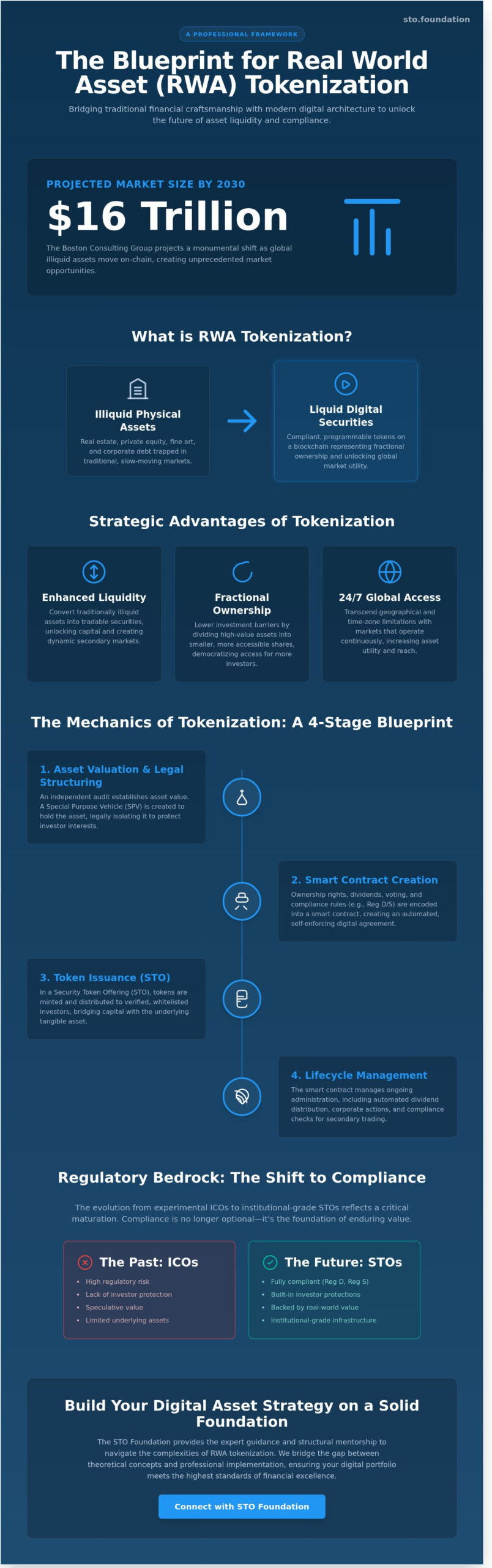
The transition from a physical asset to a digital security requires a rigorous structural framework. It’s not merely a technical migration; it’s a synthesis of legal precision and cryptographic architecture. This process, known as rwa tokenization, follows a four-stage blueprint to ensure the digital representation maintains its value and legal standing within the global financial ecosystem of 2026.
- Step 1: Asset Valuation and Legal Structuring. The process begins with an independent audit and the creation of a Special Purpose Vehicle (SPV). This legal entity holds the physical asset, isolating it from the balance sheet of the original owner to protect investors.
- Step 2: Smart Contract Creation. Developers encode the specific rights, restrictions, and compliance rules into a smart contract. This code dictates how the token behaves, ensuring it cannot be traded to unverified wallets.
- Step 3: Token Issuance. Once the digital blueprint is finalized, tokens are minted and distributed to verified investors. This stage bridges the gap between capital and tangible value.
- Step 4: Lifecycle Management. The final stage involves the ongoing administration of the asset. This includes the automated distribution of dividends, the execution of voting rights, and the facilitation of secondary market trading.
The Legal Wrapper and the Digital Twin
For a token to hold value, it must represent a valid legal claim under international law. The Special Purpose Vehicle (SPV) acts as the essential bridge, ensuring that the token is more than just a digital entry. It’s a digital twin of the physical reality. Maintaining the “Golden Record” is critical; this involves a continuous synchronization between off-chain ownership registries and on-chain data. By 2026, the adoption of the MiCA framework in Europe has standardized these legal wrappers, providing the security and verifiability that institutional architects of finance require. Those seeking to understand the intersection of traditional craftsmanship and modern finance can explore the educational resources at the STO Foundation to deepen their knowledge.
Smart Contracts as Governance Tools
Smart contracts function as the “digital handwerk” of modern finance. They automate complex administrative tasks that previously required manual intervention. Compliance checks, such as KYC (Know Your Customer) and AML (Anti-Money Laundering) protocols, are now embedded directly into the token’s logic. Programmable dividends reduce administrative overhead for issuers by 85% compared to traditional methods. This automation ensures that payments reach the correct stakeholders instantly, eliminating the need for intermediary clearing houses. It’s a system where the precision of the code reflects the integrity of the underlying asset.
The Economic Case for RWA Tokenization in 2026
The financial architecture of 2026 rests on the systematic conversion of tangible value into digital units. Through rwa tokenization, the structural barriers that once siloed high-value assets have dissolved. Fractional ownership serves as the primary catalyst for this shift. By dividing a €50 million infrastructure project into compliant digital shares, the entry threshold drops from institutional levels to accessible increments. This democratization allows a broader range of participants to support the built environment while diversifying their portfolios with precision. The economic logic is clear: when you lower the barrier to entry, you invite a surge of capital that was previously sidelined.
- Fractional Ownership: Lowering the minimum investment from €100,000 to €1,000 increases the potential investor pool by more than 500 percent according to 2025 market studies.
- 24/7 Secondary Markets: Liquidity isn’t tied to banking hours anymore. Assets that previously required 6 to 9 months for a sale now trade on global exchanges with near-instant execution.
- Operational Efficiency: Smart contracts automate dividend distribution and compliance checks. This removes the administrative overhead that typically consumes 2 to 4 percent of an asset’s annual yield.
- Transparency and Auditability: Public ledgers provide a real-time, immutable record of asset performance. This reduces the cost of annual audits by approximately 40 percent for major holdings.
Unlocking Liquidity in Private Markets
Private equity and real estate have long suffered from liquidity discounts often reaching 25 percent. By 2026, blockchain integration has largely mitigated this penalty. Businesses now access capital at lower costs because the risk premium associated with locked capital has diminished. Choosing a professional tokenization platform is the decisive step for issuers who require technical excellence and regulatory certainty. These platforms ensure that every digital unit remains compliant with multi-jurisdictional regulations while maintaining a direct, verifiable link to the underlying physical asset.
Reducing Intermediary Friction
The traditional T+2 settlement cycle is an artifact of a slower era. On-chain finance achieves finality in seconds. This speed eliminates counterparty risk and frees up capital that would otherwise be trapped in clearinghouses for days. Managing 10,000 fractional owners is now as simple as managing ten, thanks to automated cap table updates and digital voting systems. Through rwa tokenization, assets also integrate seamlessly with DeFi protocols. Owners can use their tokenized property shares as collateral for instant loans. This bridges the gap between static property value and active liquidity without the need for 30-day bank approval cycles.
Regulatory Bedrock: Compliance as a Non-Negotiable Standard
The transition toward rwa tokenization in 2026 rests on a singular pillar: absolute legal certainty. Without rigorous adherence to global securities laws, digital assets remain fragile experiments rather than institutional instruments. Institutional capital doesn’t move without clarity. In the United States, the SEC applies the Howey Test to determine if an asset qualifies as an investment contract. For real-world assets, the answer is almost always affirmative. This security classification isn’t a hurdle; it’s the architectural foundation that protects both the issuer and the participant.
Addressing the primary objection regarding cross-border friction requires a multi-jurisdictional strategy. The STO Foundation advocates for a compliance-first infrastructure where legal requirements are embedded directly into the smart contract code. This ensures a token issued in Zurich remains valid when traded by a verified participant in Singapore. By 2025, more than 45 countries established specific digital asset frameworks, making “regulatory arbitrage” a relic of the past. Success in this space demands a mentor-like approach to legal engineering, bridging the gap between legacy statutes and future-proof technology.
Reg D and Reg S: The Global Issuance Framework
Regulation D allows issuers to access US accredited investors with legal certainty, specifically under Rule 506(c) which permits general solicitation. Regulation S governs offerings conducted outside the United States. Combining these frameworks creates a robust capital-raising mechanism. By utilizing both, an issuer can tap into the deep liquidity of the US market while simultaneously engaging global participants. This dual-track approach ensures that the rwa tokenization process remains compliant across the most significant financial corridors.
Automated Compliance and KYC/AML Integration
Identity-aware tokens represent the next evolution in financial craftsmanship. These assets restrict transfers to verified wallets, ensuring only “whitelisted” participants can hold or trade the asset. This real-time monitoring is essential for meeting sec sto requirements. In institutional digital finance, whitelisting isn’t just a security measure; it’s a prerequisite for secondary market liquidity. By early 2026, automated KYC/AML integration has reduced administrative overhead by approximately 60% compared to manual legacy systems, allowing for a more efficient connection between head and hand in financial management.
Implementing a Professional Tokenization Strategy
Moving from theoretical exploration to operational reality requires more than just technical aptitude. It demands a marriage of “head and hand,” where academic rigor meets practical craftsmanship. The STO Foundation serves as a mentor in this transition, ensuring that rwa tokenization isn’t just a pilot project but a core pillar of corporate finance. By 2026, the distinction between digital and traditional assets has blurred, making the choice of execution partner a decisive factor for long-term success. We believe that true progress stems from a deep appreciation for the architecture of finance, where every digital security is built with the same precision as a structural masterpiece.
Choosing Your Infrastructure Wisely
Architecture dictates longevity. While general-purpose tokens might suffice for simple utility, professional-grade digital securities require specialized standards like ERC-1400. This standard provides the necessary hooks for compliance, such as transfer restrictions and document handling, which are essential for institutional adoption. A modular platform allows for the evolution of the technical stack as global regulations, such as the EU’s MiCA framework, continue to mature. We prioritize technical excellence over market hype. Our focus remains on building systems that stand the test of time, much like a well-constructed building. Choosing the wrong stack today creates technical debt that can stifle scalability by 2027. We advocate for a quality-first approach that favors robust, audited code over speculative trends. A thorough understanding of how NFTs compare to fungible security tokens within a regulated framework is equally important when selecting the appropriate token standard for your asset class.
The STO Foundation Partnership
Successful asset tokenization requires a deep integration into existing corporate workflows. This isn’t a replacement of traditional finance, but an upgrade to its plumbing. The STO Foundation acts as a bridge, helping companies launch compliant and investable digital securities that meet the high standards of global capital markets. We support the next generation of financial architects in navigating the complexities of on-chain finance with professional integrity. Our commitment is to foster a culture of excellence where innovation is balanced with responsibility.
The path forward is defined by precision and a commitment to the craft of financial engineering. In a market where a significant portion of early blockchain projects failed due to poor architectural planning, the STO Foundation offers the stability and expertise needed for enduring value. We invite you to join us in shaping the future of finance, where rwa tokenization represents a commitment to quality and every transaction is a testament to transparency. By focusing on the holistic development of the digital asset ecosystem, we ensure that the benefits of blockchain reach the real economy with safety and reliability.
Mastering the Architecture of Digital Asset Excellence
The evolution of rwa tokenization represents a fundamental shift in how global markets perceive and trade value. By 2026, the integration of physical assets into decentralized ledgers isn’t just a trend; it’s a structural necessity for institutional liquidity. Boston Consulting Group predicts the market for tokenized assets will reach $16 trillion by 2030, highlighting the immense scale of this transition. Success in this new era requires a balance between technical innovation and the disciplined application of Reg D and Reg S compliance standards. It’s about building a bridge where traditional finance meets the speed of the blockchain through precise, foundation-led planning. The STO Foundation acts as a professional mentor for institutional issuers, offering the infrastructure and expertise required to launch secure offerings. We invite you to join this movement toward a more transparent and efficient financial future. Launch your compliant investment offering with the STO Foundation platform. The path to asset excellence starts with a solid regulatory foundation.
Frequently Asked Questions
Is RWA tokenization legal in the United States and Europe?
RWA tokenization is legal in both regions provided issuers adhere to established securities frameworks like the European Union’s Markets in Crypto-Assets (MiCA) regulation implemented in June 2024. In the United States, the Securities and Exchange Commission (SEC) regulates these assets under existing frameworks like Regulation D or Regulation S. These laws ensure that digital representations of physical assets carry the same legal weight as traditional ownership certificates. Compliance requires rigorous identity verification to maintain the integrity of the financial architecture.
How does RWA tokenization differ from traditional fractional ownership?
The primary difference lies in the use of blockchain technology to provide 24/7 liquidity and near-instant settlement. Traditional fractional models often rely on manual ledgers and intermediaries that take 3 to 5 business days to process transactions. Through rwa tokenization, ownership is recorded on a transparent, distributed ledger that automates dividend distributions and voting rights. This modern approach reduces administrative costs by approximately 40 percent compared to legacy systems, bridging the gap between physical craftsmanship and digital efficiency.
What happens to the token if the underlying physical asset is damaged or lost?
The token’s value remains intrinsically linked to the physical asset’s condition, which is typically protected through legal structures like Special Purpose Vehicles (SPVs) and comprehensive insurance. If an architectural structure or industrial asset suffers damage, the insurance payouts are distributed to token holders as defined in the smart contract’s legal metadata. By 2026, standardized protocols ensure that the digital “head” of the investment is always synchronized with the physical “hand” of the asset. This structure provides a secure recovery path for all participants.
Can any asset be tokenized, or are there specific requirements?
Most tangible assets can be tokenized if they possess a clear legal title, an independent valuation, and a verifiable custody arrangement. Real estate, fine art, and infrastructure projects require a 100 percent transparent audit trail to qualify for on-chain finance. Regulatory bodies demand a formal prospectus for any public offering to ensure investor protection. These requirements filter out low-quality assets, ensuring that only projects with genuine economic or architectural merit enter the global digital marketplace.
How do smart contracts ensure that only accredited investors buy security tokens?
Smart contracts use automated “whitelists” to restrict transactions to wallet addresses that have completed a rigorous vetting process. The code verifies the investor’s credentials against a secure database before allowing any transfer to execute. Under United States law, specifically Rule 506(c) of Regulation D, issuers must verify the status of every participant. This digital gatekeeping prevents unauthorized trades with 100 percent accuracy, maintaining regulatory compliance without the need for constant manual oversight by the issuing institution.
What are the main costs associated with launching an RWA tokenization project?
Launching an rwa tokenization project involves significant expenditures for legal structuring, technical development, and third-party auditing. Legal fees for a compliant prospectus in the European Union often range from 20,000 to 50,000 Euros depending on the asset’s complexity. Technical costs include smart contract programming and security audits by established firms to ensure the code’s resilience. Ongoing expenses for asset appraisal and digital custody are also necessary to maintain the long-term viability and transparency of the digital offering.