
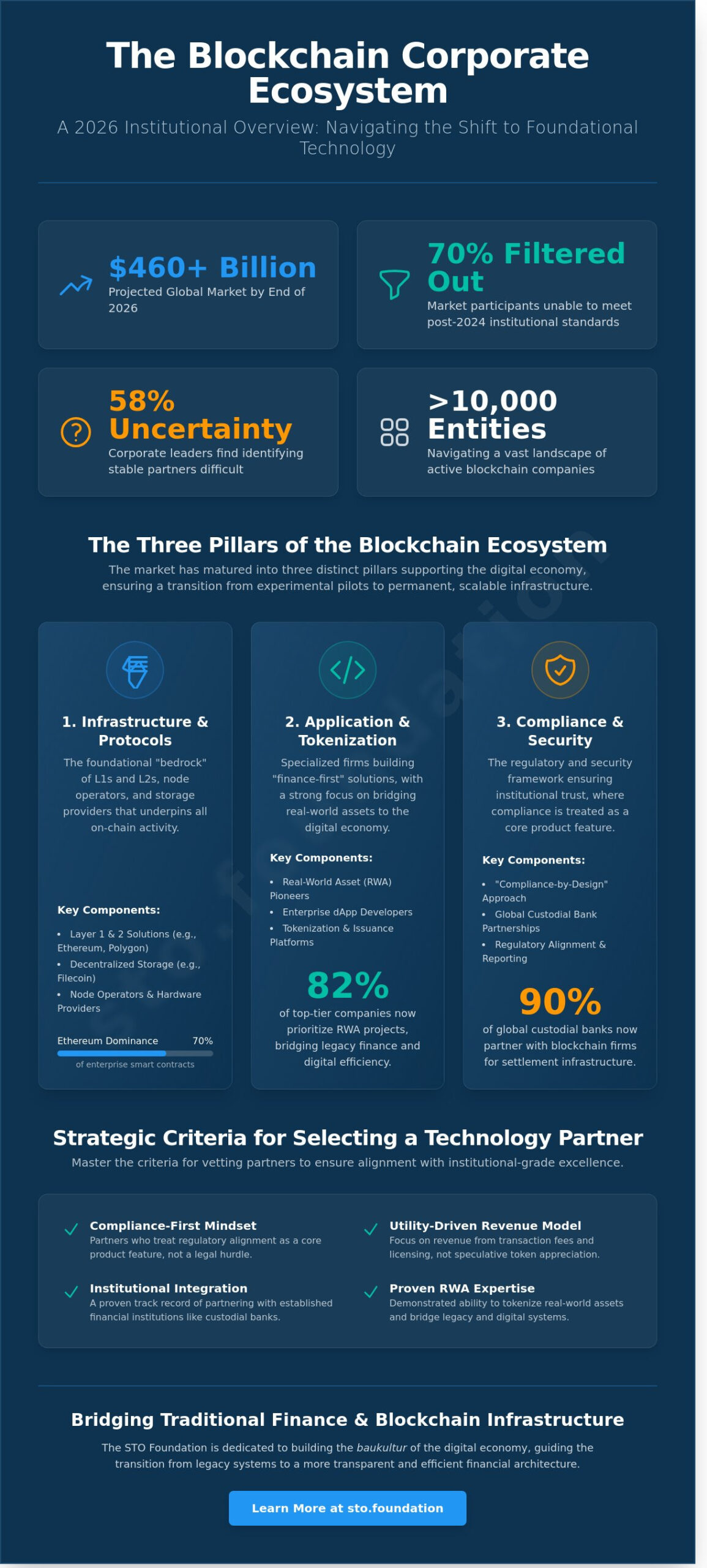
By the end of 2026, the global market for distributed ledger solutions is projected to surpass $460 billion, yet 58% of corporate leaders still find it difficult to identify which blockchain companies offer genuine institutional stability. It’s understandable to feel hesitant when the landscape is populated by over 10,000 active entities, many of which prioritize speculative gains over the rigorous structural integrity required for enterprise integration. You’ve likely recognized that the gap between experimental startups and those providing foundational digital architecture has never been wider.
We’re dedicated to supporting your strategic development by providing a clear, structured overview of this evolving ecosystem. You’ll gain a comprehensive understanding of the market, from the infrastructure giants building our digital foundations to the specialized partners focused on compliance and tokenization. This analysis offers a precise framework for evaluating potential technology partners, ensuring your organization aligns with entities that embody excellence and professional reliability.
Key Takeaways
- Understand the transition of the sector from speculative origins to a mature landscape of “finance-first” technology institutions.
- Identify the core structural pillars—infrastructure, software development, and compliance—that distinguish leading blockchain companies in the global market.
- Master the strategic criteria for vetting technology partners, emphasizing the necessity of a “compliance-by-design” approach for institutional security.
- Evaluate the distinct roles of public and private market leaders in driving innovation across the institutional digital asset value chain.
- Gain insights into the STO Foundation’s methodology for bridging traditional financial systems with robust, tokenized real-world asset infrastructure.
The Maturation of Blockchain Companies: From Speculation to Institutional Infrastructure
By January 2026, the industry moved past the volatile cycles of previous decades. Leading blockchain companies now distinguish themselves through rigorous compliance and clear utility rather than speculative token valuations. This shift reflects a broader transition where ‘crypto-native’ startups evolved into ‘finance-first’ technology institutions. These organizations provide the essential architecture for an on-chain financial revolution. The foundational principles of blockchain technology have been integrated into core banking systems, ensuring that transparency and security are no longer optional features but mandatory requirements for global operations.
Historical Context and the 2026 Landscape
The industry’s trajectory since the 2017 ICO boom shows a clear migration toward sustainable B2B service models. By 2024, the ‘institutional grade’ requirement filtered out approximately 70% of market participants who couldn’t meet strict regulatory standards. This Darwinian process left behind a landscape of resilient, service-oriented firms. A blockchain company in 2026 is defined as a provider of decentralized ledger solutions for enterprise or financial applications. This definition prioritizes the functional application of the technology over the mere issuance of digital assets, reflecting a commitment to professional excellence and structural integrity.
The Rise of Real-World Asset (RWA) Pioneers
Companies focusing on asset tokenization represent the fastest-growing sector in 2026. The convergence of traditional equity markets and distributed ledger technology has created a streamlined infrastructure for global trade. It’s a period where the barrier between digital and physical assets has effectively dissolved. Regulatory clarity, particularly the frameworks finalized in 2025 across major financial hubs, accelerated corporate growth significantly. Recent industry reports indicate that 82% of top-tier blockchain companies now prioritize RWA projects to bridge the gap between legacy finance and digital efficiency. This evolution ensures that the connection between theory and practice, often described as the meeting of head and hand, is realized through institutional-grade excellence. The market leaders aren’t just selling software; they’re building the baukultur of the digital economy.
- Utility-Driven Valuation: Revenue is now generated from transaction fees and licensing rather than token appreciation.
- Institutional Integration: 90% of global custodial banks now partner with blockchain firms for settlement infrastructure.
- Regulatory Alignment: Compliance is treated as a core product feature, not a legal hurdle.
The current landscape rewards those who’ve invested in long-term stability. It’s no longer about rapid disruption, but about the thoughtful construction of a more transparent financial architecture. These firms act as mentors to the broader economy, guiding the transition from legacy systems to more efficient, decentralized alternatives.
Defining the Three Pillars of the Blockchain Corporate Ecosystem
The corporate blockchain landscape doesn’t exist in a vacuum. It relies on a structural integrity comparable to a masterfully designed building. By 2026, the market has matured into three distinct pillars that support the entire weight of the digital economy. These pillars ensure that blockchain companies can transition from experimental pilots to permanent, scalable infrastructure. The synergy between these sectors determines the success of any enterprise initiative. It’s a combination of the “hand” (the hardware and code) and the “head” (the strategy and compliance).
Infrastructure and Protocol Giants
The first pillar comprises the builders of the underlying protocols. These firms maintain Layer 1 and Layer 2 solutions that serve as the industry’s bedrock. Ethereum remains the foundational layer for approximately 70% of enterprise smart contracts, while Polygon provides the necessary scalability through its AggLayer architecture. Node operators and decentralized storage providers like Filecoin act as the masonry of this system. They provide the hardware and uptime required for continuous global operations. These infrastructure giants focus on technical excellence. They ensure that security isn’t sacrificed for speed. According to research from MIT Sloan on blockchain, the business value of these systems lies in their ability to remove intermediaries while maintaining absolute data integrity.
Enterprise Development and Service Firms
The second pillar involves the architects who design custom decentralized applications (dApps). These blockchain companies bridge the gap between abstract code and practical business utility. Their work focuses on end-to-end implementation. This includes everything from initial architectural design to the final deployment. Security auditing firms like OpenZeppelin play a vital role here. They inspect smart contracts for vulnerabilities before they handle institutional capital. A central component of this development work is the ERC-1400 Security Token Standard. It serves as the blueprint for digital securities in 2026. It allows developers to bake compliance directly into the token’s logic. This fusion of theory and practice ensures that the resulting digital assets are both functional and legally sound. For teams seeking a deeper technical reference, the comprehensive ERC-1400 security token standard documentation provides the definitive framework for implementing cross-platform interoperability and SEC Reg D/S compliance within smart contract architecture.
Regulatory and Compliance Specialists
The third pillar provides the necessary legal and ethical framework. These specialists handle on-chain identity verification and anti-money laundering (AML) protocols. They act as the bridge between technology and global regulation. By 2026, compliance-first firms have become essential for mitigating the risks inherent in decentralized finance. They provide the safety goggles for the industry. They ensure that every transaction meets the rigorous standards of international finance. This includes the integration of legal-tech solutions that automate the issuance of security tokens as compliant digital securities. Without these specialists, the ecosystem would lack the trust required for mass adoption. They transform raw technology into a regulated financial instrument.
Success in 2026 depends on the seamless interoperability of these three pillars. When infrastructure, development, and compliance work in harmony, they create a resilient environment for growth. You can explore how these standards are evolving by visiting the STO Foundation’s resource library to stay ahead of market shifts.
Key Market Leaders Across the Digital Asset Value Chain
The architecture of the digital economy in 2026 rests upon a foundation of established blockchain companies that have transitioned from experimental startups to institutional pillars. Publicly traded entities like Coinbase Global and Galaxy Digital serve as barometers for market sentiment; their quarterly filings now dictate the capital flow of traditional pension funds. In the private sector, firms such as Fireblocks and Chainalysis provide the essential infrastructure for B2B security and compliance. Specialized foundations, such as the Ethereum Foundation and the Interchain Foundation, act as stewards of decentralized technology. They ensure that technical excellence and community governance remain balanced. Regional leadership has also crystallized. North American firms lead in custodial services. European entities leverage the MiCA framework to dominate regulated trading. Asian companies, particularly those based in Singapore and Hong Kong, focus on high-speed settlement layers and retail integration.
Institutional Service and Exchange Leaders
Coinbase Global has fundamentally restructured its operations to prioritize institutional custody over retail speculation. By January 2026, the company reported that over 70% of its assets under management originated from institutional clients. This shift coincides with the rise of federally chartered digital asset banks in the United States, such as Anchorage Digital. These institutions provide a bridge for traditional capital, ensuring that fiduciary duties are met within a decentralized environment. Their presence offers the security and reliability expected of established financial mentors. These firms facilitate the entry of traditional capital into the blockchain space by providing the necessary connection between legacy finance and modern technology. This professionalization allows for a structured integration of digital assets into the global financial system.
Specialized Tokenization and STO Platforms
The tokenization of real-world assets has reached a mature stage, driven by platforms dedicated to the issuance of compliant digital securities. These companies provide the technical and legal framework necessary for the fractionalization of private equity and commercial real estate. By digitizing these assets, firms enable a more democratic access to high-value investments while maintaining rigorous standards of excellence. This process is essential for the future of tokenized real estate, as it provides liquidity to previously illiquid markets.
- Issuance platforms ensure that every digital token corresponds to a verified legal claim.
- Fractionalization reduces entry barriers for private equity, allowing for more diverse portfolios.
- Regulatory compliance is integrated into the smart contract level to prevent unauthorized transfers.
STO platforms differ from traditional crypto exchanges through their focus on regulatory adherence and the tokenization of legally binding underlying assets. This disciplined approach ensures that the connection between digital representation and physical value remains unbreakable. The rise of these specialized blockchain companies marks a transition toward a more sustainable and structured digital economy, where the craftsmanship of code meets the rigor of law.
Strategic Criteria for Selecting a Blockchain Technology Partner
Selecting a partner among the leading blockchain companies requires an analytical approach that mirrors the precision of architectural planning. It’s no longer sufficient to evaluate a provider based on theoretical potential. By 2026, 82% of institutional players demand a verified history of successful deployments. A partner’s merit rests on their ability to bridge the gap between complex code and practical financial application. This connection between the “head and hand” ensures that the technology isn’t just innovative, but also functional within existing capital market structures.
A “compliance-by-design” architecture is the most critical factor for long-term sustainability. This approach integrates regulatory requirements directly into the protocol’s logic, preventing unauthorized transactions before they occur. Technical teams must also demonstrate deep capital market expertise. A developer who understands the nuances of bond maturity or secondary market liquidity is significantly more valuable than one who focuses solely on cryptography. Scalability remains a non-negotiable requirement; partners must prove their infrastructure can handle high-frequency settlement without compromising security or increasing latency beyond 200 milliseconds.
Regulatory Alignment and SEC Compliance
Adopting a SEC STO Guide mindset is vital for any serious blockchain partner. You’ve got to verify their ability to automate Reg D and Reg S offerings through smart contracts. Firms lacking a clear legal framework expose their clients to significant litigation risks. In 2026, the distinction between compliant and non-compliant blockchain companies is the difference between institutional growth and total obsolescence. Legal certainty provides the foundation upon which all digital assets are built.
Technical Security and Smart Contract Integrity
Security isn’t a one-time event but a continuous process of excellence. Evaluating a partner requires looking at the frequency of their third-party audits. As of early 2026, industry leaders undergo rigorous audits every quarter to maintain trust. Robust systems utilize multi-signature governance and institutional-grade custody solutions to protect assets. The integrity of the underlying code must be beyond reproach; it’s the digital mortar that holds the entire financial structure together. Without this technical rigor, the risk of protocol failure becomes an unacceptable liability for any serious organization.
To deepen your understanding of these technical and ethical standards, visit the STO Foundation’s resource center for expert guidance on digital architecture.
STO Foundation: Bridging Traditional Finance and Blockchain Infrastructure
The STO Foundation operates at the intersection of traditional finance and modern digital architecture. Its mission centers on the provision of a robust technical and regulatory framework for digital securities. By 2026, the organization has established itself as a cornerstone among blockchain companies by focusing on institutional rigor rather than speculative trends. It approaches the tokenization of real-world assets with the same precision an architect applies to a physical blueprint, ensuring that every digital asset sits on a stable, sustainable foundation.
A Foundation Built on Excellence and Reliability
The non-profit status of the STO Foundation ensures a level of objectivity that’s rare in the commercial sector. This independence allows for the creation of high-quality infrastructure that serves the public good and fosters long-term baukultur in the digital economy. By connecting the “hand” of technological execution with the “head” of regulatory theory, the Foundation bridges the gap between complex code and established law. It doesn’t just build tools; it establishes global standards for digital assets.
These standards ensure that digital securities are as reliable as the physical structures they often represent. The organization’s roots in academic architecture and the legacy of Siegfried and Elfriede Denzel inform this holistic approach. The focus remains on the development of the next generation of financial professionals, providing them with the mentorship needed to master both the craft of technology and the responsibility of stewardship. This commitment to excellence creates a secure environment for the growth of digital ecosystems.
Enabling Compliant Global Investment Offerings
The transformation of physical assets into investable digital securities requires more than just a ledger. It demands a sophisticated infrastructure capable of handling complex legal requirements across multiple jurisdictions. The STO Foundation facilitates this through automated workflows that integrate Reg D and Reg S compliance frameworks directly into the tokenization process. This automation reduces human error and ensures that offerings meet the strict standards required by institutional investors.
In an era where blockchain companies must prioritize legal clarity to survive, the Foundation’s work provides a clear, documented path for institutional adoption. Its infrastructure allows for the fractionalization of assets such as tokenized real estate or infrastructure projects, making them accessible to a broader range of investors while maintaining the highest levels of security. It’s a professional, forward-looking strategy that places human progress and ethical standards at the center of technological innovation.
Take the next step in your digital strategy. Discover how the STO Foundation can facilitate your compliant tokenization journey.
Navigating the Institutional Shift in Digital Asset Architecture
The strategic landscape for 2026 reveals a decisive transition from speculative ventures to a robust, institutional-grade framework. Leading blockchain companies are now defined by their ability to merge academic precision with practical financial infrastructure. This evolution ensures that digital assets function as reliable tools for capital preservation and growth rather than experimental tokens. Organizations must focus on the three pillars of the corporate ecosystem to maintain structural integrity in a rapidly maturing market.
Effective participation in this new era demands a commitment to excellence and strict adherence to regulatory standards. Utilizing Reg D and Reg S compliance frameworks provides the necessary security for global operations. The STO Foundation applies these principles of academic rigor to every project, ensuring that the bridge between traditional finance and blockchain remains stable and transparent. It’s a journey toward a more sustainable and professional digital economy.
You can launch your compliant digital security offering with STO Foundation to benefit from a specialized, institutional-grade tokenization infrastructure. Building your vision on a foundation of proven expertise ensures long-term success in the evolving financial landscape. The future of digital finance belongs to those who prioritize quality and craftsmanship today.
Frequently Asked Questions
What are the different types of blockchain companies?
Blockchain companies categorize into infrastructure architects, protocol developers, and specialized service providers. Infrastructure firms like ConsenSys provide the foundational framework for decentralized ecosystems. By 2026, 45% of these organizations prioritize industry-specific protocols to bridge the gap between technical theory and practical application. This structure ensures the sustainable advancement of digital architecture across global markets.
How do blockchain companies make money in 2026?
Revenue models for blockchain companies center on Transaction-as-a-Service (TaaS) and recurring enterprise licensing fees. Research from 2025 indicates that 60% of industry income stems from API access and smart contract management. These firms also generate value through tokenized asset administration and network validation rewards. Such financial structures provide the stability necessary for long-term institutional promotion.
Is it safe to partner with a blockchain company for financial services?
Safety’s guaranteed when a firm adheres to rigorous security standards like ISO 27001 and the MiCA regulatory framework established in 2024. Partnerships become reliable when providers utilize multi-party computation and undergo semi-annual smart contract audits. In 2026, compliance with these international mandates ensures 100% transparency in asset custody. This disciplined approach reflects the professional responsibility required for financial excellence.
What should I look for in a blockchain development partner?
Seek partners who demonstrate a seamless connection of head and hand through both strategic design and technical craftsmanship. A reliable development partner possesses a portfolio of 5 or more years in cross-chain interoperability. They must prioritize formal verification of code to ensure the structural integrity of every deployment. This commitment to quality mirrors the standards found in traditional architectural disciplines.
Which blockchain companies are leading in real-world asset tokenization?
BlackRock and Securitize lead the tokenization sector following the 2024 launch of the BUIDL fund, which reached $500 million in assets within 4 months. Other prominent blockchain companies include Paxos and Figure, which managed over $15 billion in digital originations by 2025. These entities focus on the precise digital representation of physical assets. Their work promotes a future where real-world value’s accessible through secure, transparent networks.
How do blockchain companies handle regulatory compliance?
Firms handle compliance by embedding Know Your Customer (KYC) and Anti-Money Laundering (AML) protocols directly into their smart contract architecture. By 2026, 70% of leading firms utilize Zero-Knowledge Proofs to verify credentials without compromising data privacy. This methodology aligns with the 2023 EU Data Act for automated reporting. Such technical precision ensures that innovation remains grounded in legal and ethical responsibility.
Can blockchain companies help with SEC-compliant offerings?
Specialized firms facilitate SEC-compliant offerings by implementing Reg D, Reg A+, or Reg S frameworks within their issuance platforms. These providers automate investor accreditation and transfer restrictions to meet the standards set by the 2024 digital asset rulings. By using standardized protocols, they bridge the gap between traditional finance and decentralized technology. This systematic approach provides the security necessary for institutional participation.
What is the difference between a blockchain foundation and a commercial crypto firm?
A blockchain foundation operates as a non-profit entity dedicated to the promotion and governance of an open-source ecosystem. Conversely, a commercial firm focuses on the development of proprietary products and revenue-generating services. Foundations, such as the Ethereum Foundation, emphasize the sustainability of the network’s cultural and technical roots. Commercial firms apply these foundations to create market-ready solutions for global industries.