

The digital architecture of global finance is undergoing a structural renovation where the ledger itself becomes the settlement layer. You’re likely aware that traditional asset management still grapples with T+2 settlement cycles, creating friction in an otherwise instant economy. By 2026, the transition to on chain environments will serve as the primary foundation for institutional capital markets. This shift isn’t merely a technological upgrade; it’s a fundamental reimagining of how we build trust through mathematical precision rather than manual reconciliation.
It’s natural to feel cautious about the regulatory complexities and security requirements of these new digital structures. This guide establishes a rigorous framework for digital asset architecture, ensuring your firm maintains regulatory precision and operational security. You’ll gain specific criteria for choosing between on-chain and off-chain solutions while learning how the 2030 projection of $16 trillion in tokenized assets by Boston Consulting Group relies on this transparency. We’ll examine the structural benefits of real-time data and the precise steps for maintaining compliance in an evolving decentralized environment.
Key Takeaways
- Understand the fundamental architecture of distributed ledgers and how they establish an immutable source of digital truth for institutional data.
- Evaluate the critical trade-offs between execution speed and settlement finality to determine when to prioritize on chain architecture for high-value assets.
- Discover how automated smart contracts and the elimination of manual reconciliation can optimize administrative excellence within global financial systems.
- Learn the sophisticated frameworks required to transition physical real-world assets into liquid, fractionalized digital representations.
- Explore how a compliant, mentor-led infrastructure provides the necessary foundation for long-term institutional success in the evolving digital economy.
Defining ‘On-Chain’: The Foundation of Digital Truth
The term on chain describes the state of data that’s recorded directly and permanently onto a distributed ledger. This technical status signifies that a transaction has undergone a rigorous validation process and achieved finality within a decentralized network. Unlike traditional centralized databases, where a single entity maintains the power to alter or delete entries, an on-chain record exists as a shared reality across thousands of global nodes. This distributed architecture ensures that the data remains resistant to tampering, providing a level of security that mirrors the structural integrity required in high-stakes engineering or architectural projects.
Consensus mechanisms serve as the governing logic of this digital environment. These protocols require a majority of network participants to agree on the validity of a transaction before it’s finalized. By removing the need for a central intermediary, the network establishes a “digital truth” that’s verifiable by anyone at any time. This shift provides an immutable proof of ownership and a transparent transaction history. It’s helpful to distinguish between the technical state of being on-chain and the broader financial ecosystem. While the technical state refers to the data’s location, the ecosystem encompasses the protocols, assets, and participants that utilize this infrastructure to build a more resilient financial future.
The Core Mechanics of On-Chain Records
The structural reliability of these records stems from how blocks are formed and linked. Every new block contains a cryptographic hash of the previous one, creating a chronological sequence that’s virtually impossible to reverse without compromising the entire network. This fundamental principle of Blockchain technology ensures that the history of an asset remains intact from its creation. Cryptographic hashing acts as a digital seal, securing the data’s integrity against unauthorized modifications. On-chain is the immutable ledger of the digital age.
- Block Formation: Data is bundled into discrete units that are cryptographically secured.
- Decentralized Validation: Global nodes confirm the accuracy of each entry through mathematical proofs.
- Permanent Finality: Once recorded, the data cannot be edited, providing a reliable audit trail for institutional users.
The Evolution of On-Chain Transparency
The industry is transitioning from the pseudonymity of early retail adoption to the verified transparency required by institutional standards. A 2023 study by Chainalysis indicated that the demand for real-time auditable assets has increased significantly as traditional finance entities enter the space. This evolution includes the rise of “proof of reserve” protocols, which allow stakeholders to confirm a platform’s solvency without relying on quarterly paper audits. While public blockchains offer total visibility, private or permissioned chains provide the controlled transparency necessary for sensitive corporate environments. This shift represents a move toward a more sustainable and accountable digital architecture, where trust is earned through mathematical verification rather than institutional reputation alone.
On-Chain vs. Off-Chain: Navigating the Architectural Trade-offs
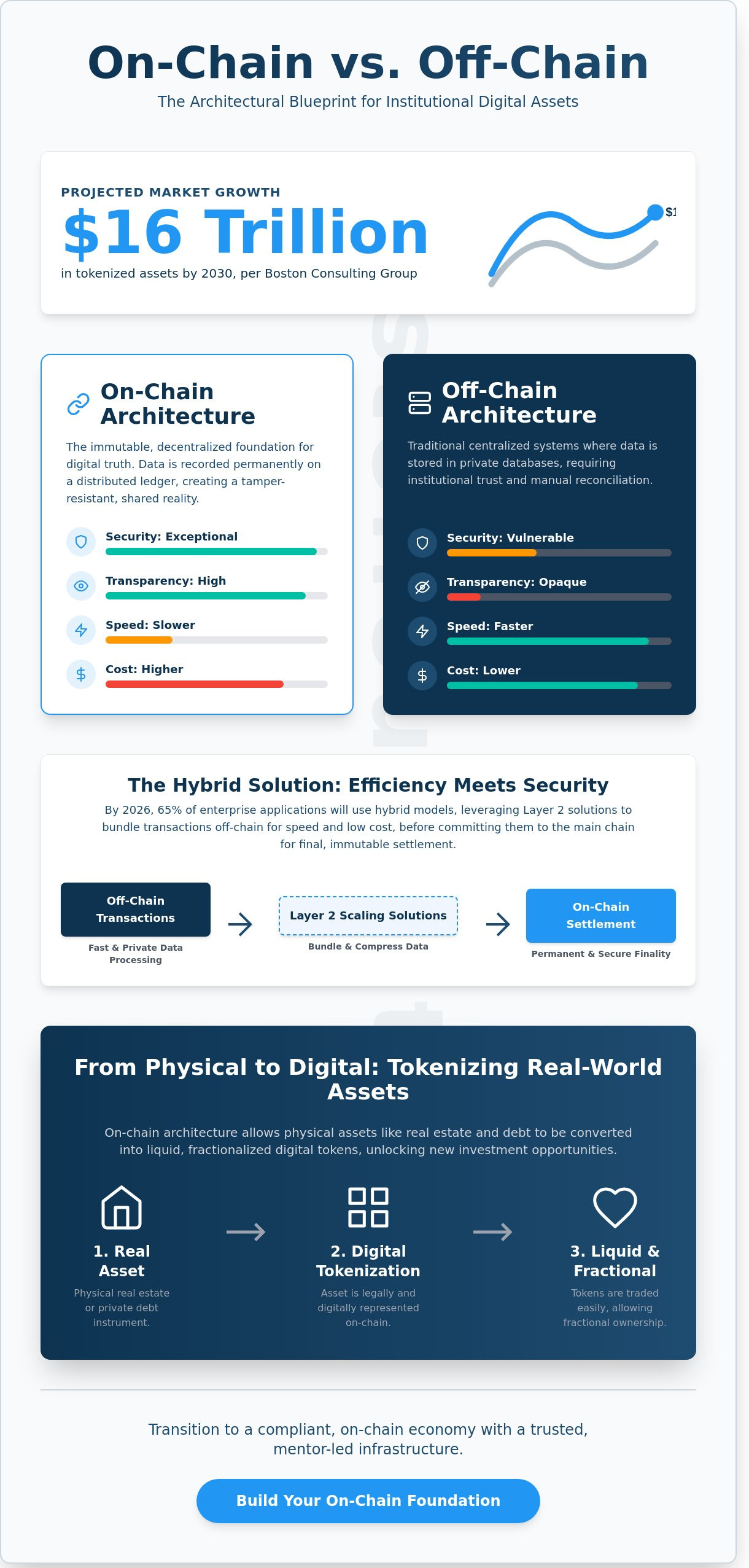
The structural integrity of a financial system depends on its foundational layers. In the digital landscape, the choice between on-chain and off-chain environments dictates the balance of speed, cost, and security. On-chain processes provide immutable finality; every state change is recorded across a distributed network of nodes. This ensures a level of security that off-chain databases cannot match. However, this security comes with higher computational costs and slower transaction times. By 2026, industry projections suggest that 65% of enterprise blockchain applications will utilize hybrid models. these systems combine the privacy of off-chain environments with the robust security of a public ledger.
Layer 2 scaling solutions act as the architectural bridge in this ecosystem. They bundle multiple transactions together before committing them to the main layer. This maintains the integrity of the on chain environment while significantly reducing the friction associated with network congestion. It’s a method that prioritizes efficiency without sacrificing the underlying trust of the system.
When to Prioritise On-Chain Transactions
High-value asset settlement demands the absolute certainty of mainnet finality. For the primary issuance of security tokens, an on-chain transaction provides a permanent, verifiable record that’s essential for regulatory reporting. In these instances, the speed of a sidechain is secondary to the security guarantees of a robust mainnet. Managing a cap table directly on chain ensures that ownership records remain transparent and resistant to unauthorized modification. This level of precision is vital for maintaining trust between issuers and investors, mirroring the meticulous standards required in traditional architectural drafting.
The Role of Off-Chain Computation
Efficiency in modern finance often requires a “head and hand” approach; the head handles complex logic off-chain, while the hand executes the final command on the ledger. Sensitive data, such as private KYC (Know Your Customer) information, shouldn’t reside on a public ledger. Instead, modern architectures keep detailed data in secure off-chain silos and only push a compliance flag to the blockchain. Oracles serve as the vital link here. They feed real-world data, such as property valuations or interest rates, into smart contracts. This allows for sophisticated automation without bloating the blockchain’s storage. Professionals seeking to master these technical structures can explore the educational initiatives provided by our foundation to deepen their understanding of digital architecture.
- Structural Difference: On-chain is for finality; off-chain is for performance.
- Security: Mainnet settlement provides the highest level of resistance against censorship.
- Hybrid Future: 2026 will likely see the standardisation of zero-knowledge proofs to bridge these layers.
The Strategic Value of On-Chain Finance for Global Enterprises
The adoption of on-chain finance represents a fundamental shift in corporate treasury and asset management. Traditional financial structures often suffer from fragmented workflows and manual oversight. By contrast, the integration of programmable logic into financial transactions allows for the seamless execution of complex agreements. This automation ensures administrative excellence. Smart contracts handle the distribution of dividends, the calculation of interest, and the enforcement of compliance rules without the necessity of manual intervention.
Legacy systems fail due to siloed ledgers. When disparate banking systems attempt to communicate, reconciliation errors frequently occur, leading to costly delays and disputes. Operating on a unified ledger eliminates these discrepancies at the source. Global liquidity also sees a dramatic improvement. Markets that operate 24/7 on chain provide constant access to capital, which optimizes efficiency for multinational corporations. This 24-hour availability removes the constraints of traditional banking hours and geographic time zones. It’s a structural evolution that fosters a culture of sustainability and long-term accountability.
Real-Time Auditability and Compliance
Quarterly audits are reactive and labor-intensive. On-chain systems transform this paradigm by enabling continuous, real-time verification of all transactions. This transition from periodic checks to constant oversight provides a level of security previously unattainable in traditional finance. Enterprises can align their operations with the SEC STO Guide to ensure their digital assets meet rigorous regulatory standards. The implementation of automated on chain records reduces the cost of regulatory oversight by up to 40%. This efficiency allows firms to reallocate resources toward innovation and growth rather than administrative maintenance.
Enhancing Investor Trust through Transparency
Trust is the cornerstone of any financial partnership. Digital finance provides investors with direct, unmediated access to asset performance data. This transparency eliminates the information asymmetry that often plagues traditional markets. We’re witnessing a psychological shift. Investors are moving from trusting fallible institutions to trusting immutable code. It’s a more reliable foundation for cooperation. Transparent governance structures ensure that every stakeholder has a clear view of decision-making processes. These elements don’t just protect capital; they foster deep, long-term partnerships built on a foundation of technical excellence and shared clarity.
From Real Estate to Debt: Moving Real-World Assets On-Chain
The transition of tangible value into digital environments represents a fundamental evolution in asset stewardship. It connects the physical craftsmanship of the built environment with the precision of digital architecture. Moving assets on chain involves more than a simple digital record; it requires a sophisticated framework where every token represents a verifiable claim on a physical or financial resource. This process transforms how we perceive value, shifting from opaque, paper-based systems to transparent, programmable ledgers. It’s a bridge between the traditional wisdom of asset management and the efficiency of modern technology.
Managing complex debt instruments and revenue shares through digital logic allows for unprecedented automation. When a property generates rental income, smart contracts distribute those funds to token holders instantly. This eliminates the administrative friction often found in traditional finance. The synergy between on chain finance and hand-crafted asset management ensures that the human element of quality and ethics remains central. This foundational excellence is what allows for the sustainable growth of new financial ecosystems.
Tokenizing Physical and Financial Assets
Real estate portfolios and private equity funds are the primary candidates for this digital migration. In 2023, the total value of tokenized real-world assets reached over $2 billion, excluding stablecoins, according to industry reports. This shift allows for fractional ownership, where a high-value commercial building is divided into affordable units. The technical bridge between a physical deed and a digital token requires rigorous legal structuring; this ensures the security token is a valid legal instrument in a court of law. For a detailed exploration of these technical mechanics, consult the Asset Tokenization Definitive Guide.
Liquidity and the Secondary Market
Secondary markets for these assets operate on specialized security token platforms. These venues use automated market makers (AMMs) to maintain price discovery and liquidity, even for traditionally illiquid assets. Unlike traditional exchanges that close on weekends, these digital markets operate continuously. Compliance is maintained through standards like ERC-1400, which embeds regulatory requirements directly into the token’s code. This architectural precision ensures that assets remain interoperable across different networks while respecting global legal boundaries. It’s a method that provides security and reliability for a new generation of investors.
Transitioning to an On-Chain Economy with STO Foundation
The shift toward a decentralized economy requires a structural integrity similar to the architectural standards the STO Foundation has championed for decades. Transitioning to an on chain environment isn’t merely a software upgrade; it’s a fundamental rebuilding of how value is recorded and verified. We act as a mentor for organizations, providing the intellectual scaffolding needed to navigate this transition. Institutional success depends on a compliant infrastructure that prioritizes security over speed. Without a rigorous framework, the benefits of transparency and efficiency remain out of reach for established players. We help firms ensure their digital foundations are as solid as the physical structures they manage.
Building a Compliant On-Chain Roadmap
Moving from legacy ledgers to tokenized assets involves a clear, three-step methodology. First, organizations must conduct a technical audit to identify which illiquid assets benefit most from fractionalization. Second, they must establish a legal framework that aligns with evolving European and global regulations. Third, selecting the right blockchain companies is critical to ensure long-term interoperability. The STO Foundation’s definitive guide to institutional asset tokenization bridges the gap between theoretical blockchain architecture and practical, day-to-day implementation. We help firms translate complex cryptographic concepts into operational excellence, ensuring that the “hand” of execution follows the “head” of strategy. Our role focuses on:
- Providing educational resources that demystify tokenization for executive leadership.
- Developing best practices for the secure custody of digital assets.
- Creating a network of excellence where traditional finance meets decentralized innovation.
The 2026 Outlook for On-Chain Assets
By the end of 2026, industry projections from analysts like Roland Berger suggest the tokenized asset market will exceed $2 trillion globally. We’re seeing a rapid convergence where DeFi protocols meet institutional Real-World Asset (RWA) frameworks. This merger creates a unified on chain standard that eliminates the friction of traditional settlement cycles, moving from T+2 to T+0 instantly. The 2026 landscape won’t view blockchain as an experimental alternative; it’ll be the default global ledger for everything from real estate to sovereign debt. Organizations that haven’t prepared their internal systems for this shift will face significant liquidity disadvantages. You can’t afford to wait until the transition is complete to build your foundation. Join the on-chain revolution with a partner dedicated to technical excellence and professional integrity. Let’s build a future where finance is as transparent and reliable as the finest architecture.
Architecting the Future of Institutional Finance
The architecture of global finance is undergoing a permanent transformation. By 2026, the shift from siloed databases to a unified digital truth will be the standard for institutional excellence. Moving real-world assets on chain provides the necessary foundation for liquid, transparent, and secure markets. This evolution isn’t just about speed; it’s about the craftsmanship of compliant systems that respect both legacy wisdom and future potential. Organizations that master the interplay between decentralized protocols and rigorous regulatory frameworks will lead the next decade of economic growth. Building this future requires a steadfast commitment to technical precision and a clear vision for the digital landscape. It’s time to elevate your strategy through a partnership that values both the head and the hand in financial engineering.
Explore the STO Foundation’s infrastructure for compliant on-chain tokenization to leverage our expertise in Reg D and Reg S compliant frameworks. We specialize in bridging traditional finance with decentralized excellence using the ERC-1400 standard.
The path forward is clear, and the tools for professional integration are ready for your next project.
Frequently Asked Questions
What is the difference between on-chain and off-chain transactions?
On-chain transactions occur directly on the blockchain and are verified by network participants, while off-chain transactions happen outside the ledger to increase speed. This distinction’s vital for the architectural precision required in modern financial systems. Off-chain solutions, like the Lightning Network, processed over 6.6 million transactions in August 2023. On-chain data provides a transparent record of every movement, ensuring the integrity of the digital foundation.
Is on-chain data truly permanent and immutable?
Data recorded on a decentralized blockchain is technically permanent due to the consensus mechanisms that prevent retrospective changes. Each block connects to the previous one through cryptographic hashes. This makes alteration practically impossible without 51% of the network’s computing power. Such structural integrity reflects the STO Foundation’s commitment to excellence and the long-term preservation of digital building blocks. It’s a reliable record for future generations.
How do on-chain transactions impact regulatory compliance for STOs?
On-chain transactions facilitate regulatory compliance by embedding specific rules, such as investor whitelist requirements, directly into the asset’s smart contract. Under the EU’s MiCA regulation, which became fully applicable in December 2024, issuers must provide transparent reporting. Automated compliance ensures that security tokens meet legal standards for sustainability. This approach removes the need for manual intervention while maintaining the dignity of the foundation’s work.
Can on-chain assets be integrated with traditional banking systems?
Integration occurs through specialized gateways and APIs that bridge decentralized ledgers with the SWIFT network or ISO 20022 standards. In 2023, J.P. Morgan’s Onyx platform demonstrated that institutional assets can move on chain while maintaining links to legacy accounts. This fusion of theory and practice allows traditional institutions to benefit from the efficiency of modern architectural finance. It bridges the gap between traditional craftsmanship and digital innovation.
What are the costs associated with keeping assets on-chain in 2026?
The costs of maintaining assets on chain in 2026 depend on network congestion and the chosen Layer 2 scaling solution. Ethereum’s EIP-4844 upgrade in 2024 already reduced data availability costs by over 90% for certain protocols. Maintaining digital excellence requires balancing these operational fees with the long-term value of a secure foundation. We anticipate that technological progress will continue to lower the financial barriers for academic and professional participation.
How does the STO Foundation ensure on-chain security for its clients?
The STO Foundation ensures security through rigorous multi-signature wallet protocols and the promotion of audited smart contract standards. We advocate for a “head and hand” approach where academic research meets practical implementation. By supporting projects that utilize Formal Verification, we help eliminate 99% of common coding vulnerabilities before deployment. This ensures the safety of the digital building culture and protects the collective efforts of our partners.
Does ‘on-chain’ mean the data is public for everyone to see?
Public blockchains allow anyone to view transaction hashes and wallet addresses, but the identity of participants remains pseudonymous through Zero-Knowledge Proofs. According to a 2023 report by Messari, ZKP adoption increased by 40% among privacy-focused protocols. This balance provides the necessary transparency for building culture while protecting the sensitive data of individual contributors. It maintains the privacy required for high-level academic and professional discourse.
What happens if an on-chain smart contract has a technical error?
If a smart contract contains a technical error, the code executes exactly as written because the blockchain can’t distinguish between intended and unintended logic. To mitigate this risk, developers implement “pause” functions or upgradeable proxy patterns. The STO Foundation emphasizes the importance of craftsmanship in coding; over $1.1 billion was lost to smart contract exploits in 2023. Rigorous testing ensures that the digital architecture remains as solid as a physical foundation.