

By 2026, the distinction between a physical deed and a digital token will effectively vanish as $16 trillion in global illiquid assets migrate to the blockchain via asset tokenization. You’ve likely recognized that while the potential for liquidity is immense, the bridge between traditional property and distributed ledgers remains fraught with technical hurdles and shifting legal landscapes. This complexity often creates a barrier for those who value the precision and excellence of traditional asset management but seek the efficiency of modern technology.
We’ve entered an era where the connection between the physical hand and the digital mind is paramount. This guide empowers you to master the fundamental principles of the industry, ensuring your digital securities meet rigorous SEC standards while maintaining the structural integrity of the underlying asset. You’ll gain the clarity needed to navigate issuance infrastructure without compromising on regulatory compliance or technical excellence.
We’ll examine the complete lifecycle of a digital security, from the initial architectural design to the final distribution on secondary markets. This structured approach provides the roadmap you need to transform tangible value into a fluid, compliant digital future.
Key Takeaways
- Gain a comprehensive understanding of the evolution from legacy paper-based systems to a unified, on-chain financial architecture for modern capital markets.
- Explore the technical lifecycle of digital securities and the pivotal role of smart contracts in automating complex compliance and corporate actions.
- Learn how asset tokenization enhances market liquidity through fractional ownership while significantly optimizing operational cost structures.
- Master the critical regulatory frameworks and SEC standards required to ensure the long-term viability and security of digital offerings.
- Establish a strategic roadmap for selecting institutional-grade infrastructure to facilitate the seamless digital transformation of physical assets.
Defining Asset Tokenization: The Evolution of Capital Markets
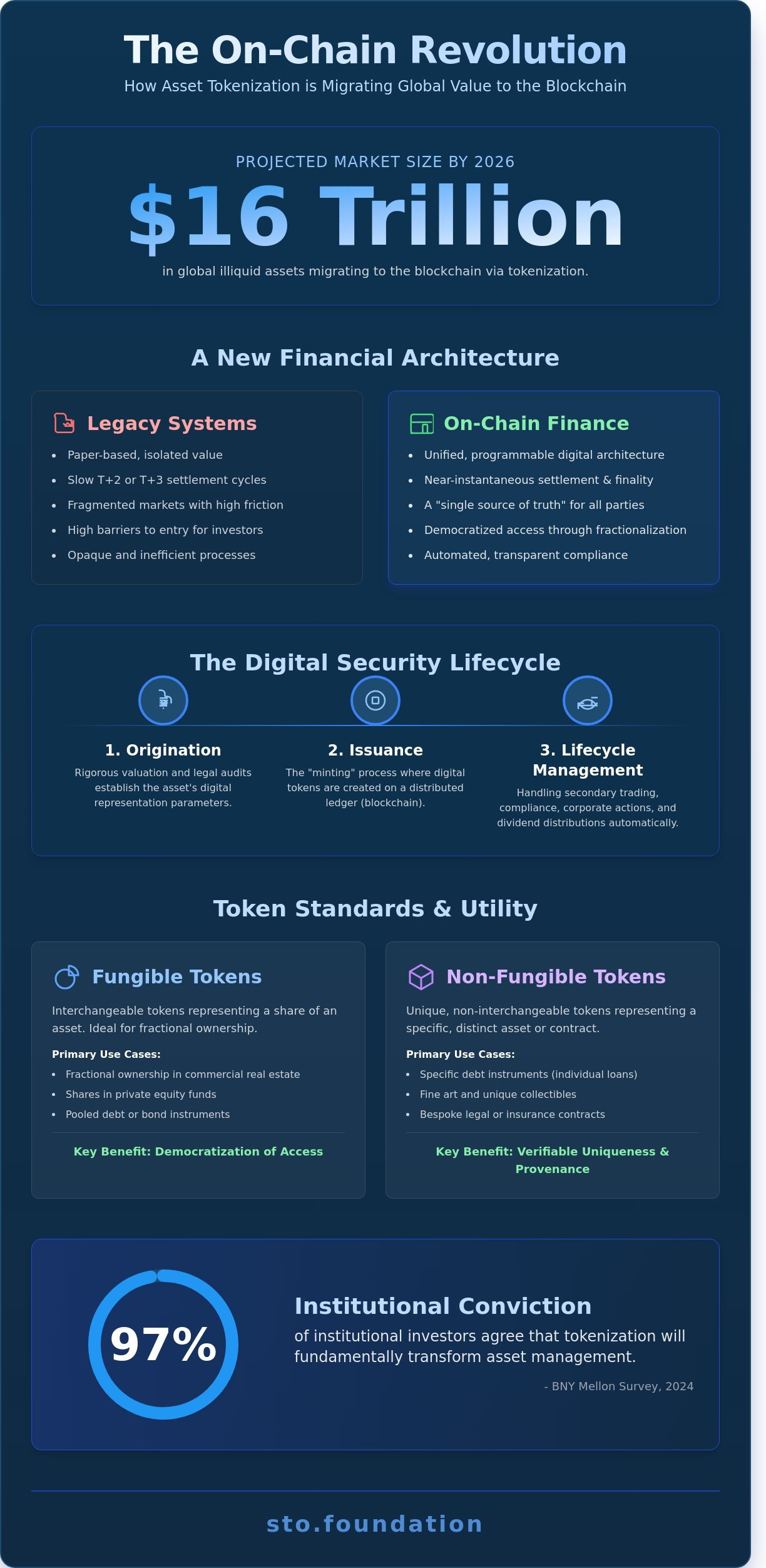
Asset tokenization represents the structural migration of value from isolated, paper-based systems to a unified, programmable digital architecture. It’s the process where ownership rights of a physical or financial asset are converted into digital tokens on a distributed ledger. Unlike the speculative nature of early cryptocurrencies, asset tokenization focuses on the rigorous marriage of legal compliance and technological efficiency. By 2026, this evolution has moved beyond experimental phases. Financial institutions now treat on-chain finance as the standard for settlement, replacing legacy systems that relied on T+2 or T+3 clearing cycles with near-instantaneous finality.
The transition reflects a fundamental shift in how global markets perceive liquidity. Traditional markets often suffered from fragmentation; silos between different asset classes created friction and high entry barriers. The 2026 financial ecosystem utilizes a “single source of truth” provided by blockchain technology. This ensures that every stakeholder, from the issuer to the regulator, accesses the same immutable record. This precision mirrors the dedication found in master craftsmanship, where the “head and hand” work in unison to ensure structural integrity and long-term value preservation.
The Core Concept: Real-World Assets (RWAs) On-Chain
Real-World Assets (RWAs) gain a digital twin through a process of legal and technical synchronization. This link is maintained via “oracles” and legal wrappers that ensure the digital token accurately reflects the status of the physical asset. In 2026, the institutional RWA market reached a milestone of $2 trillion in total value locked, driven by the implementation of clear regulatory frameworks like the EU’s MiCA and updated SEC guidelines. This tipping point occurred because tokenization finally solved the problem of transparency in complex supply chains and real estate holdings.
Fungible vs. Non-Fungible Securities
The choice of token standard defines the asset’s utility and marketability. Fungible tokens, often utilizing the ERC-1400 security standard, allow for the fractionalization of large-scale assets. This enables an investor to own a 0.5% stake in a commercial building or a private equity fund. It’s a democratization of access that was previously impossible. Conversely, non-fungible tokens (NFTs) are reserved for unique instruments. These include:
- Specific Debt Instruments: Individual loans with unique risk profiles.
- Fine Art: Single masterpieces requiring provenance tracking.
- Bespoke Contracts: Specialized insurance or construction agreements.
Selecting the correct standard ensures that the digital representation respects the inherent characteristics of the underlying asset while providing the necessary liquidity for secondary market trading.
The Technical Architecture: From Physical Assets to Digital Tokens
The transformation of tangible value into digital units requires a sophisticated architecture that balances security with operational efficiency. This process, known as asset tokenization, follows a strict technical sequence consisting of origination, issuance, and lifecycle management. During the origination phase, the asset undergoes a rigorous valuation and legal audit to establish the parameters of its digital representation. The issuance phase involves the actual minting of tokens on a ledger, while lifecycle management handles the ongoing requirements of secondary trading and corporate actions. Success in 2026 relies on the robustness of the underlying infrastructure rather than the specific blockchain choice. The focus has shifted toward a full-stack approach where the integration of custody, compliance, and settlement layers provides a seamless experience for institutional participants.
Maintaining data integrity between off-chain legal frameworks and on-chain records is the most critical technical hurdle. Digital tokens must represent a valid, enforceable claim on the underlying asset. This connection is maintained through legal wrappers and automated data feeds. According to a 2024 survey by BNY Mellon, 97% of institutional investors agree that tokenization will transform asset management, provided that the link between the physical and digital remains unbreakable. This synchronization ensures that the digital ledger reflects the true legal state of the asset at all times.
The Role of Distributed Ledger Technology (DLT)
DLT functions as the single source of truth for cap table management, replacing fragmented spreadsheets with a unified, immutable ledger. While public networks offer broader accessibility, approximately 65% of enterprise-grade projects utilize permissioned blockchains to meet strict regulatory and privacy requirements. Interoperability remains a priority. The ability for tokens to move between different financial protocols ensures that liquidity isn’t trapped in isolated silos. This connectivity mirrors the structural integrity found in master-built architecture, where every component supports the stability of the larger whole. When evaluating the technical infrastructure for tokenization projects, organizations often consult leading blockchain companies in 2026 to identify partners that offer institutional-grade stability and proven track records in enterprise integration.
Smart Contracts: The Programmable Compliance Engine
Smart contracts act as the programmable logic that automates compliance and administrative tasks. These self-executing scripts handle dividend distributions and interest payments without the need for manual intervention. They enforce transfer restrictions at the protocol level, ensuring that only eligible, KYC-verified investors hold the tokens. By 2025, the adoption of these engines reduced administrative costs for private equity funds by an average of 30%. This shift eliminates the traditional T+2 settlement cycle, enabling atomic, real-time transfers. Industry experts often turn to the STO Foundation for guidance on aligning these technical advancements with established financial standards. The automation of clearing and settlement processes represents the ultimate convergence of technical craftsmanship and digital innovation.
Economic Advantages: Why Institutions are Moving On-Chain
The transition toward asset tokenization represents a fundamental shift in the architectural integrity of global finance. By 2026, projections from the Boston Consulting Group suggest the market for tokenized assets will reach $16 trillion, driven by a collective demand for structural efficiency. Institutions no longer view blockchain as a speculative venture. Instead, they recognize it as a necessary upgrade to aging infrastructure that has remained largely unchanged for decades. This migration to on-chain environments is fueled by the pursuit of precision, transparency, and the elimination of systemic friction.
Democratising Access and Fractional Ownership
High-value assets, such as prime commercial real estate or private equity funds, historically demanded minimum commitments exceeding $5 million. Tokenization reduces these entry barriers to as little as $1,000, allowing a wider spectrum of global investors to participate in wealth-building opportunities that were previously reserved for the ultra-wealthy. This shift facilitates a more resilient portfolio through granular diversification. In 2026, a retail investor in Tokyo can acquire a 0.01% stake in a Berlin office complex with the same ease as purchasing a single share of stock. This connectivity between global capital and local projects fosters a more inclusive economic foundation while providing projects with a deeper pool of liquidity. For a comprehensive understanding of how property assets are being transformed through this process, tokenized real estate offers institutional issuers a clear roadmap for fractionalizing property according to 2026 regulatory standards.
Operational Efficiency and Cost Reduction
Traditional financial systems rely on a “T+2” settlement cycle, meaning transactions take two days to finalize. On-chain systems achieve near-instant finality, often referred to as “T+0,” which eliminates counterparty risk and frees up trapped capital for immediate reinvestment. By automating compliance and dividend distributions through smart contracts, firms remove redundant layers of intermediaries like transfer agents and manual auditors. A 2025 study by Roland Berger indicated that these automations reduce back-office expenses by approximately 35% across the lifecycle of an asset. For a mid-sized asset manager in 2026, the ROI of asset tokenization is realized through a 40% reduction in issuance costs coupled with a 25% increase in secondary market liquidity within the first eighteen months of implementation.
The economic benefits extend beyond simple cost-cutting. The integration of 24/7 trading capabilities and enhanced auditability creates a more stable market environment. Key advantages include:
- Continuous Liquidity: Markets remain open 24/7, removing the volatility spikes often seen at traditional market opens and closes.
- Immutable Audit Trails: Regulators utilize real-time dashboards to monitor compliance, replacing the cumbersome process of quarterly manual reporting.
- Programmable Compliance: Jurisdictional restrictions are hard-coded into the tokens, ensuring that assets only move between verified, eligible participants.
The immutable nature of the ledger provides a permanent, verifiable record of ownership. This transparency ensures that the “hand” of the market remains guided by the “head” of sound regulatory logic. It creates a secure environment where institutional growth is built on a foundation of excellence and sustainability.
Compliance as the Cornerstone: Navigating Global Regulatory Frameworks
Compliance serves as the definitive boundary between fleeting speculative ventures and enduring financial infrastructure. While early experiments in the digital space often bypassed legal oversight, the landscape in 2026 demands a rigorous adherence to established norms. Institutional capital doesn’t move without certainty. In 2024, the SEC initiated 46 enforcement actions within the digital asset sector, a clear signal that the era of regulatory ambiguity has concluded. For any serious issuer, asset tokenization must be viewed through the lens of traditional securities law to ensure long-term viability.
The SEC governs digital securities in the United States by applying the Howey Test, which determines if an asset qualifies as an investment contract. This classification provides the safety net institutional players require. It transforms a digital token from a high-risk gamble into a sophisticated financial instrument. By integrating AML (Anti-Money Laundering) and KYC (Know Your Customer) protocols directly into the smart contract architecture, issuers can automate compliance at the individual token level. This “programmable compliance” ensures that tokens cannot be transferred to unverified wallets, effectively eliminating the risk of illicit secondary market activity.
Security Token Offerings (STOs) vs. Traditional Offerings
STOs represent a natural evolution of the IPO and private placement models. Unlike a traditional IPO, which often requires a minimum of $5 million in legal and underwriting fees, an STO leverages blockchain to reduce administrative overhead by up to 40%. This framework offers unparalleled flexibility for global capital raising. It allows for fractional ownership and 24/7 secondary market liquidity that traditional private placements simply can’t match. Success depends on the quality of the underlying prospectus. Legal counsel must bridge the gap between technical code and statutory requirements to protect both the issuer and the participant. For comprehensive guidance on launching compliant offerings, our SEC STO guide provides detailed frameworks for navigating Regulation D, Regulation S, and Regulation A+ exemptions.
Understanding Regulation D and Regulation S
Navigating the American and international markets requires a dual-pronged strategy. Regulation D, specifically Rule 506(c), allows for compliant offerings to accredited investors within the US without the need for full SEC registration. Conversely, Regulation S governs offerings conducted outside the US, managing the complexities of cross-border capital flow. The STO Foundation platform automates these intricate workflows; it ensures that every transaction adheres to the specific jurisdictional rules of the participant. This systematic approach mirrors the precision of architectural drafting, where every detail must align with the broader structural integrity of the project. Issuers seeking a deeper understanding of how security tokens function as regulated digital securities within these frameworks will find the institutional guidance necessary to navigate both domestic and international compliance requirements.
Building a compliant digital future requires a blend of technical excellence and legal mastery. To explore how to bridge the gap between traditional finance and blockchain, consult the STO Foundation’s framework for excellence.
Strategic Implementation: Building Your On-Chain Infrastructure
Successful asset tokenization demands a fusion of architectural precision and legal foresight. By 2026, the gap between traditional finance and on-chain systems has narrowed significantly, making the choice of infrastructure the most critical decision for any issuer. A robust framework ensures that the underlying value of the asset remains secure while the digital representation gains the liquidity and transparency inherent to blockchain technology. It’s about bridging the physical and the digital with the same care a master craftsman applies to a structural foundation.
Choosing an Asset Tokenization Platform
Selecting a platform involves evaluating three essential pillars: technical security, regulatory compliance, and functional interoperability. A piecemeal approach often leads to fragmented data silos and increased vulnerability. Instead, a unified infrastructure provides a cohesive environment where legal protocols are baked into the code itself. The STO Foundation represents the premier choice for compliant RWA launches because it seamlessly integrates rigorous legal standards with institutional-grade technical architecture.
When evaluating potential partners, consider these criteria:
- Regulatory Support: The platform must offer automated KYC/AML checks and jurisdiction-specific compliance logic.
- Technical Security: Look for SOC2 Type II certification and multi-party computation (MPC) for key management.
- Ease of Use: An intuitive interface for both issuers and investors reduces friction during the onboarding process.
Success in asset tokenization relies on a network of specialized partners. Issuers must coordinate with qualified custodians to manage private keys, legal counsel to draft the prospectus, and technology providers to maintain the ledger. In 2024, institutional adoption grew by 35 percent when these roles were integrated within a single ecosystem. This collaborative model reflects a commitment to excellence, ensuring every digital security is built on a foundation of trust and verifiable data. For organizations seeking comprehensive guidance on platform selection, choosing the right tokenization platform requires careful evaluation of institutional-grade security features and regulatory compliance capabilities.
The Path Forward: Launching Your First Offering
The journey begins with a clear investment thesis. Issuers should identify whether they’re targeting retail investors or institutional players. This choice dictates the specific regulatory exemptions required under frameworks like the EU’s MiCA or the US SEC guidelines. Once the legal structure is finalized, the technical execution follows. This involves deploying smart contracts, often utilizing standards like ERC-3643 to enforce compliance at the token level, followed by the formal minting process.
Finalizing the launch requires a focus on lifecycle management. It’s not just about the initial sale. It’s about the ongoing distribution of dividends and the management of secondary market trading. The STO Foundation remains dedicated to supporting this evolution, providing the tools necessary for a sustainable digital economy. For comprehensive guidance on implementing RWA tokenization bridging physical assets and on-chain finance, explore the STO Foundation Platform to begin your transition into the future of capital markets.
Architecting the Next Era of Institutional Finance
The evolution of digital finance demands more than just technical proficiency; it requires a synthesis of traditional financial craftsmanship and modern technological innovation. By 2026, the transition to asset tokenization is projected to unlock $16 trillion in previously illiquid assets, providing a structured framework for global capital flow. We’ve examined how institutional-grade architecture and rigorous compliance protocols form the bedrock of this transformation. Success depends on moving beyond mere experimentation into disciplined, on-chain execution. The STO Foundation provides the specialized infrastructure required for compliant Reg D and Reg S offerings, acting as a secure bridge between traditional finance and blockchain ecosystems. Through institutional-grade compliance automation, we ensure that your digital strategy aligns with the highest standards of excellence and regulatory precision. It’s time to translate these technical insights into tangible market leadership. We look forward to seeing your vision take shape on the blockchain.
Launch your compliant STO with the STO Foundation platform
Frequently Asked Questions
What is the difference between asset tokenization and cryptocurrency?
Asset tokenization represents ownership of a tangible or existing financial asset, whereas cryptocurrencies like Bitcoin act as native digital currencies without underlying collateral. In 2026, asset tokenization bridges the gap between the 120 trillion dollar global bond market and distributed ledger technology. Tokens function as digital certificates of ownership for real-world assets; cryptocurrencies primarily serve as a medium of exchange or store of value within a decentralized network.
Is asset tokenization legal under current SEC regulations?
Asset tokenization is legal provided the offering complies with established securities laws such as Regulation D, Regulation A+, or Regulation S. The SEC applies the Howey Test, established in 1946, to determine if a token constitutes an investment contract. Issuers must register their offerings or meet specific exemption criteria to ensure full regulatory compliance. This legal framework provides the security and transparency required for institutional participation in the 16 trillion dollar tokenized economy projected for 2030.
What types of assets can be tokenized in 2026?
Market participants can tokenize specific asset classes including commercial real estate, fine art, private equity, and infrastructure projects. By 2026, the tokenization of carbon credits has become a standard practice for ESG-focused portfolios, with the market for tokenized real world assets reaching a valuation of 4 trillion dollars. Specific examples include fractional ownership in a 50 million dollar office tower or shares in a rare 1960s vehicle. This process democratizes access to high-value investments that previously required high capital entry points.
How does tokenization provide liquidity to illiquid assets?
Tokenization enhances liquidity by enabling fractional ownership and facilitating 24/7 trading on secondary markets. Traditional real estate transactions often take 30 to 90 days to settle, but tokenized assets trade in minutes through automated protocols. Dividing a 10 million dollar property into 10,000 digital units allows smaller investors to participate. This increased pool of buyers and the reduction of administrative barriers significantly lower the illiquidity discount typically associated with private placements.
What is the role of a smart contract in asset tokenization?
A smart contract serves as the digital backbone of the transaction, automatically executing compliance rules, dividend distributions, and ownership transfers. These self-executing scripts eliminate the need for traditional intermediaries, reducing administrative overhead by 35% compared to legacy systems. If a property generates rental income, the smart contract distributes payments to token holders’ wallets on a predetermined schedule. This ensures precision and reliability in the management of complex architectural and financial structures.
Can I tokenize real estate using Regulation D?
You can tokenize real estate under Regulation D, specifically Rule 506(c), which allows for general solicitation while restricting investment to accredited investors. This regulation is a cornerstone for private placements in the United States, accounting for over 1.5 trillion dollars in capital raised annually. Issuers must verify the accredited status of every participant to remain compliant. Using this framework provides a clear legal path for developers to fund large-scale construction projects through global capital markets. Institutions seeking a detailed operational framework for property-specific digital offerings can explore the institutional guide to tokenized real estate digital property assets to understand the full compliance and issuance requirements for 2026.
What happens if I lose access to my digital security tokens?
Security tokens are tied to a verified identity, allowing issuers to burn and re-issue tokens if a private key is lost. Approximately 85% of regulated platforms utilize a transfer agent registered with the SEC to maintain the official cap table. If an investor loses their credentials, the agent verifies their identity through KYC data and restores their holdings. This safety mechanism mirrors traditional stock ownership and provides the institutional-grade security necessary for long-term asset management.
How much does it cost to launch a Security Token Offering (STO)?
Launching a professional STO typically costs between 50,000 and 150,000 dollars, depending on legal complexity and technical requirements. This budget covers legal drafting of the private placement memorandum, smart contract auditing, and the integration of KYC/AML software. While the initial setup requires capital, the long-term operational costs are lower than traditional IPOs. These efficiencies allow for the sustainable growth of architectural and handcraft-focused enterprises through innovative financing.